
Business
EAC-ECOWAS Trade Surge Signals a New Era of African Economic Integration

By Ziad Hamoui
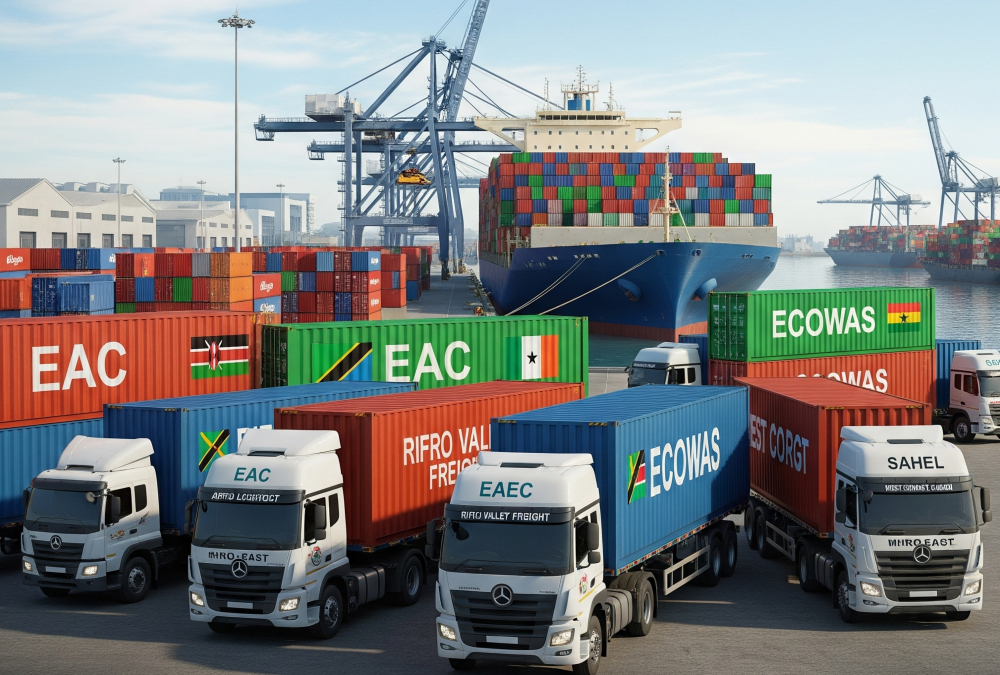
In the first quarter of 2025, a quiet but transformative shift reshaped Africa’s economic landscape: trade between the East African Community (EAC) and the Economic Community of West African States (ECOWAS) nearly doubled, rising from 0.7 percent to 1.3 percent of total regional trade volumes. While these percentages may seem modest at first glance, their implications are profound – marking a pivotal moment in the continent’s long-anticipated journey toward genuine economic integration.
This surge is not accidental. It is the result of sustained investment in regional infrastructure, harmonized customs procedures, and coordinated cross-border policies that are finally beginning to bear fruit.
The Abidjan-Lagos Corridor, long hailed as a linchpin of West African connectivity, has seen renewed upgrades and streamlined transit protocols. Meanwhile, digital customs platforms and joint border management initiatives are reducing delays, cutting costs, and restoring confidence among traders navigating Africa’s complex regional terrain.
Infrastructure and Policy: The Engines of Regional Trade Growth
The acceleration in EAC-ECOWAS commerce reflects more than market demand – it reflects deliberate, coordinated action. Over the past five years, both regional blocs have advanced corridor facilitation frameworks, supported by initiatives like the Borderless Alliance and technical partnerships with the African Union and Afreximbank.
These efforts have led to faster cargo clearance, reduced informal trade, and increased compliance with regional standards.
Crucially, landlocked countries such as Uganda, Rwanda, and Niger are now benefiting from improved transit arrangements, enabling goods to move more efficiently between coastal hubs in Lagos, Abidjan, Mombasa, and Dar es Salaam. As trade corridors mature, the cost of doing business across regions is declining – making intra-African trade not just politically desirable, but economically viable.
For decades, African economies have been structured around extractive, export-oriented models – funneling raw materials to global powers like China, Europe, and the United States. But the Q1 2025 data reveals a strategic pivot: African nations are increasingly trading with one another, building value chains that are homegrown, resilient, and less dependent on traditional North-South trade routes.
A Turning Point in Africa’s Global Trade Position
This transformation is underscored by a historic milestone: the EAC recorded its first-ever trade surplus with China – US$1.8 billion in Q1 2025. Driven by rising exports of base metals, minerals, and processed agricultural goods, this surplus marks a departure from Africa’s traditional role as a raw material supplier.
Instead, East African economies are beginning to capture more value domestically, investing in processing, packaging, and branding that enhance competitiveness.
This shift strengthens Africa’s hand in global trade negotiations. With growing intra-regional commerce and improved export capacity, African regional economic communities (RECs) are no longer merely price-takers in global markets.
They are emerging as strategic partners with diversified offerings and collective bargaining power – particularly as AfCFTA implementation gains momentum.
Toward a Unified and Prosperous African Economy
The African Continental Free Trade Area (AfCFTA) envisioned this future. Now, with EAC-ECOWAS trade momentum building, that vision is moving from policy documents to port manifests.
The doubling of commercial ties between East and West Africa may still represent a small share of global trade, but it signals a growing confidence in African markets and institutions.
Of course, challenges remain. Non-tariff barriers, regulatory misalignment, and political volatility continue to disrupt supply chains.
Yet the Q1 2025 data offers a powerful proof of concept: when infrastructure, policy, and political will converge, integration accelerates.
As we look ahead, the lesson is clear. The path to a more peaceful, prosperous, and unified Africa runs through trade.
It runs through corridors, customs reforms, and collaboration. And now, for the first time, it is gaining real traction.
The momentum is building. Let us not waste it.
Ziad Hamoui is the Co-Founder and Past President of the Borderless Alliance, a leading private-sector advocacy group promoting economic integration and removing trade and transport barriers in West Africa. With extensive experience in Ghana’s road transport, logistics, and shipping sectors, he currently serves as Executive Director of Tarzan Enterprise Ltd., a long-established family business. He is Co-Chair of the Africa Food Trade Coalition, Co-Founder of the Trade Facilitation Coalition for Ghana, and serves on multiple high-level advisory committees on trade, transport, agriculture, and security. A Chartered Fellow of the Chartered Institute of Logistics and Transport (CILT) Ghana, he is also a former member of its Governing Council.
