
Business
Africa’s local retail market promise
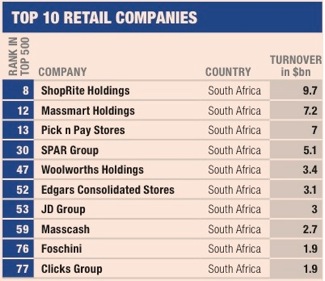
Investors seem to like what they have seen and heard from Brasher, and the company’s share price rose 50% between July and December 2013. For other retailers, like Edgars Consolidated Stores (Edcon) (#52) it has been a fight for survival. Private equity company Bain Capital bought out the company in 2007, leaving it saddled with R20 billion ($1.9 billion) in debt.
Despite selling off its debtors book to Absa (now Barclays Africa Group) for R8bn in 2012, the company has paid off very little of the original amount, leaving it in an extremely precarious position. Edcon’s fortunes can be seen in the spiraling cost of rolling over its debt. It issued six-year eurobonds with a 13.4% coupon in November 2013. Moody’s Investor Services rated them Caa2, eight levels below investment grade.
Edcon chief executive Jürgen Schreiber has the task of trying to resuscitate the core brand while at the same time attempting to reduce the massive debt burden. While a public listing could provide a solution, going to market when South African consumers are in dire straits is not a foregone conclusion.
The year 2014 could be decisive for the beleaguered company. Yet for others, like Durban-based Mr Price Group (#99), 2013 yielded only good news: growing revenue, profits and dividends. The company has managed a measured expansion into the continent and added additional stores in Nigeria and Ghana following on from positive results from trial stores in those countries.
The company has also taken a leaf out of the experience of international retailers by making a substantial investment in its online offering through its website. While still small in the context of its cur- rent operations, the company sees this developing into a major source of revenue.
Expansion plans
Upper-end retailer Woolworths (#47) has reassessed its expansion into the rest of Africa after the decision to close its three stores in Nigeria in November 2013. The announcement cited logistical difficulties as the main reason for withdrawing, and it caught many by surprise.
Chief executive Ian Moir says Woolworths will continue to expand into countries bordering South Africa, where the company knows there is a demand for its products and where import duties and the cost of moving goods are lower than in Nigeria. In East Africa, Kenya-based Nakumatt Holdings (#350) continues to pursue its ambitious growth strategy despite the Westgate Mall tragedy in Nairobi in September 2013 that destroyed its flagship store.
