
Business
What Investors Look for in African Startups: Beyond the Hype

By Farouk Mark Mukiibi
Raising capital in Africa isn’t merely difficult – it’s a labyrinth of mismatched expectations, delayed term sheets, and endless meetings that rarely lead to meaningful alignment.
I have navigated this maze firsthand: first courting local investors, then pitching global venture funds. Both routes overflow with promises, but too often lack genuine understanding of what it takes to build – and sustain – a business on the continent.
Here’s the paradox: startups backed by African investors tend to outlive those funded by Western capital. Why? Because African investors aren’t betting on glossy projections or Silicon Valley–style playbooks.
They are betting on what they can see, feel, and verify on the ground.
Beyond the Pitch Deck: Risk and Relationships
In high-context African markets, social sanction often carries more weight than technical functionality. If your venture triggers community resistance or lacks local trust, even the most innovative product won’t survive – no matter how compelling your slide deck.
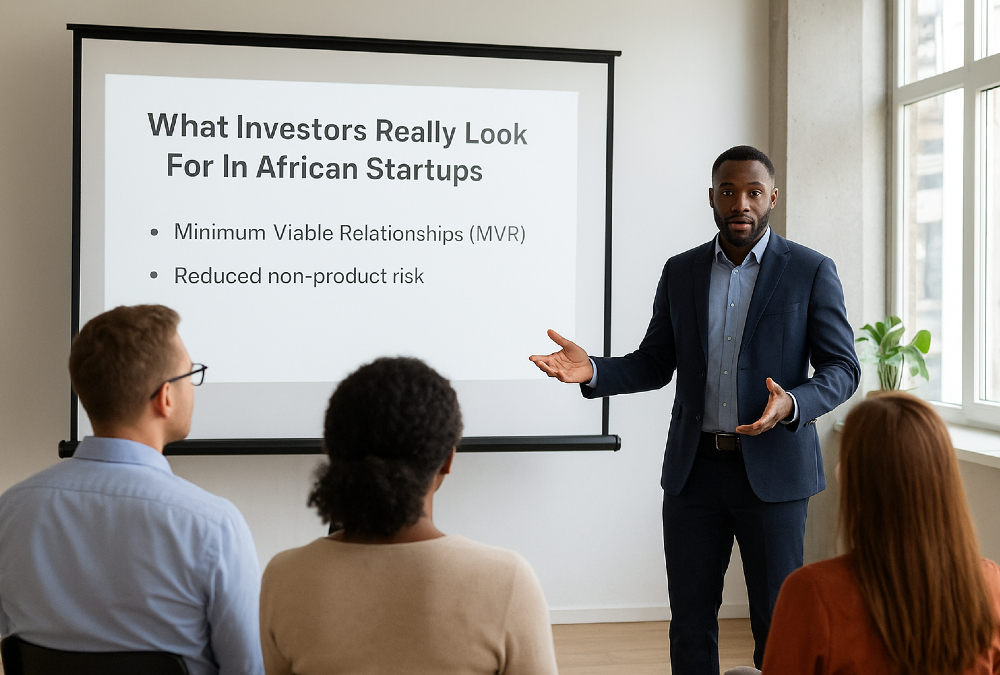
That’s why savvy founders now prioritize Minimum Viable Relationships (MVR) alongside the traditional Minimum Viable Product (MVP).
MVR isn’t a buzzword – it’s a survival strategy. It means cultivating trust with regulators, community leaders, suppliers, and early adopters before you scale.
Because in Africa, market access isn’t granted by algorithms – it’s earned through relationships.
Western investors, by contrast, rely heavily on pattern recognition. If your pitch echoes a familiar success story – say, “Uber for X” or “Amazon of Y” – funding can arrive swiftly.
But too many of these ventures collapse when their digital models collide with analog realities: when Excel sheets can’t negotiate with dukas (local shops), and Google Slides don’t translate into street-level trust.
Paper Traction Doesn’t Replace Cultural Permission
That’s why forward-thinking African founders are reshaping their narratives. Today’s pitch decks don’t just showcase TAM (Total Addressable Market); they demonstrate who will actually allow you to operate tomorrow.
They highlight the founder’s ability to navigate informal economies, read social cues as fluently as financial statements, and pivot with purpose when plans inevitably unravel.
Investors – both local and international – are beginning to recognize this. They are using MVR as a lens to assess a founder’s market navigation intelligence: the quiet, hard-won wisdom born of operating in environments where infrastructure is patchy, rules are fluid, and resilience is non-negotiable.
In Africa, capital is more than money. It’s permission. It’s continuity. It’s belonging.
The most valuable investors aren’t just writing checks – they are writing your venture’s social contract. They understand that long-term success hinges not on how fast you scale, but on how deeply you are rooted in the ecosystem you aim to serve.
So if you are raising capital in Africa, don’t just pitch your product. Show the relationships that make your venture inevitable.
Demonstrate the trust you’ve built, the barriers you’ve navigated, and the community that already sees you as part of its future.
Because the real divide in African entrepreneurship isn’t between funded and unfunded startups. It’s between those that vanish after the first check clears – and those that compound value long after.
This article draws on insights from my book, African Startups Playbook, available on Amazon, which explores the realities of building, scaling, and funding ventures across Africa.
Farouk Mark Mukiibi is the author of The African Startups Playbook and creator of the Minimum Viable Relationships (MVR) business framework. He is also a marketing consultant based in Uganda, East Africa, where he helps international brands and ventures navigate the realities of East Africa’s evolving middle class and consumer economies.
