
Business
The New Face of Nigerian Oil: Indigenous Grit Beats Western Caution
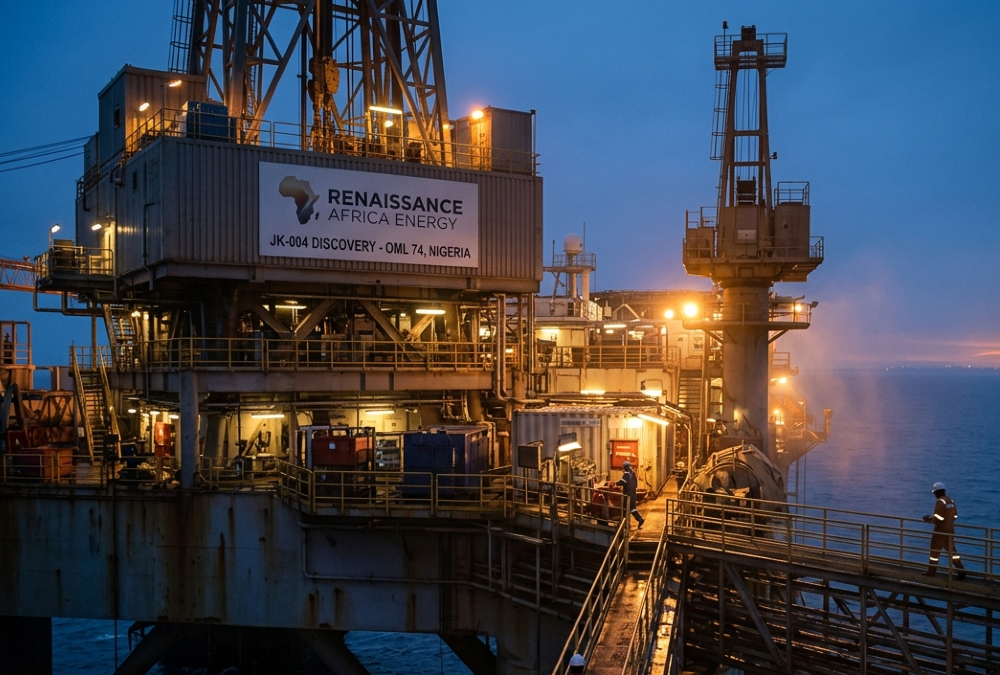
Renaissance Africa Energy’s offshore find is more than a single well. It is a proof of concept for indigenous-led exploration – and a signal Nigeria’s investment climate is finally working.

By NJ Ayuk
Nigeria’s upstream oil sector is having a moment, and it deserves the attention.
Renaissance Africa Energy Company’s offshore discovery at the JK-004 exploration well, in block OML 74, is the kind of result the industry rarely sees anymore: roughly 1,000 feet of hydrocarbon-bearing intervals spread across seven separate reservoirs. That is not an incremental find. It is the sort of discovery that used to define the golden age of exploration, before global majors retreated to the safer, cheaper ground of optimizing existing fields rather than hunting for new ones.
Credit belongs to Tony Attah and his team at Renaissance. Their success is a reminder that exploration – genuine, high-risk, high-reward exploration – remains the lifeblood of the oil and gas industry, not a relic of it. And it comes at a moment when Nigeria badly needs proof that its reforms are paying off.
A Signal, Not Just a Well
The significance of JK-004 extends well past its reservoirs. It reinforces Nigeria’s reserve-replacement efforts and supports the country’s long-term ambitions on crude production and energy security. But perhaps more importantly, it demonstrates something the market has been waiting to see: that indigenous operators can deliver world-class exploration results on their own terms.
That matters because Nigeria’s upstream sector is in the middle of a real transformation. Regulatory reforms designed to sharpen the country’s investment climate – and to give local companies a bigger seat at the table – are starting to show results. Since the Petroleum Industry Act was enacted in 2021, Nigeria has attracted US$17 billion in foreign direct investment. The 2025 Licensing Round, which put 50 new oil and gas blocks up for exploration and production, is projected to draw a further US$10 billion in investment over the next decade.
Numbers like these tend to blur together in policy briefings. JK-004 gives them a face. It shows investors what that capital can actually produce.
Exploration Is Back in Fashion – At Least in Nigeria
Across much of the Western world, oil majors have quietly shifted their priorities. Production optimization – squeezing more from known fields – has taken precedence over frontier exploration, which is riskier, slower, and harder to justify to shareholders focused on quarterly returns. It is a rational response to market pressure, but it has left a gap.
Renaissance’s success suggests that gap is an opportunity, not a dead end. Sustained investment in exploration can still deliver transformational discoveries, the kind capable of underwriting production growth for decades, not just quarters. That is a lesson worth absorbing well beyond Nigeria’s borders.
It matters for the rest of the continent too. Africa holds an estimated 125.3 billion barrels of proven crude oil reserves, much of it still underexplored. JK-004 is a case study in what sustained, serious exploration can unlock – and a reminder that the companies best positioned to do that unlocking are increasingly African ones.
The “Drill, Baby, Drill” Revolution – Nigerian Style
Call it Nigeria’s own version of “drill, baby, drill” – except this one is being led not by multinational giants but by indigenous companies willing to bet on long-term exploration when others have moved on. Renaissance’s achievement is a demonstration of the technical expertise, operational discipline, and sheer nerve required to compete at this level.
These are not just symbolic wins. They create jobs, build local technical capacity, and – discovery by discovery – make the case that Nigeria belongs among the world’s competitive upstream destinations, not merely as a source of crude, but as a place where serious exploration still happens.
JK-004 will not, on its own, transform Nigeria’s energy sector. But it is exactly the kind of result the country’s reformers have been promising investors for years. The question now is whether it becomes the norm rather than the exception.
NJ Ayuk is the Executive Chairman of the African Energy Chamber.
