
Business
The Great African Rebalance: Why Your Investment Map Is Already Outdated


By John Kourkoutas
Half the continent’s investment rankings remained static. The other half underwent a dramatic reshuffle.
If your 2026 Africa strategy mirrors your 2024 playbook, you are already operating with obsolete intelligence.
The latest investment attractiveness rankings reveal a continent in flux, where yesterday’s darlings have stumbled while overlooked markets have surged into prominence. The shifts aren’t marginal – they represent fundamental realignments in Africa’s economic geography that demand immediate strategic recalibration.
The Spectacular Risers
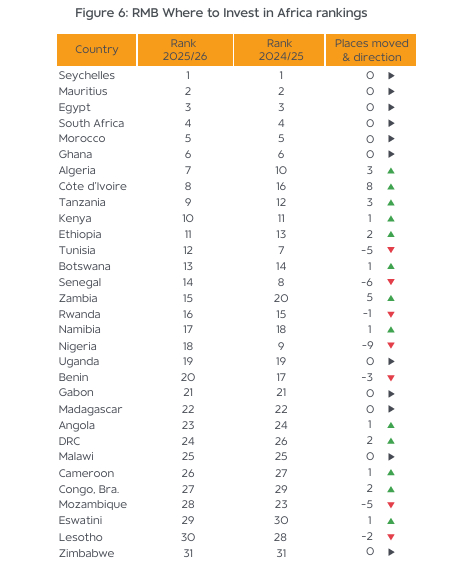
Côte d’Ivoire (Ivory Coast) has executed the most remarkable ascent, vaulting eight positions from 16th to 8th place. The West African nation’s transformation from post-conflict economy to regional investment hub represents one of Africa’s most compelling turnaround stories.
Zambia has climbed five spots to 15th, propelled by surging copper prices, substantial Chinese infrastructure investment, and newfound policy stability. Algeria advanced three positions to 7th, while Tanzania matched that gain to reach 9th place.
Kenya edged up one spot to 10th despite political turbulence, and Ethiopia rose two positions to 11th – a particularly noteworthy achievement given ongoing internal conflicts.
The Dramatic Decliners
Nigeria’s nine-position plunge from 9th to 18th marks the most precipitous fall among major African economies. The naira’s chaotic float, cascading policy uncertainty, and persistent foreign exchange dysfunction have transformed Africa’s largest economy from a must-have market into a substantially riskier proposition.
Senegal dropped six places to 14th, while Mozambique fell five positions to 28th. Tunisia, once ranked 7th, now sits at 12th – a five-position decline that reflects broader North African economic headwinds.
The continent’s investment elite remained unchanged: Seychelles, Mauritius, Egypt, South Africa, Morocco, and Ghana occupy the top six positions, their dominance a testament to sustained institutional quality and business-friendly environments.
Why These Rankings Matter More Than Market Sentiment
These aren’t ephemeral shifts driven by fickle investor psychology or quarterly earnings fluctuations. The underlying drivers – industrial capacity expansion, demographic trajectories, regulatory environments, and infrastructure development – operate on multi-year timeframes.
They compound gradually, then reveal themselves suddenly in ranking upheavals like these.
Consider the apparent paradox: Nigeria, with its massive consumer market and oil wealth, tumbled nine spots while Ethiopia, embroiled in civil conflict, rose two positions. The answer lies beneath surface narratives.
Ethiopia has maintained structural reform momentum, attracted manufacturing investment, and sustained capital inflows even as it navigated internal strife. Nigeria, conversely, has watched policy incoherence erode investor confidence faster than market size can compensate.
Tanzania’s three-position jump reflects years of infrastructure investment and improving governance finally reaching critical mass. Kenya’s resilience at 10th position, despite political volatility, demonstrates how established business ecosystems can weather temporary turbulence.
Zambia’s copper-fueled renaissance, supported by Chinese partnership and credible economic management, exemplifies how resource endowments combined with policy stability create investment magnetism.
Strategic Implications for 2026
For corporations still anchoring West African strategies on Nigeria as the dominant market, the data delivers an uncomfortable message: Ivory Coast’s eight-position surge and Ghana’s stable 6th-place ranking now offer superior risk-adjusted returns. The conventional wisdom that Nigeria’s demographic scale trumps all other considerations has been empirically invalidated.
Zambia presents perhaps the most glaring oversight in contemporary Africa strategies. Its five-position leap reflects transformation that most international strategists haven’t incorporated into their planning.
The combination of copper market dynamics, infrastructure modernization, and political stability creates conditions that early movers will capitalize on while laggards scramble to catch up.
Your Pipeline Is Probably Wrong
Here’s the uncomfortable arithmetic: if you developed market entry plans 12 to 18 months ago, roughly half your target countries have declined in attractiveness while markets you deprioritized have become top-tier opportunities. Executing strategies built on outdated intelligence doesn’t demonstrate consistency – it demonstrates negligence.
The temporal lag between strategy formation and market reality has never been more dangerous. The standard corporate rhythm – annual strategic planning, multi-year market entry timelines – assumes relative stability in country rankings.
That assumption no longer holds for Africa, where reform momentum or policy dysfunction can fundamentally alter investment calculus within months.
Recalibration, Not Revision
The solution isn’t to abandon Africa strategies wholesale or chase every ranking fluctuation. Rather, it requires embedding continuous intelligence gathering into strategic processes.
Investment attractiveness in emerging markets isn’t static context for predetermined strategies – it’s dynamic data that should trigger strategic pivots.
Companies that treat these rankings as confirmation bias fuel – cherry-picking data that validates existing commitments – will underperform competitors who subordinate institutional inertia to market reality. The question isn’t whether your 2024 Africa strategy was sound when formulated.
The question is whether it remains sound now.
The 2026 Imperative
Africa’s economic geography is being redrawn in real-time. Ivory Coast, Zambia, Algeria, and Tanzania aren’t emerging markets in the speculative sense – they are demonstrating measurable improvements in investment fundamentals.
Nigeria, Senegal, Mozambique, and Tunisia aren’t permanently diminished, but they require recalibrated approaches that acknowledge deteriorated conditions.
The companies that will dominate African markets through 2030 are those recalibrating strategies now, in early 2026, based on current reality rather than legacy assumptions. Those executing 2024 strategies in 2026 markets will discover that first-mover advantage belongs to competitors who moved first to where the opportunity actually is.
The continent has shifted. The only remaining question is whether your strategy has shifted with it.
John Kourkoutas is business development expert that specializes in helping companies, export teams, and business leaders succeed in Africa’s dynamic and emerging markets.
