
News
South Africa: President Jacob Zuma resigns from office
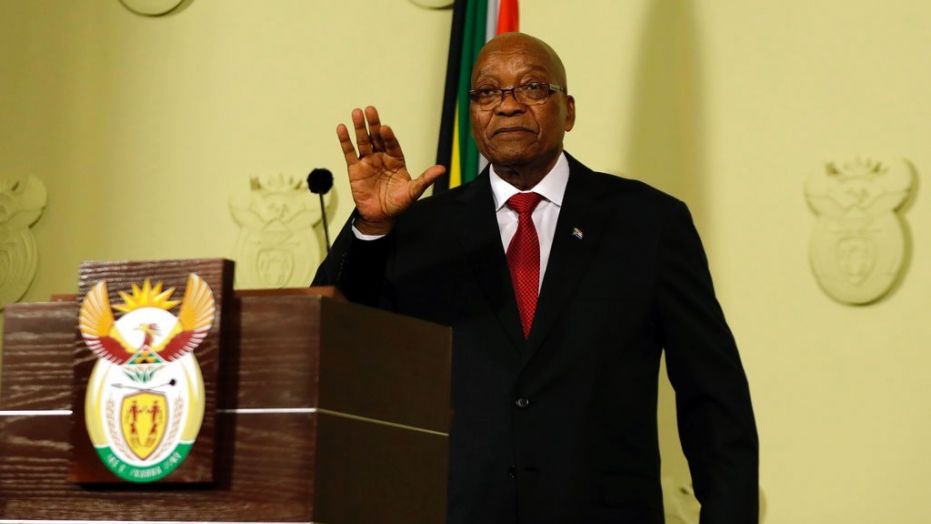
(Reuters) – Jacob Zuma resigned as president of South Africa on Wednesday, heeding orders by the ruling African National Congress (ANC) to bring an end to his 9, scandal-plagued years in power.
In a 30-minute farewell address to the nation, 75-year-old Zuma said he disagreed with the way the ANC had shoved him towards an early exit after the election of Cyril Ramaphosa as party president in December, but would accept its orders.
“I have therefore come to the decision to resign as president of the republic with immediate effect. Even though I disagree with the decision of the leadership of my organization, I have always been a disciplined member of the ANC.
The ANC should not be divided in my name” he said.
The ruling party had said it would vote him out on Thursday.
The ANC, which replaced Zuma as party leader in December with deputy president Cyril Ramaphosa, ordered him to step down as president on Tuesday. When he failed to resign on Wednesday, it announced that it would back an opposition motion in parliament to force him out.
His resignation ends the career of the former anti-apartheid resistance fighter and a decades-long history of entanglement in scandals that polarized Nelson Mandela’s “Rainbow Nation.”
South Africa’s currency – the rand – which has gained ground whenever Zuma has hit political turbulence, soared more than 1 percent to a 2-and-a-half year high of 11.79 against the U.S. dollar during the day, as pressure piled on Zuma to resign.
Earlier in the day, a defiant Zuma told state broadcaster SABC that he had been treated unfairly by the ANC.
“I am being victimized here,” Zuma said, complaining that Ramaphosa, his apparent successor, and other ANC leaders had not given him clear reasons about why he should go.
“I need to be furnished on what I’ve done,” he said.
Corruption Scandals
Also Wednesday, police raided the home of prominent business associates of Zuma who are accused of being at the center of corruption scandals that have infuriated the country, hurt the ANC’s popularity and weakened the economy.
An elite police unit entered the compound of the Gupta family, which has been accused of using its connections to the president to influence cabinet appointments and win state contracts. The Guptas deny any wrongdoing.
Several people were arrested during police operations, South African media reported.
The ANC was accelerating efforts to end the country’s political limbo and push through a power transition in Africa’s 2nd largest economy. The party wanted Zuma to end his 2nd 5-year term early so that it can build up support ahead of 2019 elections.
Ruling party leaders outlined a speedy timetable, with Ramaphosa set to be elected in parliament to succeed Zuma in time to deliver the delayed state of the nation address on Friday evening.
“We can no longer keep South Africa waiting,” said Paul Mashatile, the ANC’s treasurer general.
Zuma also could face corruption charges tied to an arms deal 2 decades ago. South Africa’s chief prosecutor is expected to make a decision on whether to prosecute Zuma on the old charges, which were reinstated last year after being thrown out in 2009.
In another scandal, South Africa’s top court ruled in 2016 that Zuma violated the constitution following an investigation of multimillion-dollar upgrades to his private home using state funds. The president paid back some of the money.
