
News
Nigeria: Boko Haram – more brazen – more dangerous
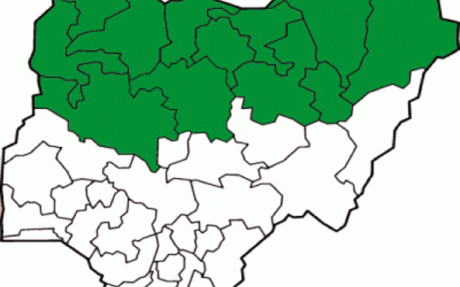
For Khalifa Dikwa, a professor at the University of Maiduguri, the endemically poor region is ripe for recruitment by the insurgency.
While the well-connected and powerful who are accused of wrongdoing can get good lawyers and soon be free, “somebody who was incarcerated for stealing just a chicken will be behind bars for six years without trial,” Dikwa said. “Again, it boils down to injustice, alienation, arm-twisting of the law, corrupting the entire system.”
Unemployment may run as high as 70 percent and opportunities remain few for youths who lack access to formal education. Boko Haram offers inclusion and a livelihood in a nation where corrupt politicians collude with religious leaders, Dikwa said.
“Anybody who feels cheated is Boko Haram,” he said.
The name Boko Haram, which locals attached to the group years ago, means “Western education is sacrilege” in Hausa. It doesn’t just imply formal learning, but rather Western ideals like Nigeria’s U.S.-styled democracy that followers believe have destroyed the country, the professor said.
Borno state Gov. Kashim Shettima said in an interview that Boko Haram wants to gain noteriety in the global terror network.
Shettima believes direct development projects are the way to win his state support from locals and make them turn away from the sect. Rows of gleaming yellow tricycle taxis sit outside his office, a project he said will provide employment for those without jobs.
A series of bank robberies that began this summer appears to provide Boko Haram most of its funding for its attacks, the diplomat and Nigerian officials say. The government is sending more officers, soldiers and shiny new pickup trucks to the region, but Boko Haram’s attacks continue.
The security officials complain that they cannot distinguish friend from foe in the markets of Maiduguri and neighborhoods where burned-out buildings from bombings and the 2009 crackdown still stand. Some selling cheap goods serve as lookouts for the sect, officials say.
Frustrated and enraged soldiers have beaten, whipped and shot innocent bystanders after attacks on the military, local residents say. Some people detained by the police have disappeared while in their custody.
This makes many locals resentful of authority. The diplomat acknowledged that the backlash by authorities has “gotten out of hand” at times.
The fear in Maiduguri, even at the manicured governor’s compound, is palpable. As a reporter waited to interview the governor, an electrical transformer exploded near the tricycle taxis. Soldiers on guard duty jumped, rifles at ready as sparks fell to the ground.
Copyright 2011 The Associated Press.
