
Business
Malawi’s Rare Earth Moment: A $100 Million Bet on the Minerals That Will Power the Future
A single investment by an Australian miner could reshape the global supply chain for critical minerals – and place a small landlocked nation at the center of the clean energy transition.

By Mark-Anthony Johnson
For decades, the world’s appetite for rare earth elements has been satisfied by one dominant supplier: China. That dependence, long treated as a geopolitical inconvenience, has hardened into something more troubling – a structural vulnerability running through every electric vehicle battery, wind turbine gearbox, and advanced missile guidance system.
Malawi, a landlocked nation in southeastern Africa better known for its freshwater lake than its mineral wealth, is now preparing to offer part of the answer.
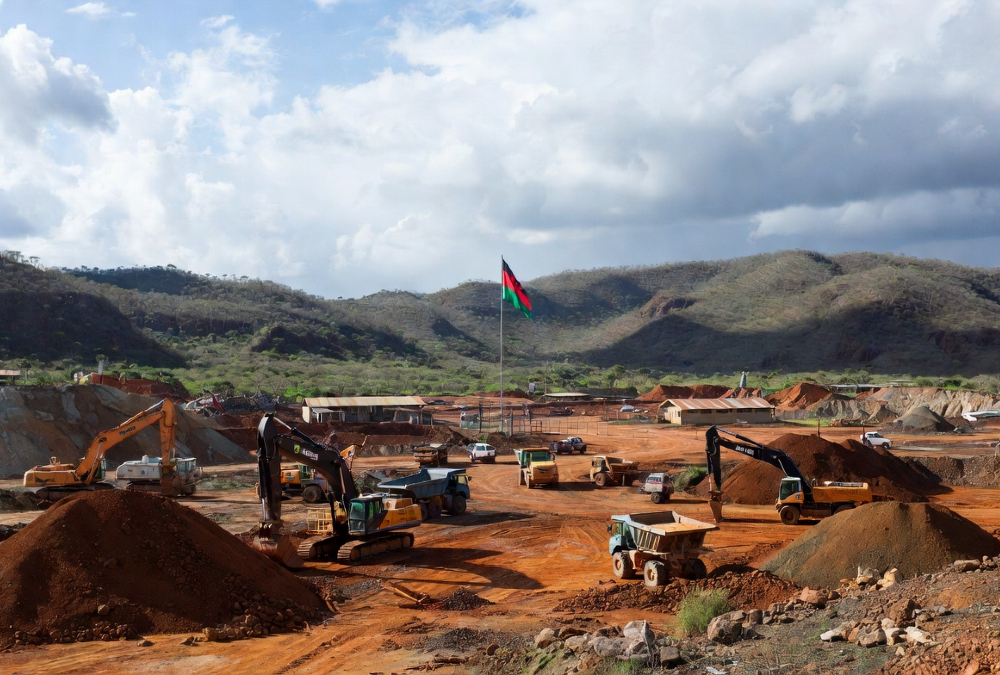
In early April 2026, Lindian Resources, an Australian mining company listed on the ASX, announced it had raised A$100 million through an oversubscribed institutional placement – a rare and telling signal of investor confidence. The funds are earmarked to fully finance construction of Stage 1 production at the Kangankunde Rare Earths Project, situated in Malawi’s southern highlands, and to accelerate feasibility studies for a substantially larger Stage 2 expansion.
First concentrate production is targeted for the fourth quarter of 2026. The pace is striking; it suggests that, for once, the gap between geological promise and commercial reality may close quickly.
Key project details
| Developer | Lindian Resources (ASX: LIN) |
| Investment | A$100 million, oversubscribed institutional placement |
| Location | Kangankunde, southern Malawi |
| Stage 1 target | First concentrate production, Q4 2026 |
| Downstream | SARECO processing facility, Kazakhstan |
| Designation | One of the world’s largest high-grade deposits in development |
Why Kangankunde Matters
Kangankunde is not a marginal deposit awaiting a favorable commodity cycle. Geologists have long recognized it as one of the world’s largest and highest-grade rare earth deposits currently in development.
What has changed is the geopolitical climate surrounding it. The same neodymium and praseodymium that make permanent magnets hum inside EV drivetrains and offshore wind turbines are increasingly the subject of export controls, trade disputes, and strategic stockpiling.
In that environment, a credible, non-Chinese source of rare earths commands a premium that goes well beyond its spot price.
Lindian appears to understand this. The company is not merely planning to dig and ship concentrate; it is integrating its operations with the SARECO processing facility in Kazakhstan, where Kangankunde concentrate will be refined into mixed rare earth carbonate – a higher-value intermediate product that moves the project further up the supply chain.
This kind of downstream integration is precisely what Western governments have demanded of would-be mining partners, and it signals that Lindian is positioning Kangankunde as a systemic fix, not simply a source of raw material.
The same minerals that make wind turbines turn and EV motors hum are becoming the subject of strategic competition – and Malawi may hold a decisive card.
Africa’s Critical Minerals Map Is Being Redrawn
The development positions Malawi alongside South Africa and the Democratic Republic of Congo in Africa’s emerging critical minerals hierarchy. This is no small thing.
For much of the continent’s post-colonial history, its mineral wealth has been extracted under terms set elsewhere, with value added elsewhere and strategic leverage held elsewhere. The Kangankunde investment, structured as a vertically integrated project with clearly defined downstream ambitions, represents a different model – one in which the producing country participates in a supply chain rather than merely supplying feedstock to one.
Malawi is not alone in this pivot. Mkango Resources has recently updated the feasibility study for its Songwe Hill rare earth project, which has been designated a strategic project under the European Union’s Critical Raw Materials Act – a designation that confers preferential treatment in procurement and financing.
Meanwhile, a senior United States government delegation visited the Kangankunde site in early 2026 to assess its potential role in national security and the energy transition. That level of diplomatic attention, focused on a single mine in a country of under 20 million people, speaks to how dramatically the calculus of critical minerals has shifted.
The Risks Are Real – But So Is The Imperative
None of this is without risk. Malawi faces the infrastructural and institutional challenges common to many developing-world mining jurisdictions: limited rail connectivity, power supply constraints, and a regulatory environment that, while improving, is not yet road-tested at scale.
The processing partnership with Kazakhstan introduces its own set of geopolitical considerations, given that country’s complex relationships with both Russia and China. And the rare earth market, as history attests, is prone to price volatility that can strand projects with the best of intentions.
But the imperative is equally real. Western governments and the companies that supply them have spent the better part of a decade calling for supply chain diversification without doing much to produce it.
Financing a credible project in a stable jurisdiction, at commercial scale and with a realistic production timeline, is harder than it sounds – and rarer than the metals themselves. The oversubscription of Lindian’s placement suggests that private capital, at least, has concluded that the moment is now.
Malawi’s entry into the rare earth supply chain will not end the world’s dependence on China overnight. It may not even dent it perceptibly in the near term. But it adds a node to a network that urgently needs more of them – and it does so at a moment when the cost of continued dependence is becoming impossible to ignore. That is worth more than the A$100 million it took to make it happen.
Mark-Anthony Johnson is the founder and CEO of JIC Holdings, a global asset and investment management firm founded in 2009. With over 30 years of experience and strong ties to Africa, his investments span mining, infrastructure, power, shipping, commodities, agriculture, and fisheries. He is currently focused on developing farms across Africa, aiming to position the continent as the world’s breadbasket.
