
News
Liberia: Supreme Court authorities presidential runoff election with conditions
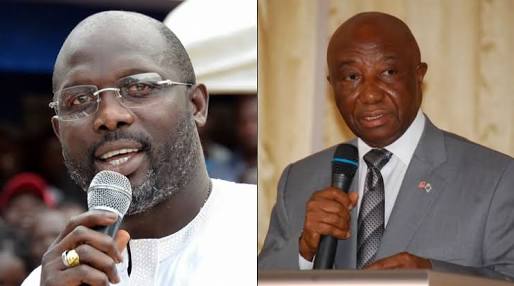
AFP | Liberia’s Supreme Court, Thursday ordered the electoral commission to proceed with a presidential runoff delayed for a month by fraud complaints, but said the national voter register must be corrected of anomalies first.
“The stay order issued on November 6, 2017 against the National Elections Commission (NEC) is hereby lifted and the NEC is ordered to proceed with the scheduling of the runoff elections in accordance with the constitution,” Associate Justice Philip Banks said on behalf of the court in Monrovia.
The ruling Unity Party and opposition Liberty Party had alleged irregularities and fraud tainted the results of the first round of voting on October 10 and called for a total re-run of elections.
That request was denied by the court which said it was “not convinced that burden of proof was met”, thereby paving the way for the planned runoff between former international footballer George Weah and current Vice-President Joseph Boakai to move forward.
The parties had to prove fraud was “not just at a few isolated centers but at most if not all polling centers,” Banks said, and could not do so with the evidence presented. However, the 5-strong panel ordered a technical clean-up of the much-criticized voter registration roll before the second round, which was called after no single candidate gained more than 50 percent of the vote on October 10.
Liberian voters will breathe a sigh of relief at the 4-1 court ruling, which puts an end to weeks of tensions, but with no date set for the runoff and a planned mid-January transition drawing ever closer, much remains up in the air.
The October 10 first round vote was held to replace President Ellen Johnson Sirleaf, a Nobel Peace Laureate and Africa’s first elected female leader who is stepping down after a constitutional maximum of 2 six-year terms.
The Supreme Court put a temporary stay on the poll while the NEC heard the complaints of the parties that came in 2nd and 3rd.
The commission found the parties’ allegations either unfounded or exaggerated and ruled it had not carried out a fraudulent election, a decision maintained upon appeal. The Supreme Court was unhappy with the conduct of NEC Chairman Jerome Korkoya, its judgement showed, accusing him of “expressed bias” against the parties which meant he “could not be expected to display impartiality” in hearing their complaints.
As a result the commission was prohibited from airing its views in public on “any matters which may grow out of the runoff election,” Banks said.
Liberia’s presidential election is considered a crucial test of the west African nation’s stability and would be the first democratic transition of power in several decades.
