
Business
Hurdles in Africa’s grand plan
Why have they become so popular in Africa?
Economists argue that free trade zones are particularly suited to African countries which were created under colonial occupation when land was divided up, often with little regard for the economic sustainability of the newly created units (countries).
Plus, post-independence conflict in Africa has left much of the continent with a legacy of poor governance and a lack of political integration which free trade zones aim to address.
For example, landlocked Uganda was almost ruined by the Ugandan-Tanzanian War (1978-79). Today it remains dependent for the supply of finished goods on its wealthier neighbour Kenya, with its international seaports.
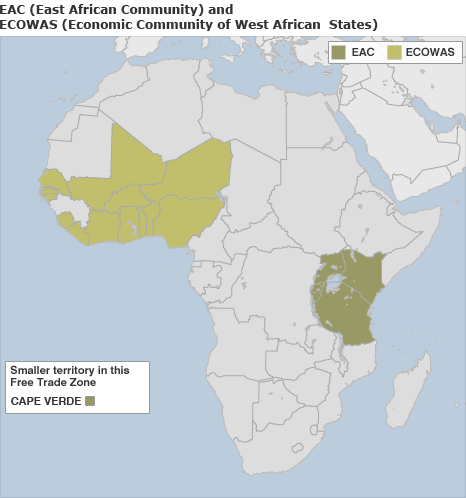
The two countries entered into the East Africa Community Customs Union, EAC, in March 2004, along with Tanzania.
However, these trading blocs are not always tariff free. Kenya continued to pay export duties to Tanzania and Uganda for five years after the EAC union began, to compensate for the fact that it was a more prosperous, diversified economy.
Free trade zones can also cover individual areas within a country. The Lekki free trade zone in Nigeria’s former capital, Lagos, aims to create a new commercial hub by removing tariffs for international investors. Eritrea plans a similar arrangement at its port at Massawa on the Red Sea coast.
What do free trade zones claim to offer?
The hope is that free trade zones will boost both trade and Africa’s economic independence.
Babatunde Raji Fashola, governor of Lagos state, told Africa Business Report: “At airports, Nigerians are the people you see with excess luggage and it comprises mainly of household goods, clothing.
“Every time we import goods, we invariably, without knowing it, export jobs because we keep those industries offshore.”
World trade experts also believe in the future, more of the world’s big multi national deals will be “South-to-South”, ie between Southern Hemisphere nations.
A recent example is a plan by India’s mobile phone giant, Bharti Airtel, to take a controlling stake in South Africa’s MTN. Free trade zones can greatly boost the attraction of such deals.
Is there any evidence they work?
Some critics claim that free trade zones give an unfair advantage to multinational corporations, who are able to manufacture in a low-cost base and export around the world, rather than indigenous firms.
These companies are often given other incentives to locate in developing economies, such as grants to help with set-up costs and lax employment legislation, which trade unions and some charities claim are open to abuse.
Free trade zones can also take a long time to set up while member countries agree terms. The East African EAC bloc took six years to come into being, even though it was replacing a previous similar arrangement which collapsed in the 1970s.
The fear is that the dominant economy will set the agenda for the bloc as a whole – a criticism levelled at the SADC (as idicated above), which contains South Africa, the continent’s only G20 member country.
But supporters say free trade zones are ultimately one of the fairest ways for developing world economies so that they can begin to compete on a global scale. They could even be extended to encompass other financial unions, such as pan-regional banks and a common currency.
Source: Financial Mail; BBC
