
News
Ethiopia and Eritrea leaders sign peace accord – as relations continue to thaw
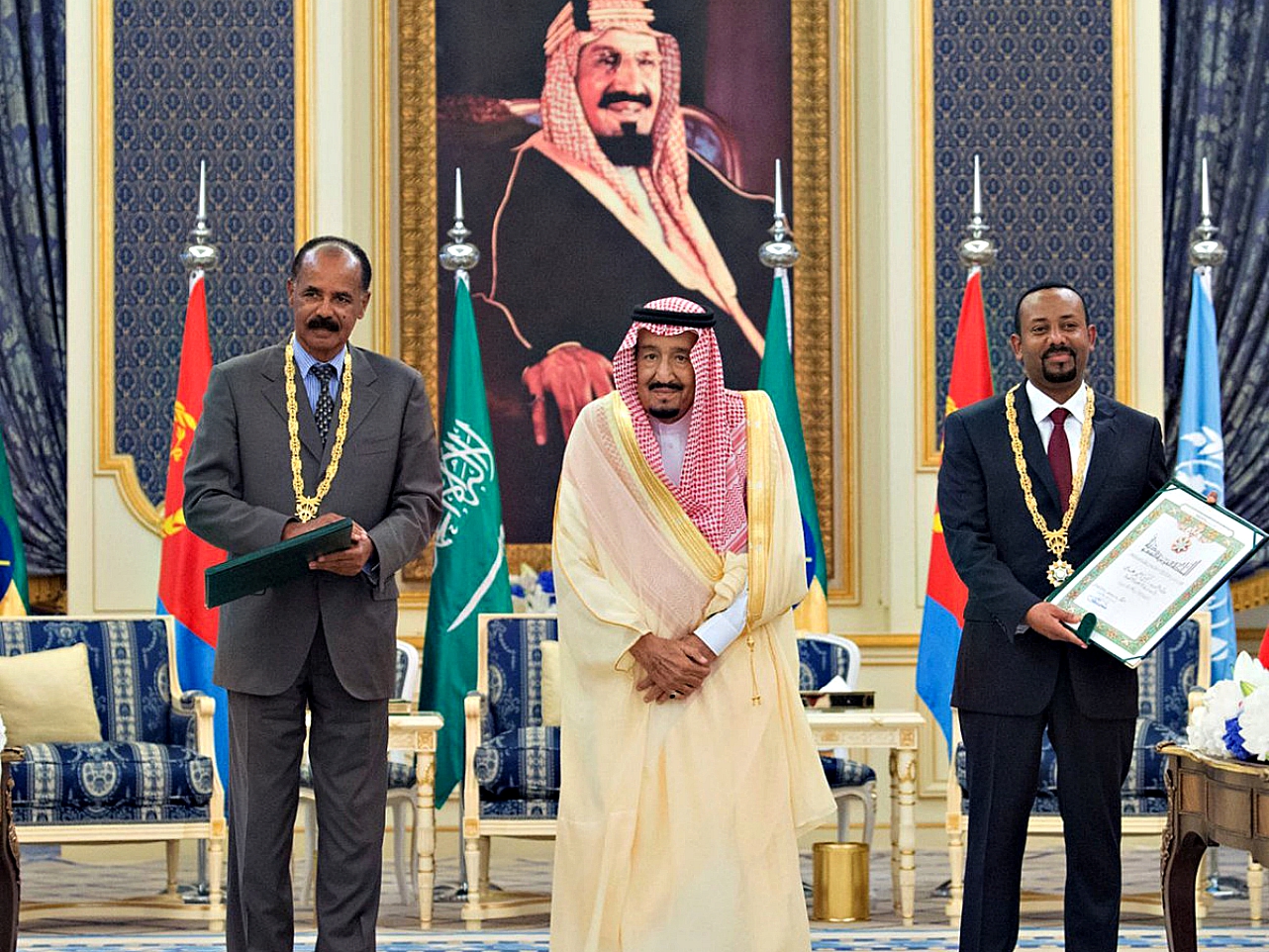
Leaders from Ethiopia and Eritrea signed a peace agreement on Sunday during a summit in Saudi Arabia, yet another sign of warming ties between two nations that have face decades of war and unease.
Terms of the agreement signed by Ethiopian Prime Minister Abiy Ahmed and Eritrean President Isaias Afwerki were not immediately clear. Ethiopia’s Foreign Ministry described it as a “7-point agreement” while Eritrea offered no details.
Authorities did not respond to specific questions about the accord, which earlier had been described as being a further endorsement of a historic deal reached between both countries in July.
“The peace deal resulted in restoration of normal relations between the countries, on the basis of the close bonds of geography, history and culture between the two nations and their peoples,” according to a statement Sunday.
“The kingdom of Saudi Arabia praised the leaders of Ethiopia and Eritrea for exercising leadership and courage to restore the brotherly relations between the two countries, thus forming the foundation for a new phase that will bring significant developments in the relations between the two nations in all fields,” the statement added.
Saudi King Salman and Crown Prince Mohammed bin Salman, were on hand for the summit in the Red Sea port city of Jeddah. Also attending was Emirati Foreign Minister Sheikh Abdullah bin Zayed Al Nahyan and United Nations Secretary General Antonio Guterres.
“There is a wind of hope blowing in the Horn of Africa,” Guterres told journalists after the signing. “It is not only the peace between Ethiopia and Eritrea – it is the fact that tomorrow and the day after tomorrow we will have, here in Saudi Arabia, the president of Djibouti and the president of Eritrea – 2 countries that have also been at odds with each other.”
In September, an Ethiopian-mediated effort saw relations normalize between Eritrea and Djibouti after a long border dispute. Between 2010 and 2017, Qatar had attempted to mediate a settlement but that effort failed. Qatar in June 2017 withdrew its 450 peacekeeping troops from the Eritrean-Djiboutian border after being isolated by Saudi Arabia, the United Arab Emirates (UAE) and two other Arab nations as part of a diplomatic dispute.
Abiy and Isaias signed a 5-point “Joint Declaration of Peace and Friendship” on July 9, ending 20 years of enmity and formally restoring diplomatic relations between Ethiopia and Eritrea.
Landlocked Ethiopia fought a bloody war with Eritrea from 1998 to 2000 over a border dispute. The conflict ended in an uneasy peace with Eritrea, which earlier fought a decades-long war of independence from Ethiopia.
Yet that suddenly changed with the election of Abiy as prime minister. A whirlwind of talks suddenly ended the long conflict between the two nations in July, with telephone calls and flights suddenly possible between the two nations.
It was particularly surprising for Eritrea, the country’s system of compulsory conscription has led thousands of Eritreans to flee.
The signing ceremony Sunday also served as a nod to the growing importance Gulf Arab nations put on East Africa.
The strategic Bab al-Mandeb Strait, which sits off Eritrea and neighbouring Djibouti, links the Red Sea and the Suez Canal with the Gulf of Aden and ultimately the Indian Ocean.
Dozens of commercial ships transit the route, some 16 kilometers (10 miles) wide at its narrowest point, every day.
Copyright 2018 The Associated Press
