
Opinion
BRICS+, Rwanda and Africa’s New Currency Calculus
As the world’s economic center of gravity drifts toward the emerging world, a small East African nation has borrowed in two currencies at once. Other governments should pay attention.

By Gregory September
Most headlines about African debt feature a single currency: the dollar. Eurobond issues are celebrated, and Eurobond defaults are lamented. Either way, the conversation rarely strays from the greenback. Rwanda has just strayed from it on purpose.
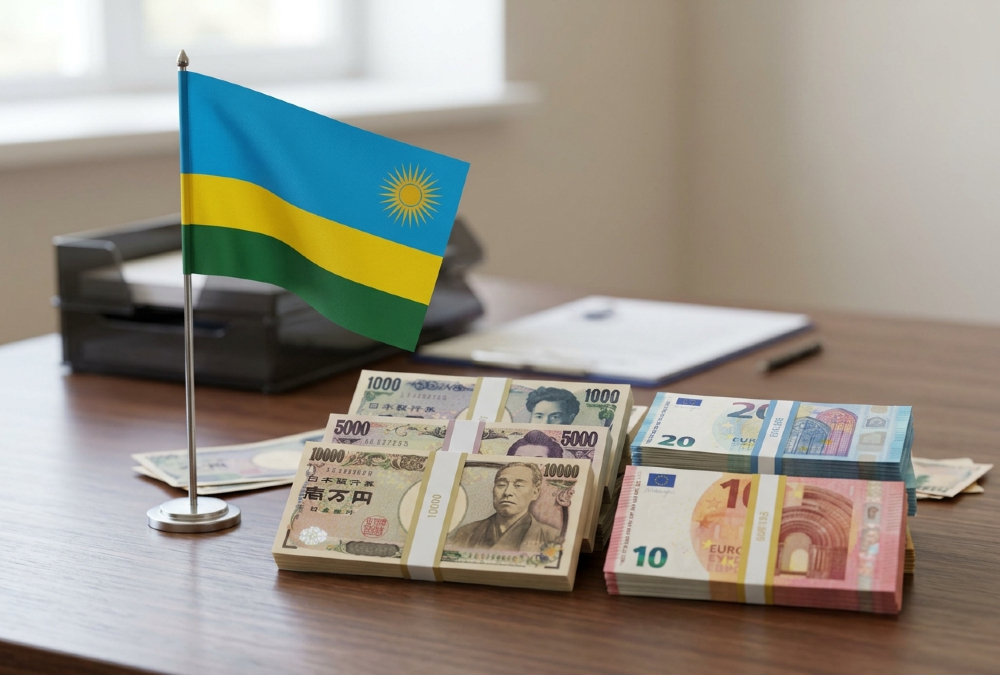
Kigali has secured a World Bank-backed loan split between euros and Japanese yen, the country’s first-ever yen-denominated financing. The package combines €82 million with ¥15 billion. It carries a six-year grace period before repayments begin and a 15-year term. The pricing is not the point. The structure is.
A Strategy, Not a Bargain
Borrowers usually chase the lowest rate. Rwanda appears to be chasing something scarcer: independence from any single currency. When a government’s debt is concentrated in dollars, every tightening cycle at the Federal Reserve becomes a domestic budget problem. A stronger dollar raises the local-currency cost of servicing loans, squeezes reserves and crowds out spending on schools, roads and clinics. Spreading obligations across currencies will not eliminate that exposure, but it dilutes it.
The timing helps. Rwanda’s credit story has improved: Moody’s and Fitch both moved its outlook to stable, in 2025 and 2026 respectively. Lenders reward predictability, and this deal suggests Kigali is now negotiating from a stronger position.
The Global Backdrop
The wider shift in the world economy makes the experiment more relevant. In purchasing-power-parity (PPP) terms, BRICS+ now accounts for roughly 39.8 percent of global output in 2026, against 27.9 percent for the G7. The bloc also represents about half of the world’s people and around a quarter of world trade. The economic center of gravity is moving.
Yet it would be a mistake to overstate the case. At market exchange rates, the G7 remains far larger, and it retains a disproportionate grip on global finance, capital markets, reserve currencies and advanced technology. PPP measures what money buys at home. Nominal figures measure what it commands abroad. The exact gap also moves with IMF revisions, membership definitions and PPP updates, though the long-term direction is clear.
That mismatch is the crux for African treasuries. The world’s output is diversifying faster than the world’s financial plumbing. Governments that borrow only where the plumbing is strongest will remain exposed to the decisions of others. Governments that widen their menu of currencies and lenders gain room to maneuver.
Not Without Risk
Multi-currency borrowing is no free lunch. A loan in yen or euros must eventually be repaid in yen or euros, and a government earning revenue largely in local currency or dollars takes on new exchange-rate risk. Yen borrowing, in particular, looks cheap until the currency moves the wrong way. Diversification works only when debt managers match currencies to revenue streams, hedge prudently and have the technical capacity to monitor a more complex portfolio. Rwanda’s institutions may be up to the task. Many peers’ are not.
The Development Dividend
The financing also touches three of the United Nations’ Sustainable Development Goals:
- SDG 17 (Partnerships): Multi-currency deals depend on deep relationships with global lenders, here the World Bank and its co-financiers.
- SDG 8 (Decent Work and Economic Growth): Lower currency concentration supports steadier long-term investment planning.
- SDG 9 (Industry, Innovation and Infrastructure): Proceeds are earmarked for infrastructure, agriculture and industry.
The Verdict
Should more African sovereigns borrow in several currencies at once? Those with disciplined debt offices, credible institutions and the ability to hedge should. Diversification is not a fashion; it is insurance in a world where power is dispersing but the financial system has yet to catch up. Those without the capacity to manage the risk should build it first, with help from multilateral partners.
Rwanda has shown that a small economy can make a large point. The dollar will not vanish from African finance, nor should it. But the era in which it was the only currency worth discussing is ending. The smart money is learning to speak more than one.
Gregory September is a South African academic, author, and geopolitical analyst with extensive experience in government and Parliament. He is the founder and CEO of SAUP (Sustainability Awareness and Upliftment Projects NPC), which focuses on sustainability education and community development. He previously served as Head of Research and Development for the Parliament of South Africa. His work centers on sustainability, African geopolitics, and economic development, and he regularly contributes to analysis of global political and economic affairs.
