
Life
Visitors at New Black Civil War Museum Say Race Education Is Missing In America
Racial profiling and police brutality; economic inequality; racial stereotypes; disparate incarceration rates, unbalanced criminal justice and media bias.
These are just a few of the racial ills still raging like an ideological civil war across America as the nation continues to commemorate the sesquicentennial, 150th anniversary, of the start of the Civil War, the raging violence that separated a nation and brought an end to slavery in the United States.
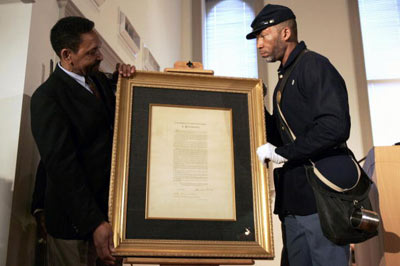
Some among the streams of people who attended grand opening activities at the African American Civil War Museum and Memorial in the heart of the District of Columbia, were adamant that the education of America’s youth and re-education of adults are among the key answers to racial reconciliation and Black progress.
“I am a history major at University of the District of Columbia (UDC). I love everything about American history,” said Micaiae Strong, a student at the UDC. Her son, Marqus, tried on a Civil War Union uniform and gave a salute as part of his educational outing. “I would like to know the ins, the outs, the whys, the reasons and how Black people used the laws they created against us to get our freedom. And I want my son to understand there’s no option to fail,” Strong said.
They toured the new 5,000 square foot facility during a break between panels during a racial reconciliation conference that kicked off the weekend event that included a festival class race films and Monday’s ribbon-cutting.
Sheila Willis of Atlanta also brought her 5 year old son.
“I feel that if we would teach kids integrity and equality across the board, that will level the playing field,” she said. “I want him to know his history because if you know our history, you can move forward.”
That kind of teaching, for children and adults alike, are what Paul LaRue told the audience he’s been doing.
LaRue, a history teacher at the Washington High School in Washington Courthouse, Ohio, took to the stage and showed ways to get other teachers involved doing hands-on lessons with African-American heritage like what he’s been doing in his community for past 10 years.
“By getting students involved hands-on working with African-American heritage or Civil War heritage, you get students to not just talk about it but actually doing it,” said LaRue, who is White.
One of his activities with Black and White Middle School students involved setting headstones for veterans who have unmarked graves.
“By helping to mark a veteran’s grave, I think that makes it real. We have marked about 70 unmarked graves, about half of which are African-Americans,” he said. “Then, instead of just discussion or a debate, it’s, ‘I’ve made a contribution’. It’s been a really positive team collaboration.”
Still others say children must be retaught how to take control of their own lives and futures regardless of their educational backgrounds.
“We just taught our kids, through civil rights and integration, to go to college, work hard, get a good job, but that’s not how you build a nation,” said Ernest E. Johnson, 60, a real estate broker, who describes himself as a “lover of the struggle.”
He said, “We have to first re-educate our children through ownership and control. That’s how you establish permanency and uplift your race.”
The commemoration that started on April 12, 1861, will last for four years through the anniversary of the end of the war, April 9, 1865. Dr. Frank Smith, founder and visionary of the AACWMM, who also serves as its executive director, hopes that will be enough time to create enough dialogue to move toward racial healing in America.
“I’m hoping that by the time this sesquicentennial period – this four-year celebration – is over, America will have a greater appreciation of the role that African-Americans played in making America a better place – by ending slavery and keeping America united under one flag,” Smith said. “Furthermore, there could be no racial reconciliation in America until we got rid of slavery and Jim Crow. And it took the Civil War and the Civil Rights movement to do that and I think most people would admit that America is a better place.”
