
Life
Visitors at New Black Civil War Museum Say Race Education Is Missing In America
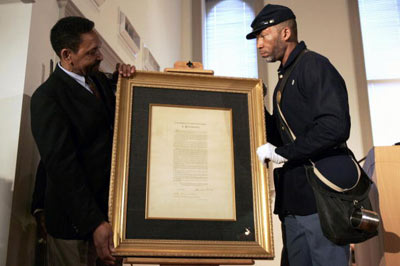
Civil War re-enactors, historians, teachers and interested onlookers of all ages packed into the museum over the weekend. Many held the same sentiment – that the true story of Black soldiers’ battle for their own freedom and the subsequent progress can’t be told enough.
“People who started off as slaves ended up as businessmen; You don’t hear about all those accomplishments. You don’t learn about those people who made contributions to assist,” said Judy Williams, a member of FREED – Female Re-enactors of Distinction. “So, I chose to be a re-enactor to help educate and tell that story…It’s a story truly of overcoming.”
The level of conversation that Smith hopes for will take the participation of all races says Darryl Jones, a D.C. business owner.
“First, we – Black, White, blue, green, purple – must recognize historically what has happened to Africans in America prior to slavery and up to the present. Once we acknowledge that, then we have a basis for going forward and the understanding of how we can have an intelligent conversation on the blight of Black people here in America.”
Jones says the details of Black history are not known well enough to have the impact that it should. “First you have to reinvent the history book. We have to teach our kids, White and Black – the history of America. Right now history remains his story. Our story remains a mystery.”
We must tell our own story, says Keith Butler, who worked for 10 years as a technology coordinator for D.C. Public Schools. “A lot of us have forgotten about our pasts.”
Butler is working with the National Association of Colored Women to establish a Grandparents Academy. “We’ve gotten away from the basics,” Butler said. “This will focus on re-teaching our kids.”
Coming up on the second half of the reconciliation forum, D. J. Walls, 34 and Nicole Williams, 31, dropped in just to see what they might learn.
“We are young,” she said. “We came today to look around and see what it’s about.”
Acknowledging the plight and social statistics involving young Black males, Walls says racial reconciliation can only come when individuals pursue it as a personal goal.
“There’s so much negativity,” he said. “We need more understanding and communication and for people to have an open mind. You have to understand before you can judge.”
