
Business
The Military Means Big Business in Egypt
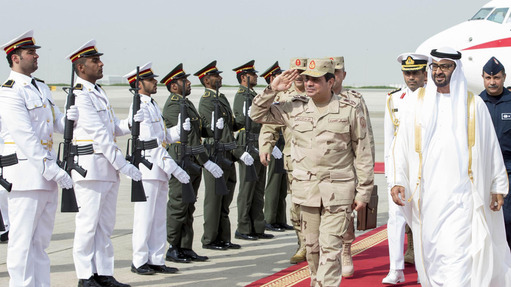
Field Marshal Abdelfatah al-Seesi, the army chief who ousted the freely elected government of Egyptian President Mohamed Mursi and the Muslim Brotherhood, flew to the United Arab Emirates on March 12 to observe military maneuvers. A few days before his trip it was announced that the UAE’s Arabtec Construction would collaborate with the Egyptian military in a $40 billion project to build a million low-income housing units in Egypt. The collaboration is part of the UAE’s assistance to get Egypt back on its feet. It is also a sign that the Egyptian military’s grip on the economy is growing stronger.
Egypt’s business executives say they owe the army a lot for unseating Mursi. After the 2011 fall of Hosni Mubarak, many of his supporters found themselves facing a public reckoning for the corruption and crony capitalism of the old regime. Prosecutors filed charges against them in criminal courts.
The prosecutions “happened to many business people, and that’s why the business people, or a part of them, stopped investing,” says Mohamed Abou El Enein, owner of Egypt’s largest ceramics exporter. “Part of them left.” But in the last year, the Cassation Court has overturned all the corruption verdicts it has ruled on. The business class has been vocal in its support of al-Seesi, who is probably the next president. “We’re back on the right track,” says El Enein, who was acquitted of charges of organizing attacks on protesters in Tahrir Square.
The army may have saved Egypt’s business owners, but it has little interest in re-creating Mubarak’s Egypt. “It’s not only a different game than before Mubarak. It’s a game without rules,” says Tamer Wageeh, director of the economic and social justice unit at the Egyptian Initiative for Personal Rights. “The new thing is that the army is getting stronger and … is dictating more and more its will, even in business.”
The army has been expanding its businesses since the 1970s. Today it develops real estate and operates hotels, cleaning services, and gas stations; it sells pasta, mineral water, and olive oil; it makes refrigerators and washing machines. Now it is filling a vacuum created by the end of the Mubarak era, when Hosni and his son Gamal controlled the fates of many tycoons. The Mubaraks’ influence has vanished, and companies run by their supporters, which before 2011 would have won bids, are not assured of success now.
This became clear when a government stimulus package of 30 billion Egyptian pounds ($4 billion) was announced in August 2013, financed in large part by the UAE. A close look at the distribution of funds suggests the army got half the projects, including paving roads and industrial infrastructure deals, according to Mohamed Farouk, a member of the Egyptian Council for Economic Issues. None of the contracts, he says, went to the big construction companies, a departure from the Mubarak era.
Although the military is known for delivering projects on schedule, critics say none of the army’s budget is published, making public accountability impossible: “With the same amount of money spent,” Farouk says, “you could have made double the amount of projects on the market.”
