
Business
Nigeria: Africa’s biggest economy now in recession as oil output drops
Nigerian GDP contracts 3.6% in third quarter from year earlier; oil production at the lowest in 4 years after OPEC+ cuts
Bloomberg | Africa’s largest economy has slumped into a recession in the third quarter as oil production dropped to a 4-year low.
Nigeria’s gross domestic product (GDP) shrank 3.6 percent in the 3 months through September from a year earlier, compared with a 6.1 percent contraction in the previous quarter, Statistician-General Yemi Kale said Saturday in a report released on Twitter. The median estimate of 6 economists in a Bloomberg survey was for a 5.3 percent decline.
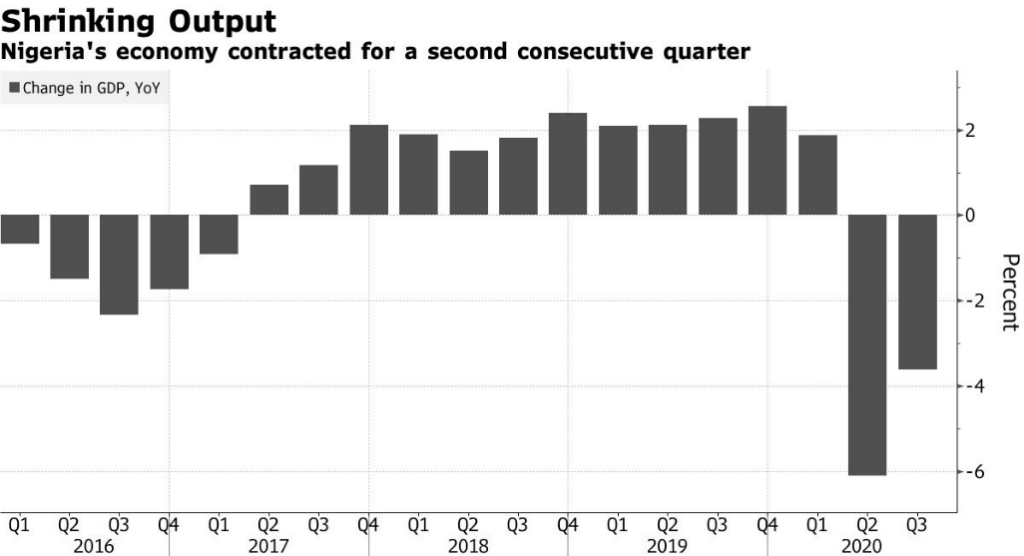
Image Source:
National Bureau of Statistics, Nigeria
Oil production fell to 1.67 million barrels a day from 1.81 million barrels in the previous 3 months. That’s the lowest since the third quarter in 2016, when the economy was in a contraction that lasted for over a year. Africa’s top crude producer cut production in order to reach full OPEC+ compliance.
While crude contributes less than 10 percent to Nigeria’s GDP, it accounts for about 90 percent of foreign-exchange earnings and half of government revenue. That means the plunge in oil prices in the wake of the pandemic, which struck as the economy’s recovery from a 2016 slump was still gaining traction, has emptied coffers.
The contraction could further complicate the task of the central bank’s monetary policy committee (MPC) as it starts its 2-day meeting on interest rates on Monday. The panel surprised with a 100-basis-point cut in September to support the economy.
Already above target for more than 5 years, inflation has continued to accelerate and pressure on the naira increased, which may force the MPC to hold on Tuesday.
Coronavirus, oil
The twin impact of Coronavirus lockdowns and the plunge in the price of oil hit the west African economy harder than most on the continent. That came on top of land borders that’s been closed since last August in an attempt to curb smuggling and boost local production. Instead, it’s weighed on Nigerian exports and on the supply of some food products, adding to inflation.
“A lot needs to be done to get Nigeria back to even the very modest 2 percent growth of the period before the COVID restrictions,” Joachim MacEbong, a senior analyst at SBM Intelligence, said by text message. “Land borders need to be reopened and the monetary policy posture of the central bank must change in order to facilitate any return to positive growth.”
The International Monetary Fund forecasts Nigerian GDP will contract by 4.3 percent this year, the biggest drop nearly 4 decades.
