
News
Kemi Badenoch: Pioneering leader as the first Black Woman of Britain’s Conservative Party
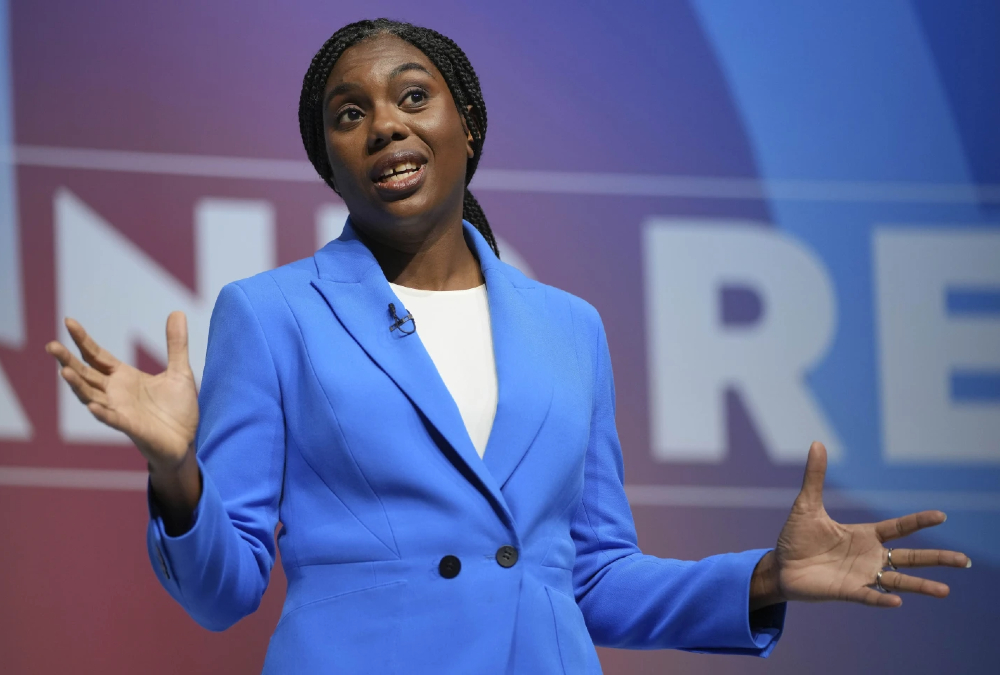
AP | Kemi Badenoch, the first Black woman to lead a major political party in the U.K., is a dynamic and straightforward libertarian who believes that the British government is in turmoil – and that she can revitalize it through limited governance and innovative policies.
Born Olukemi Adegoke in London in 1980 to Nigerian parents – her father a doctor and her mother an academic – Badenoch spent a significant part of her childhood in Nigeria. She often attributes the economic difficulties and social instability she witnessed there to the formation of her political beliefs.
“I grew up in a place where power outages were frequent, and fuel shortages were the norm, despite Nigeria being an oil-producing nation,” Badenoch remarked in a recent BBC interview. “I don’t take what we have in the U.K. for granted. Many people assume our current circumstances are secure and unchangeable, failing to recognize the hard work and sacrifices that brought us here.”
At 16, Badenoch returned to the U.K. during a time of political unrest in Nigeria, working part-time at McDonald’s while completing her education. She later studied computer systems engineering at the University of Sussex and earned a law degree, establishing a career in financial services.
In 2012, she married banker Hamish Badenoch, and the couple has three children. Badenoch was elected to the London Assembly in 2015 and joined Parliament in 2017. She held several positions under Prime Minister Boris Johnson from 2019 to 2022, resigning alongside other ministers amid a wave of resignations related to Johnson’s ethical issues, which ultimately led to his departure.
Although she did not win her bid to succeed Johnson, her public profile significantly increased. She later served as trade secretary in Liz Truss’s short-lived government and as business secretary under Rishi Sunak.
Badenoch retained her seat in the recent national election, which resulted in a significant victory for the Labour Party, leaving the Conservatives with only 121 seats in the 650-seat House of Commons.
An admirer of Margaret Thatcher, the U.K.’s first female Conservative leader who advocated for free-market reforms in the 1980s, Badenoch utilizes her engineering background to highlight her analytical and problem-solving approach. She positions herself as a disruptor dedicated to a low-tax, free-market vision, vowing to “rewire, reboot, and reprogram” the British government.
A vocal critic of multiculturalism and a self-proclaimed opponent of “wokeness,” Badenoch rejects “identity politics,” gender-neutral bathrooms, and various government initiatives aimed at reducing carbon emissions in the U.K.
Supporters view her bold and forthright style as the solution the Conservative Party needs to rebound from its significant electoral defeat. Her campaign supporters even donned T-shirts that read, “Be more Kemi.”
However, critics argue that Badenoch often clashes with colleagues and civil servants, occasionally making impulsive statements that provoke unnecessary controversy. During her leadership campaign, she faced backlash for claiming that “not all cultures are equally valid” and for suggesting that maternity pay was excessively generous, although she later retracted that comment.
“I speak my mind,” she told the BBC. “And I tell the truth.”
