
Business
Welcome to Jamaica, home of the world’s best-performing stock market
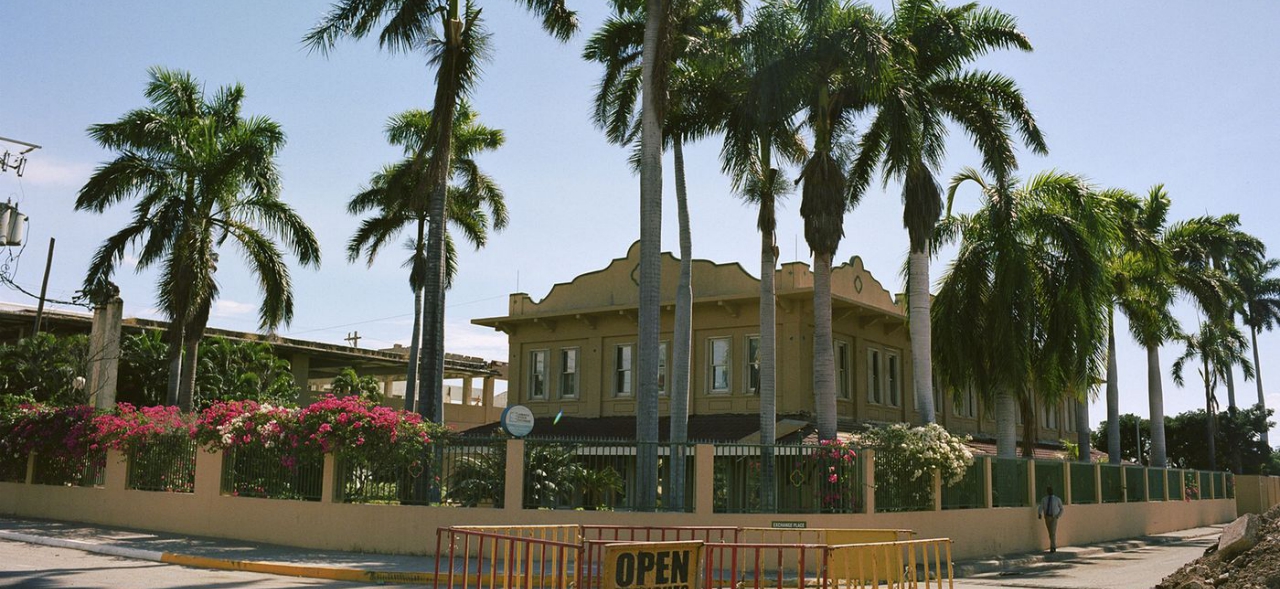
At the world’s best-performing stock market, things operate a bit differently than they do on Wall Street. No one complains about short sellers swooping in to drive down share prices or high-frequency traders eking out an unfair edge, because neither exist here. And forget about premarket or after-hours sessions that stretch the trading day around the clock. At the Jamaica Stock Exchange on the waterfront of Kingston Harbor, investors have just three and a half hours a day to buy and sell.
So this market is not ready to plug into the hyperactive trading desks of New York and London. Not yet. There are zero Jamaican stocks in U.S. exchange-traded funds, even those tracking “frontier” countries such as Kazakhstan, Sri Lanka, and Vietnam, the most emerging of the emerging markets.
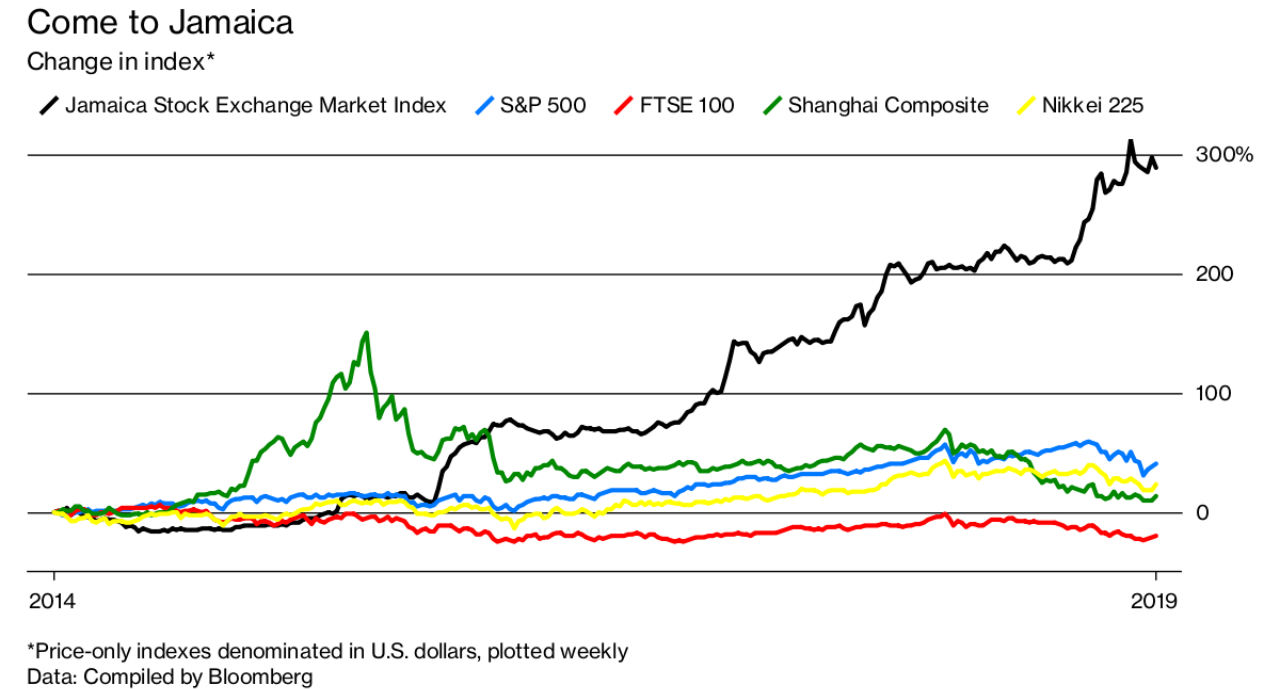
Still, Jamaica’s stock returns are the sort that tend to be a beacon for adventurous global investors – a flash of bright green digits on computer screens that have lately been lit up in red. In 2018 the nation’s main index rose 29 percent in U.S. dollar terms, the most among 94 national benchmarks tracked by Bloomberg. Its outperformance over the past five years is even more striking. Jamaican stocks have surged almost 300 percent, more than quadrupling the next-best-performing national benchmark and septupling the S&P 500’s advance.
What explains these gains? A Caribbean economic miracle the world has overlooked? Not exactly: Real growth in Jamaica has averaged less than 1 percent the past 4 years, and it’s expected to come in at 1.7 percent for 2018. The bull market is partly a matter of math. It does not take much investment to make a tiny market boom, and the total value of the 37 stocks in the main Jamaica index is less than US$11 billion, smaller than the valuation of Chipotle Mexican Grill Inc. But it is also a story about Kingston’s nascent attempts to reinvent itself as a financial hub, even as it works to reduce the heavy debt load that brought the country to the brink of crisis a decade ago. “Clearly, capital goes where it’s comfortable,” says Paul Simpson, a 36-year-old banker and investor in Kingston. “To see capital coming here means people must be comfortable.”
Jamaica’s financial industry is mostly headquartered in the neighborhood of New Kingston, which is nothing like the caricatures that dominate global perceptions of the island-nation. You won’t see a lot of hard-partying tourists, or the poverty of places like Trench Town. Instead, Audi and Porsche dealerships are here, along with one of the Starbucks stores that have sprouted up, selling Blue Mountain coffee brewed from beans grown on nearby hillsides.
Over the past decade, Jamaica’s financial sector assets have tripled and the number of institutions has grown 8-fold, according to International Monetary Fund (IMF) figures. While Kingston still regularly appears on global lists of dangerous cities, the World Bank now ranks Jamaica as the 6th-best nation in terms of ease of starting a business.
“If I could hold a megaphone and tell investors now’s the time, I’d do it,” says economist Uma Ramakrishnan, the IMF’s Jamaica mission chief. Some investors have already received the message. China’s Jiuquan Iron & Steel plans to spend about $6 billion to expand output at an aluminum refinery and develop an industrial park. Foreign corporations have also bought the producers of Red Stripe beer and J. Wray & Nephew rum in recent years. And the share of Jamaicans with brokerage accounts has gone from less than 5 percent to more than 10 percent in the past decade.
But for investors within earshot of Ramakrishnan’s megaphone, there are still enormous limitations to consider, starting with the equity market’s minuscule size. The number of shares available to the public is even smaller, because many companies are majority-owned by conglomerates, in particular foreign companies tapping into Jamaica’s capital markets. NCB Financial Group Ltd., the dominant bank, which accounts for almost a third of the stock index by market value, is more than half-owned by Jamaican-Canadian billionaire Michael Lee-Chin’s investment company. Scotia Group Jamaica Ltd., the second-biggest stock, is about three-quarters-owned by Bank of Nova Scotia. It is common for some Jamaican stocks not to trade for days or even weeks. When the list of gainers and losers is tallied on any given day, the number of unchanged stocks often outnumbers both.
The exchange’s managing director, Marlene Street Forrest, has heard the criticisms and says things are improving. The time it takes to settle trades has been shortened to 2 days from 3 to comply with international standards. The exchange is planning to introduce market making this year, a way to ensure stocks have a ready buyer and seller. It is also exploring adding other tools familiar to traders in bigger markets, from margin accounts allowing people to invest with borrowed money to short selling so they can bet on prices falling. But it is approaching change gingerly. Street Forrest sees no need to extend trading hours if the demand from investors isn’t there yet. “We ensure that we are going to get it right before we move,” she says.
Street Forrest already has a lot on her plate. She’s preparing for more than 20 new listings this year, including an initial public offering for a government-owned power supplier, Wigton Windfarm Ltd., as part of a privatization effort, and several smaller companies coming to the exchange’s junior market, which includes companies even smaller and less liquid than those in the main index.
The exchange was created 50 years ago, spearheaded by former Prime Minister Edward Seaga, who started his career as a record producer in the 1950s and ’60s and was among the first to press ska music onto vinyl. He later got into politics and was appointed finance minister. In the 1970s, Seaga went on to lead the Jamaica Labor Party, the capitalist rival to the charismatic socialist leader Michael Manley, who was moving Kingston closer to Havana and further from Washington. Jamaican politics in that era could be mistaken for civil war, with frequent deadly confrontations between supporters of Seaga and Manley. Such political violence is largely a thing of the past. Another legacy – a buildup of debt—has been harder to shake.
Source: Bloomberg Businessweek
