
Opinion
Trump and Africa – One Year Later
By David Levin

Detrimental Impact of Trump’s Presidency
Last January, I wrote an article about what I thought Donald Trump’s policies toward Africa might look like once he took office. I based my theories, in part, on the frequency that he mentioned Africa – or any of its countries assuming he could even name one – during the 2016 presidential campaign.
And, suffice it to say, as bad as I thought it would be, it’s actually been much worse than even I anticipated.
Like much of the rest his presidency, the way Donald Trump has dealt with Africa has bordered on embarrassing. Actually, in many cases, insulting would be far more accurate.
Clearly, his foreign policy style in general has been just a little heavy-handed and lacking in certain expected presidential qualities such as diplomacy, statesmanship and coherent oratory to name a few. Not to mention judgement. Just ask Mexico.
But when it comes to Africa, Trump has had more than his share of faux-pas, snubs and puerile gaffes that, when combined, clearly demonstrate his almost complete indifference toward the continents 1.2 billion men, women and children.
At times, his actions and statements have been so astonishing, so inexplicable, that even his own staff were caught off-guard and forced into spin-mode to control the damage.
Back in July for example, he decided that the G-20’s “Partnership with Africa: Migration and Health” meeting was unimportant so he tapped his daughter, Ivanka, to attend the meeting in his absence. She looked just a tad out of place stuffed between the U.K.’s Theresa May and China’s President, Xi Jinping – like a slice of sandwich meat.
In hindsight though, I suppose he could have sent his 11-year-old son, Barron, instead so maybe Ivanka wasn’t such a bad choice after all.
Or how during a G-7 meeting in Italy, he couldn’t be bothered listening to the translation when the president of Niger began delivering his remarks in French, and removed his headphones altogether, looking as bored as a 5-year-old child at a university lecture on quantum physics.
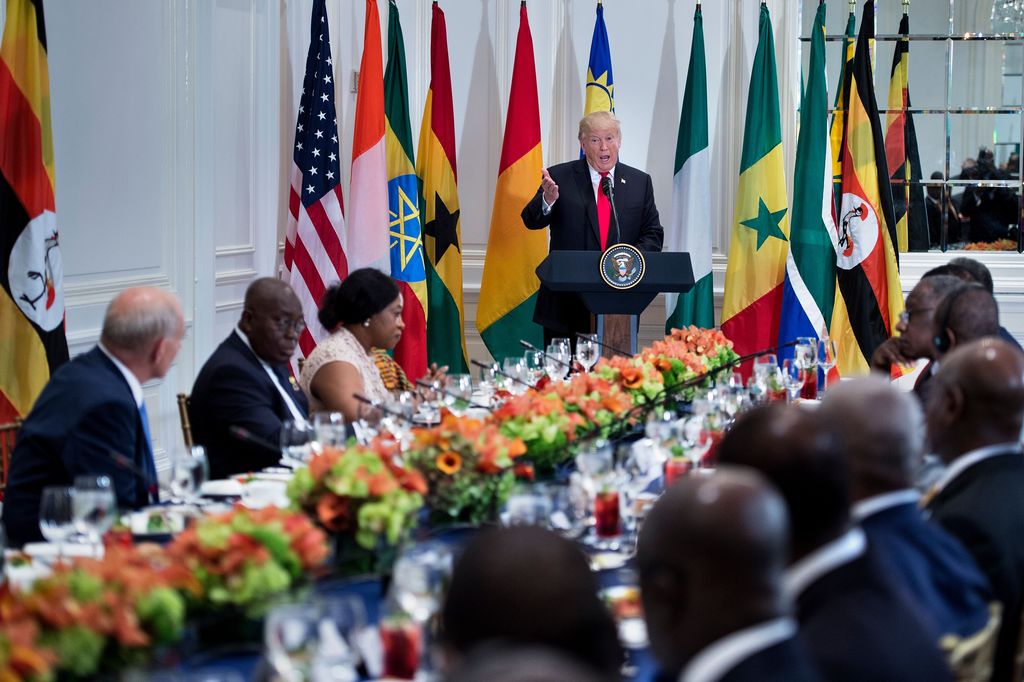
And let’s not forget when he mispronounced the name of Namibia as “Nambia” in a speech recently, merging it with its neighbor Zambia during a lunch with African leaders at the U.N., demonstrating his professorial command of African geography and broad knowledge of the world community.
But my personal favorite however, just due to his stunning lack of sensitivity and consciousness, was when he said that Africa had tremendous business potential and that he had “so many friends going to your countries, trying to get rich.”
Talk about landing with a thud!
Africa is at the bottom of the list
All of these however, are just a small sampling of the many awkward miscues that Donald Trump has become famous for since taking the White House.
Those cringe-worthy moments that will replayed time and again after his time in office is up and that will serve as the soundtrack to his presidency for future generations.
All told however, they’re actually more astounding and bewildering than damaging.
But to understand the detrimental impact of Trump’s presidency on the African people, one needs to consider some of the more quantifiable moves he has made. The ones measured in dollars and guns.
As the old expression goes; “watch what they do, not what they say.”
In his recent 2018 budget, Trump has been clear that, globally, he is prioritizing defense spending and fighting terror over diplomacy and foreign aid.
This was evidenced by the US$700 billion dollar defense bill now pending before Congress – and the simultaneous slashing of the State Department’s budget by over a third.
That’s dangerous math. And because of that, non-defense programs, like much of the aid the United States doles out around the world, will be vulnerable to Trump’s knife.
And he is licking his chops.
This is where Africa is going to take a giant hit.
To Donald Trump, Africa is at the bottom of the list. Its value to the U.S. is easily quantifiable and narrowly defined; fighting al-Qaeda, al-Shabaab, Boko Haram and ISIS. And to fund it all, Africa’s aid programs will have a giant, red bullseye right in the middle of their figurative foreheads.
Already, among other programs, George Bush’s massively successful President’s Emergency Plan For AIDS Relief (PEPFAR) program is in the cross-hairs, with Trump slashing it by 17 percent – which will drastically impact the fight against AIDS and could result in millions more African’s becoming infected, with many of them ultimately dying.
He is also looking to cut USAID by over one third meaning that much of the development assistance received by Africa will be significantly diminished as well.
And while Trump is cutting foreign aid and humanitarian programs in Africa, he is at the same time flexing U.S. military and financial muscle to fight terror there.
The Pentagon has already seen significant success fighting ISIS in Iraq. Trump’s military policies are working there. But the global war on terror has multiple fronts and Africa is central to the fight.
And as in the Middle East, the U.S. cannot risk allowing terrorism to continue to fester and spread on the continent. This would not only result in the deaths of many Africans, but would ultimately be exported to the West as well. He needs to win in Africa too.
Reckless and short sighted
But foreign policy is not all or nothing – certainly not when it comes to one’s allies. Foreign policy is a balance of interests. Support and aid come in many forms, not just high-tech attack aircraft, missiles and troops. And on a continent with so many needs, and nearly 15 percent of the world’s population, pulling the plug on vital humanitarian and health programs that millions of Africans have come to count on is both reckless and short sighted.
George W. Bush, for example, during his first term, focused on ending the bloody civil wars that were raging in Angola, Congo, Liberia, Sierra Leone and Sudan. By the beginning of his 2nd term, with the majority of those conflicts having ended, he was able to launch aggressive development and humanitarian programs focused on lifting Africa and its people back up.
And Barack Obama, while he also stepped up the war on terror in Africa, launched “Power Africa” which addressed the crippling lack of power across the continent although the results have been mixed to date.
The difference between Trump’s approach to foreign policy and that of his predecessors is clear. With Bush and Obama, there was a balance. It wasn’t all or nothing. They both flexed U.S. military muscle where it was needed. But they also focused money, manpower and know-how on the humanitarian side designed to help the African people out of poverty and address the many challenges faced by the continent.
Trump, by contrast, is looking at only one half of the equation.
With 233 million people in sub-Saharan Africa facing dangerous levels of hunger and malnutrition, and over 23 million African’s impacted by HIV/AIDS, and education and illiteracy rates at record levels compared to other parts of the world, Africa should be the last place that these programs are cut, not the first.
In all likelihood, Trump will not be voted into a 2nd term in office given the current political climate in the U.S. and his record unpopularity among the electorate.
His favorability rating is at a mere 35 percent which is the lowest of any modern day president by far. He has alienated friend and foe alike.
And although he still has 3 years left to serve, one can only hope that whoever occupies the White House in 2020, whether Democrat or Republican, will reverse many of Trump’s draconian initiatives and have a more balanced – and more humane – view of foreign policy toward Africa.
David S. Levin is the Managing Partner of Nexus Capital Markets, LLC
