
Business
Taofick Okoya and his Queens of Africa dolls have outsold Barbie in Nigeria – intends to capture African market
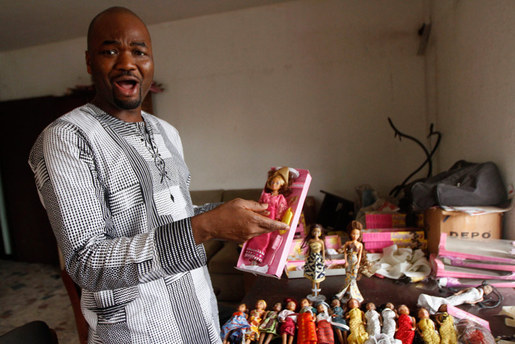
Taofick Okoya the founder and creator of the Queens of Africa dolls brand was frustrated a few years ago, by the lack of variation for dolls of color. So, he decided to create a line of dolls his daughter and nieces would better identify with.
The 43-year-old Okoya spotted a gap in the market and with little competition from foreign firms such as Mattel Inc., the maker of Barbie, he set up his own business. He outsourced manufacturing of doll parts to low-cost China, assembled them onshore and added a twist – traditional Nigerian costumes. Okoya’s Queens of Africa dolls come in a wide range of skin tones, hair styles, and eye colors, and the traditional garments of the women of the Igbo, Yoruba, Hausa ethnic groups of Nigeria are represented.
Seven years on, Okoya has captured 10-15 percent of a fast-growing market.
“I like it,” said five year-old Ifunanya Odiah, struggling to contain her excitement as she checked out one of Okoya’s dolls in a Lagos shopping mall. “It’s black, like me.”
While multinational companies are flocking to African markets, Okoya’s experience suggests that, in some areas at least, there is still an opportunity for domestic businesses to establish themselves by using local knowledge to tap a growing, diverse and increasingly sophisticated middle class.
There is no doubt about Nigeria’s economic potential. Economist Jim O’Neill has this year popularised it as one of the “MINT” countries – alongside Mexico, Indonesia and Turkey – that he sees as successors to the first wave of emerging markets he dubbed the BRICS (Brazil, Russia, India, China and South Africa).
With around 170 million people, Nigeria is Africa’s most populous country by far, and its economy is growing at about 7 percent, and has surpassed South Africa as the continent’s largest.
While Western economies struggle, the appeal of emerging markets for toymakers is clear. Between 2006 and 2011, developed countries saw toy sales grow just 1 percent a year, versus 13 percent in emerging markets, according to Euromonitor data.
