
Business
South Africa’s Jacob Zuma visits Nigeria seeking closer trade and investment ties
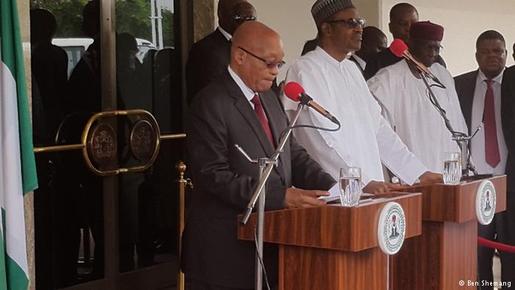
Africa’s two biggest economic rivals – Nigeria and South Africa – are turning to each other as they fall on tough economic times.
Nigeria has been hit by a collapse in oil revenue – largely because of a drop in global prices – while South Africa’s economy is threatened with recession as demand from China, its main trading partner, weakens and commodity prices plunge.
To weather the global storm, the 2 countries are seeking closer trade and investment ties. South African President Jacob Zuma led a high-level delegation of ministers and business executives to Nigeria on Tuesday, looking to rebuild a relationship that has come under diplomatic strain in the past.
Nigeria is Africa’s largest economy – having overtaken South Africa in 2014, but South Africa still dominates because of better power and transport infrastructure, a sophisticated financial services industry and a more diversified economy.
Both economies are now under pressure, with growth slowing to 3.3 percent in Nigeria, and 1.3 percent in South Africa.
On Tuesday the Nigerian Bureau of Statistics said the country’s economic growth slowed to 2.11 percent in the fourth quarter of 2015 from 5.94 percent a year earlier as a result of lower oil prices.
South Africa is the biggest buyer of Nigerian oil in Africa, shipments of which have more than doubled between 2008 and 2014, however, Nigeria does not even feature in the top 20 of South Africa’s export markets.
“There is scope for the 2 countries to expand trade ties, particularly in non-commodity products,” said William Jackson, a senior emerging-markets economist at Capital Economics in London. There could “be greater benefits over the medium term, as rising trade in non-commodity goods tends to come alongside faster productivity growth and more rapid rises in incomes”, he said.
The one thing standing in the way of stronger trade ties is the Nigerian currency – the naira. The Bank of Nigeria central bank has effectively pegged the naira at 197 to 199 per U.S. dollar for a year by banning imports of everything from glass to wheelbarrows, and restricting foreign currency supply. The currency controls are deterring South African investors, such as Truworths International, which shut its 2 remaining stores in Nigeria in January.
In his first state visit since Muhammadu Buhari was elected Nigeria’s president last year, Zuma was expected to seek to resolve a dispute that threatens the Nigerian operations of one of South Africa’s biggest companies, MTN. Nigeria’s telecommunication regulator imposed a record US$3.9 billion fine on MTN last year for failing to meet a deadline to disconnect unregistered mobile-phone subscribers.
Even before that, diplomatic relations between the 2 countries were strained by xenophobic tensions in South Africa last April, in which Nigerian businesses were attacked. Nigeria temporarily withdrew its 2 most senior diplomats from South Africa at the time.
“These two countries need this competitive kind of relationship, where they co-operate even though they are competing,” said Azwimpheleli Langalanga, a visiting research fellow in the economic diplomacy department at the South African Institute of International Affairs.
Nigeria has com of age and wants “to be taken seriously because they are a serious player on the African continent,” he added.
Source: Bloomberg
