
Sport
Serena Williams upset in US Open finals
NEW YORK (AP) – Already being outplayed by Sam Stosur in the U.S. Open final, the last thing Serena Williams needed was to lose a game for yelling during a point…
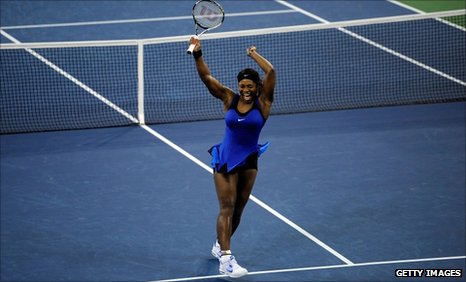
Tournament director Brian Earley said Asderaki’s ruling was proper.
But Williams had trouble putting the whole episode behind her.
During the changeover two games later, Williams continued to talk to Asderaki, saying, “You’re out of control. You’re a hater, and you’re just unattractive inside. And I never complain. Wow.”
Williams also told the official: “Really, don’t even look at me.”
When Stosur wrapped up the match with a forehand winner, Williams refused the customary post-match handshake with the chair umpire.
“I hit a winner, but I guess it didn’t count,” Williams said during the trophy presentation. “It wouldn’t have mattered in the end. Sam played really well.”
Asked after the match about being awarded the point because of Williams’ shout, Stosur said: “I was just kind of there, realizing what was happening. It had never happened to me before. I was trying to see what was happening. I’m aware of the rule. Obviously, it was something I’d never had to deal with before.”
Williams went over to talk to Asderaki, saying, “I’m not giving her that game.”
This sort of thing has happened before at the U.S. Open to Williams, who won the tournament in 1999, 2002 and 2008.
In the 2009 semifinals against Kim Clijsters, Williams was called for a foot-fault that set her off on a profanity-laced outburst at a line judge. Williams lost a point there, and because it came on match point, Clijsters won. That led to an immediate $10,000 fine from the U.S. Tennis Association (USTA) and later a record $82,500 fine from the Grand Slam administrator, who also put Williams on a “probationary period” at Grand Slam tournaments in 2010 and 2011.
A poor call during Williams’ 2004 U.S. Open quarterfinal loss to Jennifer Capriati was cited as a main reason for the introduction of replay technology in tennis.
Because of rain during this year’s tournament, the women’s final was pushed from Saturday night to Sunday. It was preceded by a moment of silence in memory of the victims of the Sept. 11 terrorist attacks, “9/11/01” was painted in white next to the blue court to commemorate the 10th anniversary, and the U.S. flag atop Arthur Ashe Stadium was at half-mast.
A couple of hours before stepping on court, Williams tweeted: “My Thoughts and prayers to all who lost loved ones on 9-11. I know the entire country is with you today. I’m playing for you today.”
Stosur was playing in only her second major final, she was the runner-up at the 2010 French Open, while Williams was in her 17th.
For all of her edges in experience, Williams was the one who started a bit shakily. She was back in action less than 18 hours after winning her semifinal over No. 1 Caroline Wozniacki on Saturday night, and Williams’ game was sleepy.
Her serve, usually one of her top shots, was problematic, slower and less accurate than usual: Only three of her initial 14 first serves landed in, and they hovered around 100 mph.
Williams pushed a backhand long to get broken and fall behind 2-1. And she dumped a backhand into the net to lose serve again, making Stosur’s lead 5-2. When Stosur smacked a forehand winner moments later, she had taken 12 points in a row and owned the first set.
That was the first set Williams had lost in seven matches during this U.S. Open, a run that included four victories over women ranked in the top 20. Entering the final, Williams was 18-0 on hard courts this season, a full-throttle comeback after missing nearly a full year because of a series of health scares, including cuts on her feet from glass at a restaurant, two foot operations, clots in her lungs and a gathering of blood beneath the skin of her stomach.
She was ranked 175th after a fourth-round exit at Wimbledon, but hadn’t lost since then until Sunday and was seeded 28th at the U.S. Open.
“It’s been an arduous road. Six months ago in the hospital, I never thought I’d be standing here today,” Williams said. “I didn’t think I’d be standing, let alone here.”
Stosur dealt with her own health issues that could have sidetracked her career, and she became the oldest U.S. Open champion since Martina Navratilova was 30 in 1987.
Once a doubles specialist, she’s won Grand Slam titles in women’s and mixed, Stosur only once got past the third round in singles at a major tournament before reaching the 2009 semifinals at the French Open.
Her game has improved dramatically since she returned to the tour in April 2008 after about nine months away while recovering from Lyme disease, a tick-born illness that can affect a person’s joints and nervous system. She was ranked 149th two years ago; on Monday, she’ll rise to No. 7.
Copyright 2011 The Associated Press.
