
News
Piracy off the Coast of Somalia: Addressing the hidden causes
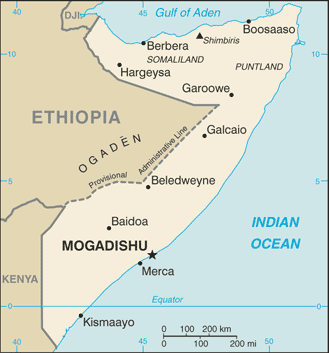
Recent high-profile events, like hostage rescue operations carried out by France and the attempted hijacking of the MAERSK Alabama and the dramatic rescue of her Captain by the U.S. Navy, have focused new attention on the scourge of piracy off the coast of Somalia.
In April of 2009, pirates off the coast of Somalia seized an American ship, the Maersk Alabama, and took Captain Richard Philips hostage. U.S. Navy SEALs staged a dramatic rescue: Snipers aboard a Navy vessel shot the three pirates on the bobbing lifeboat where Captain Philips was being held, ending a five-day standoff. The suspenseful rescue, tailor-made for the era of 24/7 cable news, brought international attention to the issue of piracy off Somalia’s coast. But the roots of Somali piracy took hold years earlier, and the problem is getting worse.
According to the International Maritime Bureau, so far this year, at least 80 commercial cargo ships have been attacked in the 2.8 million square kilometer Gulf of Aden, with 19 successful hijackings. In 2008, there were 111 ships attacked and 42 successful hijackings
In the first nine months of 2009, there were 100 pirate attacks in the waters surrounding Somalia, compared to 51 in the same period the year before.
Piracy is a product of a power vacuum in Somalia; overfishing and chemical dumping in Somali seas have set the stage for these modern-day marauders. To gain some measure of control over the pirate problem, the international community must address the environmental crises pirates use to justify their actions and create a Somali coast guard to help control piracy in the long-term.
The costs of piracy in this region are clear. Somalia lies along some of the world’s most important shipping lanes, and piracy in these lanes raises the cost of international commerce. 11 percent of the world’s petroleum passes through the region, which is colloquially known as “Pirate Alley.” Ships making that journey today pay nearly twice what they would have paid a year ago for ransom insurance, in addition to the cost of increased onboard security. Furthermore, attacks on oil tankers and other ships carrying hazardous materials raise the possibility of a serious environmental disaster in the region. Finally, the possibility that piracy could fund terrorism represents a significant threat to the many nations.
How did the current era of Somali piracy begin?
In 1991, Somalia’s government collapsed, and the lack of authority meant that all institutions of state are either very weak or non-existent. Somalia’s Gulf of Aden is one of the most fertile fishing grounds in the world, and without a central authority or coast guard, Somalia’s territorial waters are unprotected.
Boats from Europe and Asia illegally reap over $300 million worth of fish per year from Somali seas, depriving local fishermen of the livelihood of which they once relied. The foreigners often utilize invasive and illegal methods of fishing, such as nets with tight meshes that catch small and young fish.
Without regulation, fish populations have been decimated. When too many individuals fish the same waters, the ecosystem collapses, and Somalis who could have once made their living fishing turn to piracy as an alternative means of livelihood.
