
News
Piracy off the Coast of Somalia: Addressing the hidden causes
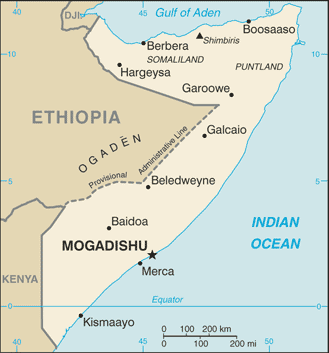
At present, the country is nominally ruled by the Transitional Federal Government (TFG), but other groups, such as the Islamic militia, the Al-Shabbab, constantly challenge the TFG for control.
In the absence of government, there is an absence of opportunity. In such conditions, poverty has driven many to piracy. The profitable life of piracy holds understandable appeal. In 2008 alone, pirates collected more than US$150 million in ransom.
Overfishing off the coast of Somalia has also pushed many Somalis to take part in piracy. The earliest pirates were fishermen who sought to force out commercial ships that plundered Somali waters.
The illegal dumping of toxic waste off Somalia’s coast by European and Asian corporations has only aggravated the problem. The UN Environmental Program (UNEP) notes that dumping hazardous waste in Somalia can cost as little as $2.50 a ton, while disposing of that same waste in Europe can cost $250 a ton. Following the great tsunami of 2004, a significant amount of waste washed up on Somali shores and sickened the local population. By damaging local fisheries, waste dumping makes piracy a more attractive career option. Yet Somalia lacks the resources and institutions needed to prevent this problem, and the international community has done little to help.
Somalia’s dysfunctional government is unable to combat the pirates, and although several nations have dispatched naval patrols to the Gulf of Aden, piracy remains an ever-present threat. The U.S. and the European Union have standing patrols in the region, and China helps escort ships through the treacherous gulf. Yet piracy cannot be eliminated until the Somali government is stable enough to control the problem internally.
In order to combat piracy, the international community must combat not only the pirates but also the aggravating factors that encourage them, such as illegal fishing and toxic waste.
Anti-piracy forces working to protect the seas and prevent the dumping of hazardous waste will earn some measure of good will from Somalis even as they crack down on pirates. By protecting the region from overfishing, the international community can create economic opportunities for those who might otherwise have turned to piracy. Furthermore, pirates will no longer be able to justify their attacks by claiming that they are simply protecting their fishing waters.
Still, piracy is profitable, and managing these environmental issues will not solely eliminate the problem. Most pirates will not lay down their guns and pick up fishing poles as the environmental situation improves. But if U.S. forces and others already in the region begin to protect fisheries, they will deprive pirates of their stated motivation to attack, thus exposing those who continue to board ships as nothing more than common criminals. Pirates need support on land for their operations, and by revealing the pirates’ true motivations, the international community can minimize the backing these buccaneers receive from some elements of the local Somali population.
Piracy in the Gulf of Aden presents a significant threat to global commerce, and there are no simple solutions. Until Somalia has a stable, functional government, pirates will continue to haunt key shipping lanes. But by understanding the circumstances that lead to piracy, the international community can better control these modern-day buccaneers. The lack of central authority in Somalia has paved the way for illegal fishing and the dumping of toxic waste. By controlling these factors, the international community can, over time, undermine Somalia’s pirates.
