
Opinion
Pipeline Politics: Why Africa’s $25 Billion Gas Deal Exposes Its Real Trade Bottleneck
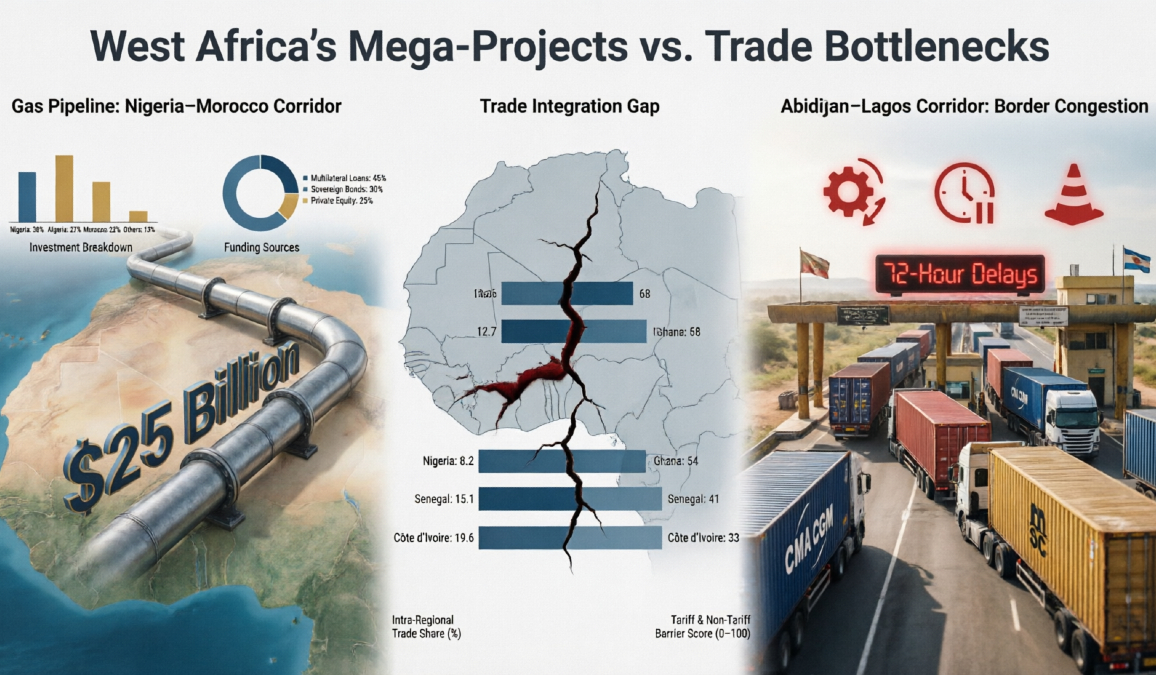
West Africa can align thirteen nations to move gas across a continent. It still can’t get a truck across a border in under three days. That gap isn’t a coincidence – it’s a choice.

By Ziad Hamoui
Thirteen countries have just agreed to build a US$25 billion pipeline stretching from Nigeria to Morocco. It is one of the most ambitious infrastructure undertakings in Africa’s history, threading gas across thousands of kilometers, a dozen jurisdictions, and countless competing national interests.
Meanwhile, on the Abidjan-Lagos Corridor – one of the busiest trade routes in West Africa – a truck can sit at a single border crossing for up to 72 hours.
That contrast is not just striking. It is diagnostic. It tells us almost everything we need to know about the state of regional integration in West Africa today.
The Coordination Nobody Doubts Is Possible
Consider what the African Atlantic Gas Pipeline (AAGP) actually demands. Thirteen sovereign governments must align permits, environmental approvals, security protocols, financing structures, and regulatory oversight across a shared corridor spanning multiple ecosystems, currencies, and legal systems. This is not a modest diplomatic feat. It requires sustained political will at the very highest levels of government.
And yet it’s happening.
Which raises an uncomfortable question: if thirteen countries can align to move gas, why can’t they align to move goods?
Same Ingredients, a Different Priority
Strip away the technical jargon, and trade facilitation requires almost exactly the same building blocks as major energy infrastructure:
- Harmonized regulations
- Coordinated border procedures
- Institutional trust between neighboring states
- Predictable, consistent implementation
- Sustained political leadership over time
The ingredients are identical. What differs is the priority assigned to them. Pipelines command the attention of heads of state. Border delays get handed down to technical committees, where they quietly stall for years—sometimes decades.
This should not be the case. And frankly, it no longer makes sense as a matter of strategy, let alone economics.
Where the Two Agendas Already Overlap
The irony is that the AAGP itself will depend on the very trade infrastructure West Africa has neglected. Heavy construction equipment for the pipeline will need to clear customs efficiently across multiple borders. International investors financing the project will demand regulatory certainty – the same certainty that traders and transport operators have been requesting for years. Security coordination along the pipeline route will run through many of the same corridors used daily by commercial trucking.
In other words, the governance architecture capable of delivering a continent-spanning pipeline is the same architecture capable of cutting a 72-hour border wait down to a few hours. West Africa doesn’t need two separate agendas here. It needs one integrated strategy that treats energy infrastructure and trade facilitation as two expressions of the same underlying capability.
The Real Test of Political Ambition
The AAGP proves something important: West Africa has the institutional capacity to coordinate at scale when the stakes are high enough. Thirteen governments can move in the same direction when there’s sufficient political appetite.
The real question isn’t whether that capacity exists. It’s whether West African leaders are willing to apply the same ambition to the unglamorous, daily work of moving goods across borders – the trucks, the customs officers, the paperwork, the waiting.
Because regional competitiveness isn’t built by energy infrastructure alone. It’s built by the everyday movement of trade – reliably, predictably, and without a truck driver losing three days of his life at a checkpoint.
Let’s keep pushing for the Africa we all want: peaceful, prosperous, and genuinely integrated – one border crossing at a time.
Ziad Hamoui is the Co-Founder and Past President of the Borderless Alliance, a leading private-sector advocacy group promoting economic integration and removing trade and transport barriers in West Africa. With extensive experience in Ghana’s road transport, logistics, and shipping sectors, he currently serves as Executive Director of Tarzan Enterprise Ltd., a long-established family business. He is a former Co-Chair of the Africa Food Trade Coalition, Co-Founder of the Trade Facilitation Coalition for Ghana, and serves on multiple high-level advisory committees on trade, transport, agriculture, and security. A Chartered Fellow of the Chartered Institute of Logistics and Transport (CILT) Ghana, he is also a former member of its Governing Council.
