
Opinion
Friend or Foe? How the UAE Is Expanding Its Influence Across Africa
Abu Dhabi isn’t colonizing Africa in the old sense. It’s doing something more modern – and, in some ways, more effective.

By Mark-Anthony Johnson
For decades, the story of foreign influence in Africa was told as a contest between old imperial powers and rising ones: Britain and France giving way to China and, more recently, Russia’s mercenaries. That narrative now needs a new chapter.
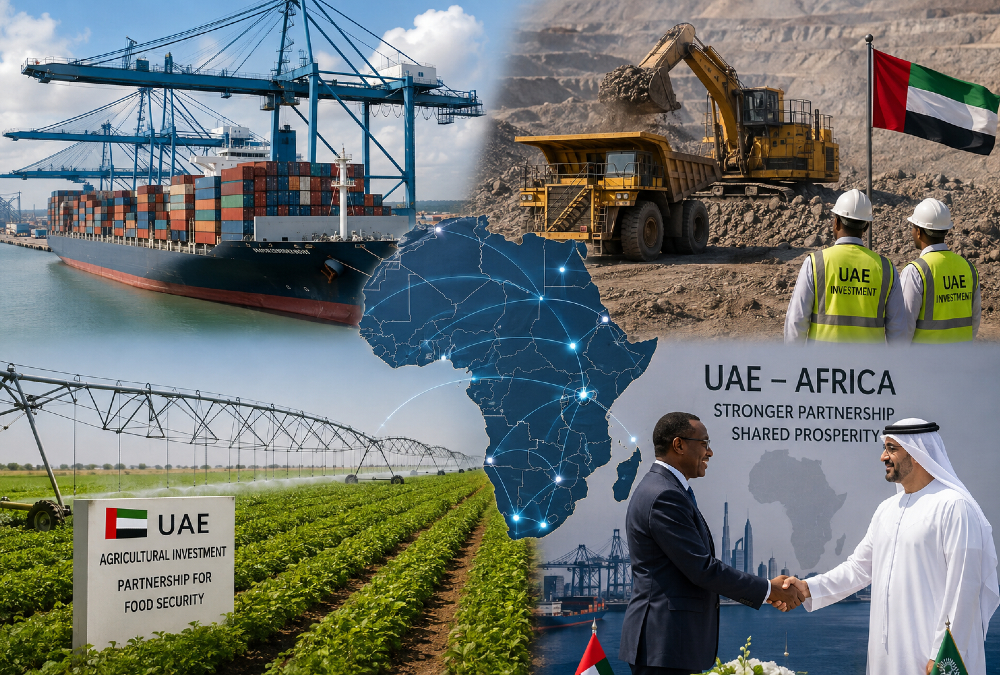
The United Arab Emirates, a federation of seven sheikhdoms with a population smaller than metropolitan London’s, has quietly become one of the most consequential foreign actors on the African continent. It is not doing so through flags or colonial administrators. It is doing so through ports, gold, farmland, and, increasingly, guns.
From Oil Wealth to Continental Strategy
The UAE’s ambitions in Africa are best understood not as a series of opportunistic deals but as a deliberate, long-horizon strategy – what might be called “system-building.” Under the direction of President Sheikh Mohamed bin Zayed al-Nahyan (MBZ), Abu Dhabi has spent the past decade constructing an interlocking web of commercial, logistical, and military relationships that stretches from the Red Sea to the South Atlantic. The goal is not territorial conquest but something arguably more durable: control over the arteries through which African trade, resources, and capital flow.
This is a strategy born of necessity. With domestic oil reserves that, however vast, will not last forever, the UAE has been racing to diversify its economy and secure the resources it lacks at home – chiefly food, water, and industrial minerals. Africa, with its underdeveloped infrastructure and abundant raw materials, has become the natural theater for that ambition.
Controlling the Arteries of Trade
Rather than governing territory directly, the UAE has positioned itself as an indispensable gatekeeper of global supply chains, with Dubai as the hub through which African trade increasingly passes.
State-backed conglomerates DP World and AD Ports Group have served as the spearhead of this maritime push. Emirati capital has funded a US$1 billion upgrade of the port of Dar es Salaam in Tanzania and modernized terminals in Luanda, Angola – investments that give Abu Dhabi leverage over some of the busiest shipping lanes on the continent.
The resource dimension is equally aggressive. Facing acute domestic shortages of arable land and fresh water, the UAE has turned to African mining and agriculture with striking intensity.
Dubai has become the world’s principal clearinghouse for African gold, reportedly receiving some US$30 billion worth of undeclared gold each year – much of it smuggled out of conflict zones with little regard for its provenance. At the same time, Emirati firms have expanded aggressively into critical mineral ventures in the Democratic Republic of Congo, positioning the UAE as a rising player in the global race for the materials that power electric vehicles and renewable energy.
When Commerce Becomes Combat
What distinguishes the UAE’s approach from more conventional investment strategies is how readily its economic footprint blurs into military intervention – and how little accountability follows. In several of Africa’s most fragile states, Emirati involvement has moved from financing to firepower.
Nowhere is this more visible, or more damaging, than in Sudan. The UAE stands accused by Sudan’s military and by international observers of arming and bankrolling the paramilitary Rapid Support Forces, led by Mohamed Hamdan Dagalo, known as “Hemedti.” The alleged price of that support: privileged access to Sudan’s fertile farmland and its gold mines. Abu Dhabi denies the allegations, but the pattern is difficult to ignore, and the human cost has been severe – Sudan’s war has displaced millions and pushed parts of the country toward famine.
A similar logic has played out in the Horn of Africa, where the UAE has skillfully exploited regional fragmentation. Bypassing Somalia’s internationally recognized federal government, Abu Dhabi struck independent port and military logistics agreements with the breakaway territories of Somaliland, at Berbera, and Puntland, at Bosaso.
These deals have quietly reshaped the security architecture of one of the world’s most strategically vital waterways, the southern gateway to the Red Sea.
The Coalition Pushing Back
Emirati assertiveness has not gone unanswered. A rival bloc – anchored by Saudi Arabia, Egypt, and Somalia – has begun mounting a coordinated response to what it sees as Abu Dhabi’s overreach.
Somalia has taken the most direct action, moving to curb Emirati influence in parts of Puntland and Somaliland. Egypt, for its part, flatly rejected a UAE bid to acquire a stake in the strategically vital port of Alexandria, a clear signal that Cairo intends to guard its own commercial chokepoints.
Saudi Arabia, meanwhile, is playing a longer game. Riyadh has pledged US$1 billion to rehabilitate Eritrea’s port of Assab – the very facility the UAE once dominated and used as a staging ground for its own regional operations. The message is unmistakable: the Saudis intend to contest, rather than concede, Emirati primacy along the Red Sea corridor.
A New Model of Influence – And Its Limits
What makes the UAE’s approach to Africa so consequential is precisely what makes it so hard to counter. There is no army of occupation to expel, no colonial governor to depose. Instead there are port concessions, mining licenses, and gold shipments – instruments of influence that operate within the language of commerce even as they reshape the sovereignty of the states involved.
For African governments, particularly those in conflict or transition, the appeal of Emirati capital is obvious: it arrives quickly, with fewer of the governance conditions attached to Western or multilateral financing. But the costs are becoming equally clear, from Sudan’s devastating civil war to the fracturing of Somali sovereignty. The emerging resistance from Cairo, Riyadh, and Mogadishu suggests that the UAE’s free run across the continent may be entering a more contested phase.
Whether Abu Dhabi adapts to that pushback, or presses on regardless, will do much to determine not only the UAE’s standing in Africa but the broader question of what twenty-first-century influence looks like when it is exercised through balance sheets rather than battalions.
Mark-Anthony Johnson is the founder and CEO of JIC Holdings, a global asset and investment management firm founded in 2009. With over 30 years of experience and strong ties to Africa, his investments span mining, infrastructure, power, shipping, commodities, agriculture, and fisheries. He is currently focused on developing farms across Africa, aiming to position the continent as the world’s breadbasket.
