
Opinion
ECOWAS’s New Leadership: Three Trade and Private-Sector Priorities for a Bolder Region

By Ziad Hamoui
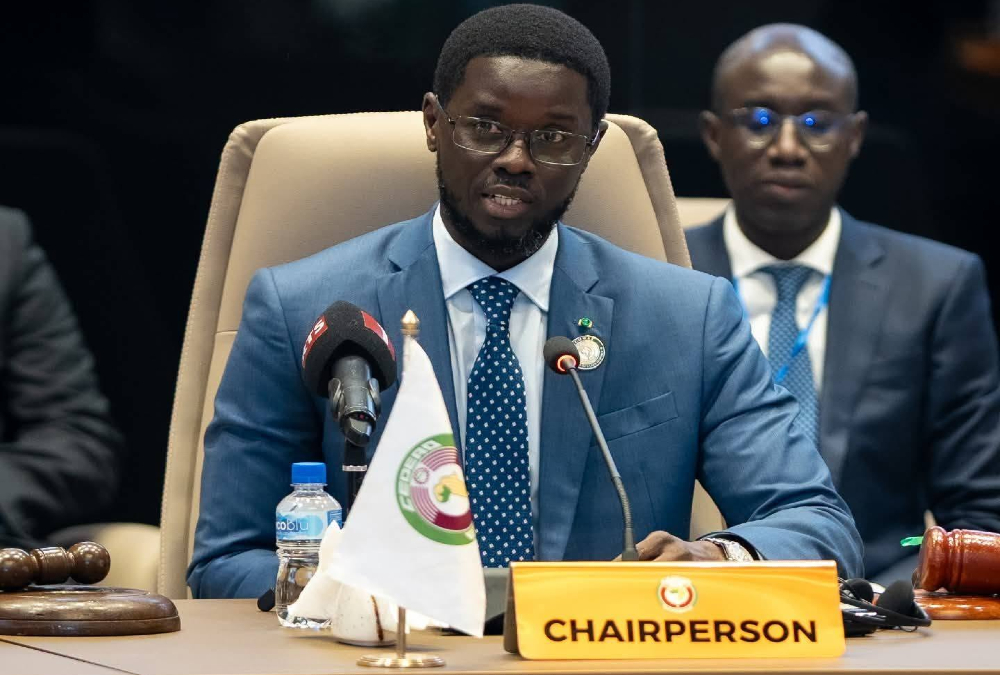
West Africa just changed hands at the top. The 69th ECOWAS Summit in Freetown handed the regional chairmanship to President Bassirou Diomaye Faye, and on September 1st General Birame Diop will take over as President of the ECOWAS Commission. New leadership brings a familiar ritual: communiqués, courtesy calls, and a slow drift toward business as usual.
Before that drift sets in, it is worth putting three priorities on the table – not from a diplomat’s perspective, but from a private sector one. These are the issues that determine whether a trader in Lagos, Lomé, or Accra can actually move goods and money across a border, rather than around one.
1. Scale What Already Works: Smart Enforcement
Skepticism about African border reform is usually earned. So it is worth pausing on what Nigeria and Benin just pulled off. Operation GEOCONTROL, the World Customs Organization’s first geospatial intelligence-led border operation in the region, ran for eight days and produced 37 seizures – using drones, GIS mapping, and real-time data exchange between agencies that do not always share a filing cabinet, let alone a database.
This matters beyond the seizure count. It is proof of a principle the Borderless Alliance has argued for years: technology can catch smugglers and speed up legitimate trade at the same time. These are not competing goals. The new ECOWAS leadership should pair this enforcement model with trusted trader programs on the region’s major corridors, so that compliant operators are rewarded with predictability rather than treated with the same suspicion as everyone else. Every hour shaved off a border crossing shows up later as a lower price on a shelf and a more competitive region overall.
2. Give PAPSS the Political Push It Needs
The Pan-African Payment and Settlement System, PAPSS, is not a pilot project anymore. It is live in 28 countries and connected to more than 190 commercial banks. And yet, by Afreximbank’s own account, central bank resistance remains the system’s principal bottleneck.
This is not an abstract plumbing problem. For a small trader paying a supplier in Lomé or Dakar, the ability to settle in local currency is not a convenience – it is the difference between trading regionally and not trading at all. Ghana’s first formal survey of informal cross-border trade found that somewhere between 37 and 61 percent of bilateral trade happens outside official channels, with foreign-exchange friction as a direct cause. That is a staggering share of economic activity operating in the shadows because the formal system has not made itself worth using.
Technical committees will not fix central bank resistance. ECOWAS heads of state can, through direct political engagement. This is precisely the kind of high-level, high-leverage problem that a new Chair and a new Commission President should make an early priority – not because it is easy, but because almost nothing else on the regional agenda will matter as much to ordinary traders.
3. Treat Soft Infrastructure as Infrastructure
The region is mobilizing serious capital: the US$15.6 billion Abidjan-Lagos Corridor, the Ghana-Burkina Faso railway, and more. These investments are necessary and welcome.
But a new road lined with 30 checkpoints, paper transit documents, and inconsistent customs codes is not a functioning trade corridor. It is expensive tarmac. Concrete and steel get the headlines; harmonized procedures and digital transit systems do not. The new Commission needs to treat the latter as part of the infrastructure program itself, not as a follow-up phase to be addressed once the roads are paved. A corridor is only as fast as its slowest checkpoint, no matter how smooth the asphalt is on either side of it.
A Region Worth Betting On
President Faye and President-designate Diop inherit an institution with real momentum: a functioning payment system, a proven enforcement model, and billions of dollars of infrastructure under construction. What is missing is the political will to connect the pieces – to let technology enable trade rather than merely police it, to make regional settlement the default rather than the exception, and to treat the rules of the road as seriously as the road itself.
Congratulations to both incoming leaders. The private sector is ready to engage. Let’s keep pushing for the West Africa we all want.
Ziad Hamoui is the Co-Founder and Past President of the Borderless Alliance, a leading private-sector advocacy group promoting economic integration and removing trade and transport barriers in West Africa. With extensive experience in Ghana’s road transport, logistics, and shipping sectors, he currently serves as Executive Director of Tarzan Enterprise Ltd., a long-established family business. He is a former Co-Chair of the Africa Food Trade Coalition, Co-Founder of the Trade Facilitation Coalition for Ghana, and serves on multiple high-level advisory committees on trade, transport, agriculture, and security. A Chartered Fellow of the Chartered Institute of Logistics and Transport (CILT) Ghana, he is also a former member of its Governing Council.
