
Opinion
East Africa Has the Pieces for an Industrial Boom. It Lacks the Glue.
Southern Africa is learning to connect minerals, power and factories into a single strategy. East Africa has nearly every piece already – scattered across a dozen different files.

By Apollo Buregyeya
Something unusual happened in Durban this week. Leaders of the Southern African Development Community (SADC) gathered under a summit theme that, for once, sounded less like a diplomatic greeting card and more like the table of contents of an industrial plan: infrastructure, agriculture, and critical minerals, tied explicitly to industrialization. Regional summits are not famous for saying anything so specific. This one did.
The instinct behind it is correct, and it is worth spelling out why.
A Mine Without a Smelter Is Just a Hole
A mine without processing capacity is not a strategic asset. It is a hole in the ground from which opportunity is exported, usually at the lowest point in the value chain, to be refined and sold back at a markup somewhere else.
A railway built without factories at either end is not infrastructure for industrialization; it is an efficient conveyor belt for moving raw opportunity to a port. And cheap electricity, absent industries that actually use it productively, mostly succeeds in air-conditioning shopping malls stocked with goods manufactured somewhere else entirely.
Even the most cherished tool of regional economics – the customs union – has a hard limit. Customs officers are very good at removing tariffs. They cannot manufacture a tractor, refine a kilogram of copper, or build a pharmaceutical plant.
Strip away the paperwork of trade, and what’s left is the question nobody wants to ask out loud: without a shared production strategy, does a customs union simply become a more efficient distribution network for factories that were built somewhere else?
What SADC Is Trying To Solve
SADC’s answer, still taking shape, is the operationalization of a Regional Development Fund designed to finance projects that no single member state could pull off alone. The logic underneath it deserves attention: industries are not built by isolated national projects bolted together after the fact.
They are built by systems that deliberately cross borders – minerals sourced in one country, power generated in another, processing done in a third, transport running through a fourth, and customers spread across all of them.
That is a genuinely different way of thinking about regional cooperation. It treats the region itself as the unit of industrial design, not the nation-state.
East Africa’s Missing Connective Tissue
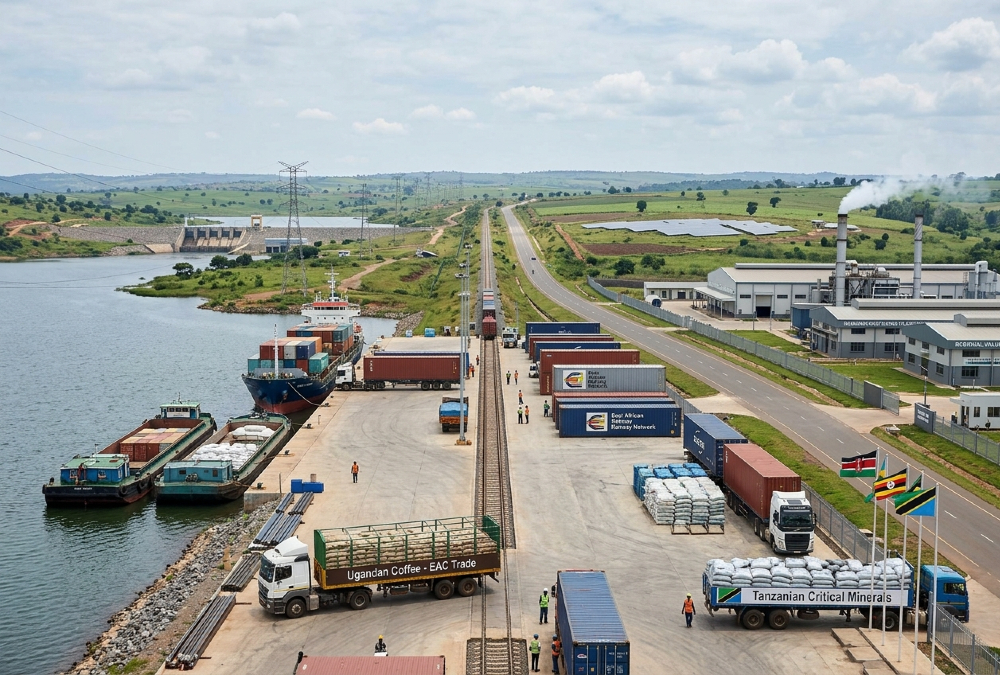
Here is the uncomfortable comparison for East Africa: we are not short of the ingredients. The East African Development Bank exists. An EAC Development Fund framework exists. The Eastern Africa Power Pool exists. We have already identified the regional value chains that matter most – agro-processing, mineral processing, pharmaceuticals, iron and steel. On paper, East Africa arguably has more of the dots than SADC does.
What we don’t have is the glue.
The next phase of East African integration needs to move past listing shared ambitions and start financing the corridors that connect them to specific industries. That means tying regional electricity trading deliberately to mines, factories, and processing zones, rather than treating power pooling and industrial policy as separate conversations run by separate ministries.
It means establishing common standards for mineral processing, product quality, and certification, so that a good manufactured in Kigali or Kampala can move through the region as easily as a customs declaration currently does. It means public procurement and investment incentives that actively reward regional inputs and regional suppliers, instead of remaining neutral – or worse, indifferent – about where a product’s components originally came from. And it means our regional financing institutions need to be capitalized at a scale that matches regional ambition, not merely national convenience.
The Real Measure of Integration
Regional integration, done properly, organizes production. It does not simply facilitate trade after someone else has already done the manufacturing. That distinction is not academic; it is the whole point.
The right measure of success for East African integration is not how quickly a shipping container clears customs on its way from the port at Mombasa or Dar es Salaam across our internal borders. Speed at the border is a trade metric, not an industrial one. The real measure is how much of what’s inside that container was actually mined, grown, financed, processed, designed, and manufactured within East Africa itself.
SADC is joining the dots. East Africa already has most of them. What remains is to stop admiring them in separate policy documents – and start connecting them into one plan.
Apollo Buregyeya, Ph.D., is a civil engineer and entrepreneur focused on developing sustainable African industries that leverage local mineral resources to improve living standards. He is the founder and CEO of Eco Concrete Ltd, a construction company specializing in innovative solutions tailored to the African environment. Committed to resource ownership and appropriate technology for value creation, he also teaches at Makerere University in Kampala, Uganda.
