
Business
Commercial lending push at Black-owned banks yielding results
Black-owned banks are beginning to find seats at the tables where corporate transactions are brokered.
After decades of operating on the periphery of financial services, Black-owned banks are beginning to find seats at the tables where corporate transactions are brokered.
Two large construction loans – one involving multiple Black-owned financial institutions and another split between Citigroup and a minority-run lender – were announced last week, and some of the architects of these deals say they are pushing for more transactions like these.
Citi is developing opportunities to make corporate transactions accessible to Black-owned banks, said Harold Butler, a managing director of the public-sector group inside the company’s investment bank.
“We are working with clients to address the hurdles in place around qualification,” Butler said. “Several corporates have expressed interest, so we are creating a framework to kind of plug them in.”
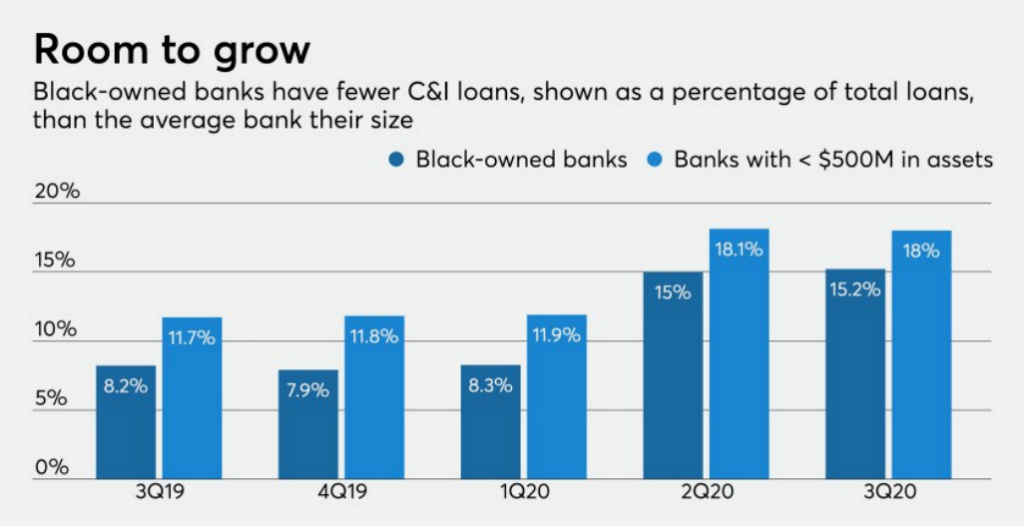
Image source: Federal Deposit Insurance Corporation
Last week, the National Basketball Association’s Atlanta Hawks announced a groundbreaking deal with a syndicate of Black-owned banks, which will provide US$35 million to refinance the construction loan on the 90,000-square-foot Emory Sports Medicine Complex that houses the franchise’s practice facility. The Hawks’ loan marks the first time a professional sports team has obtained financing exclusively from Black-owned banks, according to the NBA.
Earlier in the week, Citigroup announced a participation arrangement with Houston-based Unity Bank on a US$13.95 million loan financing construction of affordable housing. The US$133.6 million-asset Unity is contributing US$1.95 million.
Citi’s overarching goal is to help Black-owned banks build a portfolio of new clients and attract investor capital. “Everything we are doing is setting them up for success around driving new lines of revenue and increasing their visibility,” Butler said.
The African American banking sector has shrunk to 18 institutions, none holding more than US$1 billion of assets. Many Black-owned banks have grappled with capital and profitability issues for years, but in the months since George Floyd’s death and the unrest that followed, the banks’ difficulties have attracted a new level of attention within – along with significant pledges of support from – the banking industry.
In September, for example, Bank of America pledged to invest US$50 million in Black and Hispanic banks, part of a broader US$1 billion effort to address racial and economic inequality. Since then, Bank of America has completed 10 equity investments in Black-owned banks.
At the same time that prominent financial institutions have moved to assist Black-owned banks, many of their corporate clients and partners have asked where they could help, according to Butler. “We are advising them to consider opportunities like supplier finance,” Butler said. “We are working with a couple of customers today on supplier financing and creating opportunities for these – minority depository institutions – to get involved and be the bank that will discount that receivable to their suppliers.”
The consulting giant Deloitte has offered to advise Black-owned banks as they seek to upgrade their digital offerings, Butler added. “As they strategize and work with their boards on what tomorrow looks like, they now have tools that can help make them much more effective,” he said.
Hawks Principal Owner Tony Ressler said Thursday that a desire to use the team’s cash “to help the community” played into the decision to direct the refinancing to the Black bank syndicate led by the US$48.4 million-asset Carver State Bank in Savannah, Georgia.
“We couldn’t be more proud” of the deal, Ressler said. “We are doing business with a group of banks that are well capitalized and running a strong business.”
Robert James, director of initiatives at Carver, said he and his colleagues are eager for the next deal.
“This is a real transaction that adds to our bottom line. We want to do more of them,” James said.
Most Black-owned banks made progress in commercial lending this year, but it was off a low base and largely because of participation in the Paycheck Protection Program.
Commercial-and-industrial loans at Black-owned banks more than doubled over the first nine months of this year to US$535 million, according to data compiled by the Federal Deposit Insurance Corporation (FDIC). By comparison, C&I loans at all banks with assets of US$500 million or less increased by 40 percent over the same period.
C&I loans at Carver Federal Savings Bank in New York have quadrupled this year, while Optus Bank in Columbia, S.C., and Liberty Bank and Trust in New Orleans have tripled the size of their commercial portfolios.
American Banker © Copyright 2020
