
Business
Barbados economy contracts by 0.7% in Q1 2018 – Central Bank
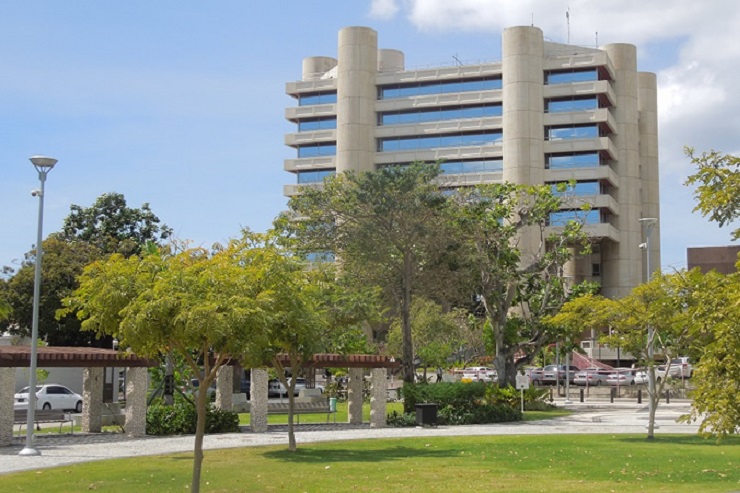
The Bank of Barbados said Wednesday that the local economy had contracted by an estimated 0.7 percent during the first quarter of this year and warned that the outlook for the economy “remains challenging”.
Bank of Barbados Governor, Cleviston Haynes, presenting the financial institution’s review of the country’s economic performance in the first quarter of 2018, said that the performance reflects the combined impact of a decline in real output in the tourism sector, the slowing of construction activity, the late start to the annual sugar harvest and the slowdown of domestic demand arising from the budgetary measures announced in the May 2017 budget.
The Bank of Barbados said that the supply of foreign exchange was more than adequate to meet market demand on a timely basis during the quarter, thus enabling foreign exchange dealers to sell some of their surpluses to the Central Bank.
“However, higher public sector debt service obligations than usual contained the growth of international reserves to BDS$14 million (US$7 million) for the period,” the central bank said, adding that as a result, the import cover of 6.9 weeks at the end of March remained below the 12-week minimum holding that the bank considers as adequate.
Modest Improvement
The central bank – which also doubles as the island-nation’s financial services regulator – said that the government’s fiscal consolidation efforts during the financial year 2017-2018 led to a modest improvement in the primary balance and an overall reduction in the fiscal deficit from the previous year, but there was a significant deviation from the targeted outcome.
The Bank of Barbados said that decisive stabilization measures that place the public finances on a sustainable path, alter the trajectory for the international reserves and create the conditions for strong durable growth are now needed in order to deal with the challenges ahead for the local economy.
It said addressing the public finances remains a priority so as to stabilize and ultimately grow the economy.
“Our efforts to date have not resulted in bringing the fiscal deficit to a manageable level. The demand for local Government securities has declined and the excess of external debt service over external borrowings continues to create added financing pressure.”
“The impact of these developments in recent years has been a build-up of domestic arrears and increased reliance on Central Bank financing. The current borrowing requirement for fiscal year 2018/2019 therefore needs to be reduced,” the statement from the financial regulator added.
It said that the task at hand is to implement a strategy that reduces the current year deficit, builds the platform for strengthening the public finances over the medium-term and fosters an environment that creates access to external funding.
“In addition, we need to create the fiscal space to enable infrastructural development that promotes long-term growth. In these circumstances, improving the outlook requires Government’s fiscal strategies to embrace durable expenditure reforms, including for state-owned enterprises and improved tax administration.”
But the central bank noted that given the estimated downturn in tourism in the first quarter and ongoing delays in project start-ups, it has revised downwards its current growth forecast for 2018 within the range of -0.25 to 0.25 percent.
“This out-turn is likely to be further influenced by the speed and nature of the fiscal adjustment policies and the quantum of new investment. However, the outlook for growth requires an overall policy framework that includes measures to strengthen the business environment, promote competitiveness, spur innovation and encourage emerging sectors, such as alternative energy.”
Tourism
In its review of the economy, the central bank said that real value-added in the tourism sector is estimated to have declined by approximately 1 percent compared to the 4.5 percent expansion in the corresponding period of 2017.
It said that long-stay arrivals rose by 5.8 percent, with data up to February indicating that visitors from the key source markets of the United States, Canada and the United Kingdom were up by 5.1, 10.1 and 6.5 percent, respectively.
However, the strong growth of shorter staying North American arrivals who now account for 42 percent of annual arrivals compared to 36 percent in 2014 was offset by a reduction in the overall average length of stay.
The Bank of Barbados said that overall traded sector activity was also dampened by the delayed commencement of the sugar harvest, partly because of the late receipt of payments by private cane owners for the prior year’s crop. The harvest is expected to be slightly above the level of output in 2017, with production occurring during the second quarter of the year.
In contrast to first quarter growth of 2.3 percent in 2017, activity in the non-traded sectors is estimated to have been flat.
Following its robust performance during the first quarter of 2017, output in the construction sector weakened, the result of the culmination of mainly tourism related projects that supported activity last year, while new tourism-related projects continued to be delayed.
“Preliminary data suggests that the other non-traded sectors were adversely impacted by the fall-off in domestic demand caused in part by the tightening of fiscal policy,” the central bank said noting that the average unemployment rate for the 4 quarters ending December 2017 was 10 percent compared to 9.7 percent for the previous year-end, but the average level of unemployed persons remained relatively stable. -(CMC)
