
Business
Aliko Dangote: Africa’s richest man makes a $17 billion bid for business immortality
By Tom Metcalf and Devon Pendleton
Aliko Dangote’s plan to reduce Nigeria’s dependency on fuel imports will carve out an even bigger slice of the nation’s US$376 billion economy for his empire.
The best way to appreciate the scale of Aliko Dangote’s empire is to hitch a ride on one of his private jets. A half-hour after his Bombardier Challenger 605 takes off from Lagos Airport, it descends into a seemingly desolate area of Kogi State in central Nigeria, dusty fields and clusters of trees stretching to the horizon. Suddenly a tangle of exhaust stacks, silos, and kilns pierces the sky to the left of the aircraft as Dangote Cement Plc’s Obajana plant comes into view. It is already the biggest in Africa, churning out enough sacks of cement to fill 1,000 trucks a day. A 5th production line now under construction will make it one of the world’s largest.
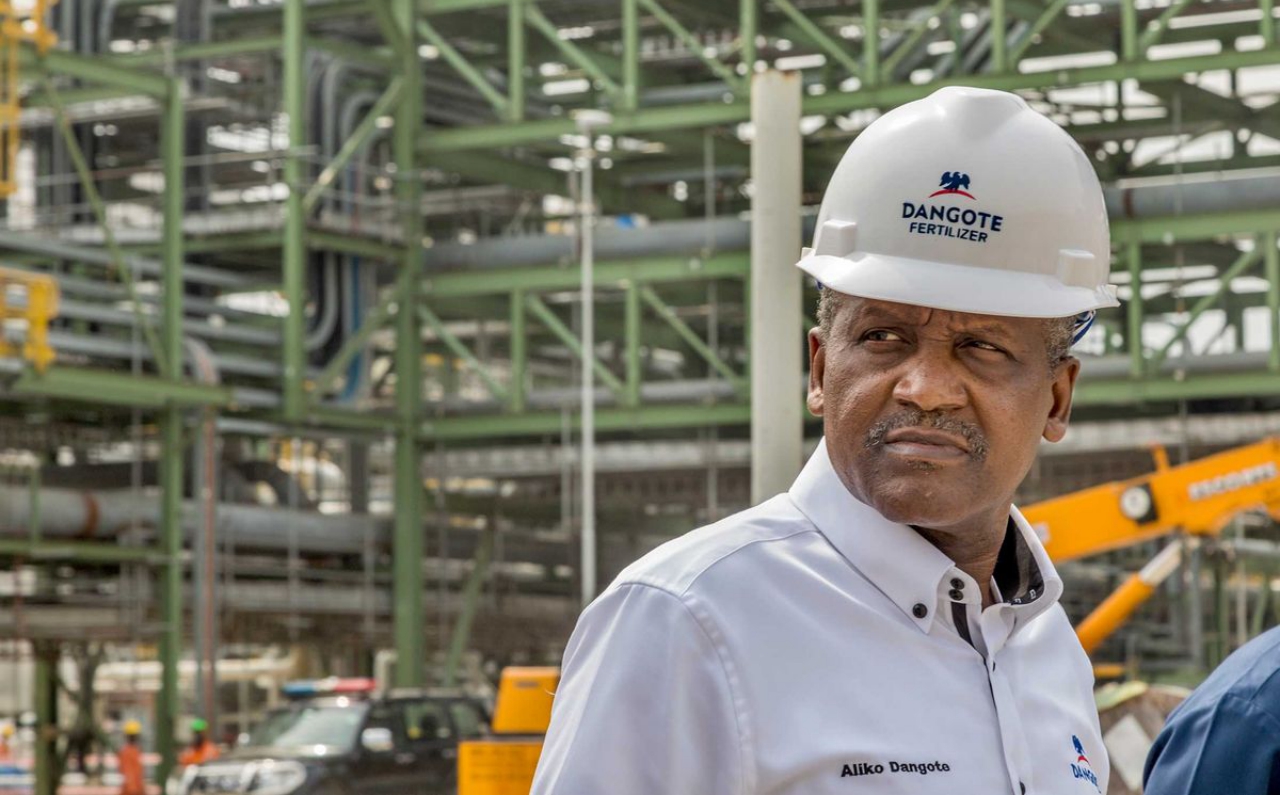
The cement plant and its 2 sister factories in Nigeria have long been the bedrock of Dangote’s fortune, Africa’s biggest. But Dangote’s future – and, as he likes to say, that of the entire continent’s economy – lies to the south on the Nigerian coast. About 64 kilometers (40 miles) east of Lagos, on more than 6,700 acres of former swampland bound by a lagoon and the Atlantic Ocean, contractors are putting the finishing touches on a fertilizer plant valued at US$5 billion. Next to it, construction of a vast oil refinery – a US$12 billion project – is under way.
If all goes according to plan, the complex will immortalize the 61-year-old Nigerian businessman as Africa’s most prominent industrialist, vaulting Dangote Industries’ annual revenue from US$4 billion to about US$30 billion, roughly 8 percent of Nigeria’s gross domestic product (GDP). Oil industry experts have questioned the project’s timeline, citing logistical and financial challenges. But Dangote insists the refinery, which will be Africa’s largest, is on track. “By 2020 I will finally dispatch oil,” he says during a January interview at his Lagos home.
Change Economy
Despite controlling the world’s 10th-largest oil reserves, Nigeria has only 4 aging, inefficient state-owned refineries, leaving it almost wholly reliant on imports for its fuel needs. Dangote says his massive refinery could end that dependency and lift electricity generation in a nation plagued by blackouts: “It will change the entire economy of Nigeria.”
The fertilizer plant, which Dangote says will come online in a few months, will be capable of producing up to 2.8 million metric tons of urea a year. “It’s probably the largest-volume urea plant ever executed at one time,” says Alistair Wallace, head of fertilizer research at Argus Media in London. Nigeria’s natural gas prices are the lowest in the world, meaning Dangote’s fertilizer will likely be profitable even in the competitive export market. “It will generate hard currency and bring in dollars. It will be a good look for the administration and for Dangote,” Wallace says.
Born into a wealthy family of traders in the north, Dangote incorporated his own business selling cement at 21. He shifted to manufacturing the building material in the 1990s, convinced his homeland, the world’s 7th-most-populous country, could meet its own demand for staples. Dangote factories churning out sugar, flour, and salt followed. A vertical integration push gave rise to other businesses, including oil, property management, packaging, and port operations.
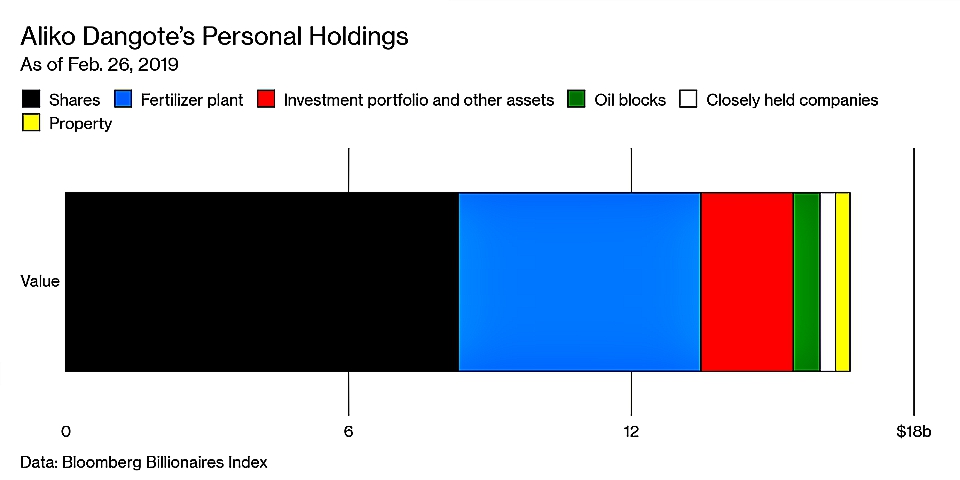
Four publicly traded companies under the Dangote Industries umbrella account for about a third of the value of the Nigerian stock exchange. While shares of Dangote Cement tumbled 26 percent in the past year amid a sell-off in emerging markets, the fertilizer plant has helped boost Dangote’s net worth to US$17 billion, according to the Bloomberg Billionaires Index.
In many ways, Dangote’s ascent recalls that of Gilded Age tycoons such as Andrew Carnegie and Cornelius Vanderbilt, who accumulated great fortunes as they created industries. While the emergence of a new generation of business titans that includes Amazon.com’s Jeff Bezos and Facebook’s Mark Zuckerberg has drawn attention to rising income inequality in the U.S. and elsewhere, Dangote’s net worth is particularly disproportionate to the lot of ordinary Nigerians, almost half of whom live in extreme poverty.
Critics have attacked him for holding much of his wealth offshore and say he is a shrewd monopolist who has plied his political connections to secure an advantage over competitors. They claim his market-dominating cement company squeezes local consumers with prices 3 times the global average while slashing prices in neighboring markets to crush rivals. A World Bank report published in 2016 found that African cement prices averaged US$9.57 per 50 kilogram (110 pound) bag, compared with US$3.38 globally. Dangote’s cement business has also been accused of exploiting a government-run investment promotion program to secure generous tax breaks.
Dangote shrugs off such criticism, while preaching the gospel of markets as the best way to narrow the divide between the haves and have-nots. “China in 30 years has taken almost 500 million people out of poverty,” he says.
Soft-spoken and unfailingly polite, he offers up his chair in meetings to guests and serves food for others during a lunch in an office conference room. But the courteous chief executive officer is also a hard-driving manager. “ ‘Not possible’ aren’t words he understands,” says Giuseppe Surace, chief operating officer of the refinery project, as our convoy of Toyota Land Cruisers sets off on a 4-hour tour of the site. “In his own way, he is very tough.”
Source: Bloomberg Businessweek
