
Opinion
Africa’s Maritime Paradox: Why the World’s Ships Sail Past Without Stopping
A map of global shipping density reveals a paradox: the busiest maritime arteries on Earth trace Africa’s coastline almost perfectly, yet the continent captures barely a sliver of world trade.

By John Kourkoutas
Look closely at any map of global merchant shipping density, and one continent stands out for a strange reason. Africa is not the destination for the traffic that surrounds it. It is merely in the way.
Every white and red line on such maps represents a ship at sea, and the brightest, densest arteries on the planet trace a route that is unmistakable: Gibraltar to Suez, down the Red Sea past the Horn of Africa, around the Cape of Good Hope, and along the Gulf of Guinea. The continent appears wrapped in a ring of intense maritime activity, as if it were the beating heart of global trade.
It is not. Africa accounts for roughly 3 percent of global trade, a figure wildly disproportionate to the volume of shipping traffic passing along its shores.
The explanation is simple, if uncomfortable: the cargo is not going to Africa. It is going around Africa – from Asia to Europe, from Europe to the Americas – hugging the coastline the entire way without ever stopping to unload.
The “Hard to Ship To” Excuse Doesn’t Hold Up
Executives in shipping and logistics frequently describe Africa as a difficult market to serve – poor infrastructure, unreliable ports, too much friction. But the map tells a different story. The main arteries of world trade already pass within sight of African ports. Container ships bound for Rotterdam or New York sail directly past Tema, Mombasa, and Durban every day.
The shipping lanes are not the problem. What has been missing is the incentive to stop – and that incentive is now taking shape onshore, as African economies grow and demand more imported goods, machinery, and consumer products.
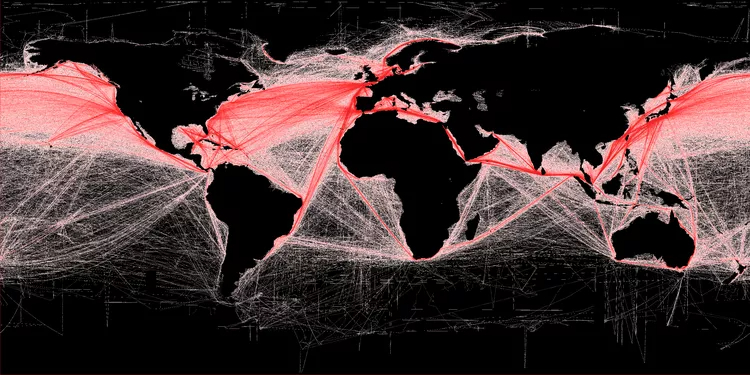
Image credit: Grolltech, Thomas Hengl, and B.S. Halpern (Wikimedia Commons, CC BY-SA 3.0).
Every Red Line Represents Untapped Infrastructure Demand
Ships that pass by still need to be serviced somewhere. Bunkering, repairs, transshipment, crew provisioning, spare parts, and agency services are all part of the vast support ecosystem that surrounds global shipping. As ports expand – from Tangier to Djibouti – pass-by traffic is gradually converting into port calls, and each converted port call pulls an entire maritime supply chain into existence around it.
This is not a hypothetical opportunity. It is already underway, and it represents one of the more overlooked infrastructure stories in global trade today.
From Through-Traffic to a True Network
Perhaps the most consequential shift will come not from external trade but from Africa trading with itself. The African Continental Free Trade Area (AfCFTA) is designed to dramatically increase intra-African commerce, and as it does, the same coastline currently defined by through-traffic will begin to fill with short-sea shipping routes connecting African ports to one another – resembling the dense, interconnected coastal shipping networks that define Europe today.
That transition, if it happens even partially, implies decades of growth in shipping, logistics, and trade infrastructure, starting from an extraordinarily low base.
The Ships Are Already There
This is the crux of the opportunity. The infrastructure of global trade – the ships, the lanes, the routes – already exists along Africa’s coastline. The open question for the next twenty years is not whether the traffic will materialize. It already has. The question is how much of what currently passes Africa will start stopping in Africa.
For anyone who supplies ports, vessels, or logistics chains, this map is not just an interesting visualization. It is a growth chart, hiding in plain sight.
John Kourkoutas is business development expert that specializes in helping companies, export teams, and business leaders succeed in Africa’s dynamic and emerging markets.
