
Opinion
Africa’s Intelligence Imperative: From Ore to AI Sovereignty
Why the continent must own the AI stack – not just supply the raw materials that power it.

By Victory Azimih
For 400 years, Africa fueled other people’s industrial revolutions. The continent exported ore, oil, and crops – and, far too often, exported the value that came with them. Wealth was extracted, refined, and monetized somewhere else. The pattern repeated across centuries and commodities, from gold to gasoline.
Artificial intelligence offers a chance to break it.
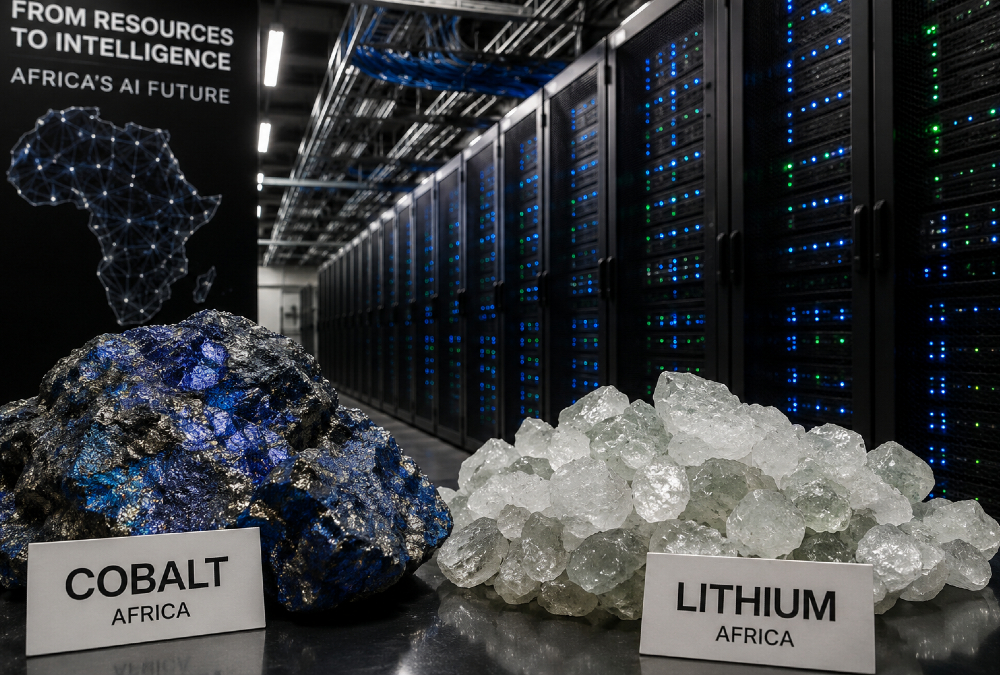
AI is not simply the next technology cycle to ride out. It is fast becoming the operating system for power, wealth, and sovereignty in the 21st century – and that system runs, quite literally, on African cobalt, lithium, copper, and energy. The question facing the continent’s boardrooms and capitals is no longer abstract. It is binary: will Africa own the intelligence layer of this new economy, or merely supply the electrons that power someone else’s?
The Stack Africa Must Own
Building genuine AI sovereignty requires more than a single flagship project. It requires an integrated stack, built deliberately and in the right order.
Sovereign compute and energy. No power, no data centers, no AI – full stop. Compute and the energy behind it are becoming the new ports, the new refineries: the chokepoints through which all future value must pass.
The risk of standing still is stark. If African nations do not build this infrastructure themselves, hyperscale technology firms will build it for them – and with it will go the data, the regulatory leverage, and the tax base that should have stayed home.
Mineral processing and refining. The economics here are not subtle. Moving from roughly three dollars a kilogram for raw ore to fifty dollars a kilogram for refined precursor materials captures fifteen times more value on African soil – value that can then be used as leverage to negotiate real technology transfer, not token partnerships.
The obvious risk is Chinese dominance of processing capacity. The answer is to “friend-shore” the buildout, drawing in capital from the United States, the European Union, and the Gulf states to diversify who controls the refining layer.
AI-enabled manufacturing. Applied intelligently, AI can multiply productivity tenfold in agriculture, logistics, mining, and health care – and it can do so with jobs attached now, not in some distant future. The constraint is a skills gap that infrastructure alone cannot close.
Every new factory should be required to anchor a university partnership and an apprenticeship pipeline alongside it.
Talent and research. A 22-year-old who is genuinely fluent in modern AI tools will outperform a resume padded with twenty years of legacy experience. Governments and investors should act accordingly: fund five true believers with the freedom to build, rather than five hundred bureaucrats with the mandate to administer.
Semiconductors – starting with packaging. Nobody should waste a decade chasing TSMC’s fabrication crown on day one. The smarter entry point is chip design and packaging tailored to distinctly African problems: energy management, fraud detection, precision agriculture. Depth beats vanity here.
The winning strategy is not to choose one layer of this stack and excel at it in isolation. It is to build all five simultaneously, as a single integrated system, so that each layer reinforces the others.
The Risks That Could Derail It
Policy whiplash. Elections have a way of killing twenty-year industrial plans overnight. The fix is structural, not rhetorical: lock long-term AI strategy into sovereign wealth fund mandates that survive changes in government.
A new dependency. The gravest danger is trading one form of extraction for another – swapping colonial-era resource extraction for twenty-first-century cloud extraction, with African data and infrastructure once again controlled from abroad. Co-ownership, not access, must be the price of entry for any foreign technology partner.
Elite capture. If the gains from this transformation pool in three capital cities, the result will be exactly the instability critics predict. Value must be distributed through regional hubs, not concentrated in a handful of favored metros.
What Should Happen Next
African governments should stop asking multinational partners and donors for “AI grants.” Grants are charity, and charity does not build sovereignty. Instead, they should start auctioning AI infrastructure concessions: mining licenses explicitly tied to joint ventures in power and compute, and data center zones that come with binding requirements for technology transfer and local equity stakes.
This is not a call for goodwill. It is a call for patient capital and hard-nosed bargaining – the same instincts that built Korea’s and Taiwan’s industrial economies in the twentieth century.
The Question Worth Asking
To the presidents, sovereign wealth funds, development finance institutions, and investors weighing where to place their bets this decade: which two African countries will become this era’s Korea and Taiwan of artificial intelligence?
The nations that come to shape the AI economy will not necessarily be the ones with the most resources in the ground. They will be the ones with the will to convert those resources into intelligence.
That is what independence looks like now – not a shift from infrastructure to intelligence as some distant aspiration, but as the defining project of this decade.
Victory Azimih is a visionary entrepreneur and global investment consultant specializing in Africa’s economic growth and industrial transformation. As the CEO and founder of Azeemi Global, he leads a pioneering firm dedicated to accelerating the continent’s development through cutting-edge technology and infrastructure solutions. Under his leadership, Azeemi Global focuses on harnessing the potential of artificial intelligence, blockchain, and smart infrastructure to unlock sustainable investment opportunities across Africa. Based in Lagos, Nigeria, Azimih is at the forefront of driving Africa’s future as a hub of innovation and industrialization.
