
Opinion
Africa’s Informal Economy Is Not Waiting to Become Formal
From neighborhood kiosks to open markets and mobile traders, systems often described as temporary or incomplete already distribute goods, extend credit, and organize livelihoods at a continental scale.

By Raymond Chimhandamba
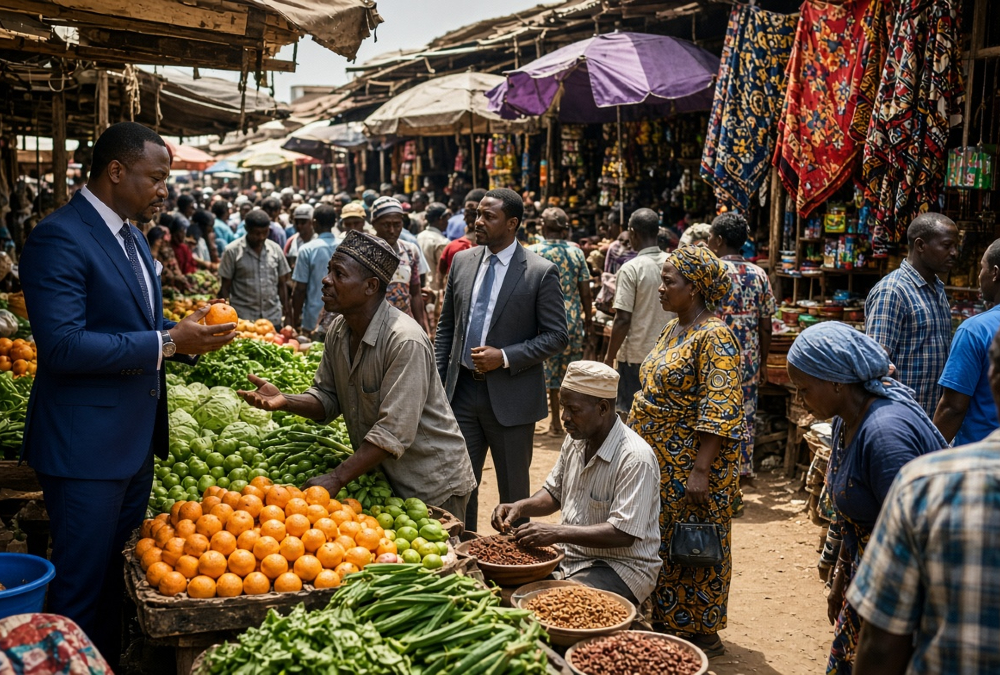
A wealthy Nigerian distribution executive I know – the kind of man with the means to shop anywhere – still does his vegetable shopping at the open market. He isn’t an outlier. Nigeria, home to thousands of dollar millionaires and, by one government estimate, some 240 private jets, is not a country short on modern retail options. Yet its open markets remain central to commerce at every income level.
That should complicate the standard economic narrative, which treats informality as a stage of poverty: something nations outgrow as incomes rise and supermarkets multiply. Africa’s markets suggest otherwise. They are not waiting to be replaced. They are doing jobs that formal retail, banking, and logistics still can’t replicate.
The Trader as Translator
Decades ago, working for a fragrance company, I watched detergent arrive in bulk sacks and get sold to shoppers by the cupful. The manufacturer had achieved industrial scale; the trader supplied the last, crucial inch of product design – breaking a factory-sized package into a portion that matched the cash in a customer’s pocket.
Call it bulk-breaking if you like, but that undersells it. The trader isn’t just dividing a product. She’s translating between two incompatible economic systems: one built on production runs and monthly targets, the other on daily wages, school fees, and whatever cash is left by evening.
That translation work matters more than price comparisons suggest. Economists rightly flag the “poverty premium” – the fact that small purchases often cost more per unit. But the smaller size isn’t just a tax on the poor; it’s frequently the only thing that makes a purchase possible at all. Informal retail synchronizes what people can buy with when they actually have money to buy it. The real challenge isn’t nudging consumers toward bulk purchases – it’s lowering the cost of small ones without destroying the flexibility that makes them work.
Formal Infrastructure, Informal Reach
Years later, working in the diaper industry, I found a Nigerian market saturated with Pampers, stall after stall stocked as deep as any formal retailer’s shelves. The secret wasn’t magic – it was a nearby P&G distributor warehouse quietly feeding the entire informal network. Formal and informal commerce weren’t rivals. They were two halves of the same supply chain: the warehouse supplying scale, the traders supplying reach and reading customers no algorithm yet tracks.
That structure has outlasted plenty of corporate strategy shifts. P&G later pulled back from local manufacturing; Türkiye’s Hayat built Molfix into a dominant homegrown brand instead. Brands rose and fell. The market itself never left – because it isn’t a symptom of underdevelopment. It’s infrastructure.
Products Must Earn Their Shelf Space – Literally
Success in this channel has its own physics. A supermarket can afford a planogram and a stockroom; a trader’s stall has no such luxury. Products must stack, survive heat and handling, stay visible in clutter, and turn over fast enough to justify scarce working capital. Get that wrong, and a brand can fail before a single customer judges its quality.
So Klin cracked this code with sachets sized for both wallets and shelf space. Indomie did something bigger: it built instant noodles into the rhythm of Nigerian life so thoroughly that the country is now among the largest instant-noodle markets on Earth. Neither brand waited for African retail to resemble somewhere else. Both engineered themselves around how Nigerians actually shop.
Informal Isn’t the Same as Unorganized
Don’t mistake “informal” for “chaotic.” These markets run on dense, functioning systems of trust: which wholesalers extend credit, which traders repay reliably, who’s good for a debt at month’s end. It’s data – just held socially instead of digitally, which is precisely its limitation. A trader’s spotless reputation in her market means nothing to a bank loan officer. Years of reliable commerce vanish the moment they need to be proven on paper.
Nor should any of this be romanticized. Traders face real precarity: unsafe conditions, harassment, counterfeit goods, zero insurance, no access to affordable capital. The fix isn’t to preserve informality’s hardships in the name of authenticity, nor to bulldoze the system in the name of modernization. It’s to extend real protections and tools – digital purchase histories that build credit, light-touch registration, micro-insurance, safer trading spaces – without forcing every trader to become a registered corporation overnight.
The Real Risk of “Disruption”
Digital platforms now promise to modernize informal commerce, and some genuinely help: better inventory visibility, lower logistics costs, verified products. But there’s a darker version of the same trend. If a platform captures the customer data, sets the prices, and gatekeeps access to credit, the trader doesn’t gain power – she becomes a low-paid subcontractor inside someone else’s system, dressed up as an entrepreneur.
The right question isn’t whether technology is formalizing African commerce. It’s whether that formalization is making traders more powerful, or simply making the extraction of their labor easier to systematize.
The Future Is Hybrid, Not Formal
Africa’s informal economy gets measured almost exclusively by what it lacks – tax revenue, registered firms, banking penetration. Those gaps are real. But the same markets have quietly mastered things the formal economy still struggles with: distributing goods in whatever quantities people can afford, extending trust where credit doesn’t reach, and showing up in neighborhoods big retailers ignore.
The future almost certainly won’t be a clean handoff from informal to formal. It will be a hybrid – formal manufacturing feeding flexible trading networks, digital records layered onto personal trust, modern logistics supplying the neighborhood kiosk.
The trader selling detergent by the cup isn’t standing outside the modern economy, waiting to be let in. She’s completing it. The real development question isn’t how fast Africa can make her disappear. It’s whether Africa can make her more visible, more secure, and more powerful – without dismantling the intelligence that built the system in the first place.
Raymond Chimhandamba is a Johannesburg-based consultant, writer, and speaker specializing in African industrial development, manufacturing value chains, and investment opportunities. He is director of Handas Consulting and founder of Kunakisa Recycling, with expertise in market entry, manufacturing localization, due diligence, absorbent hygiene products, nonwovens, recycling, and the commercial use of agricultural waste. He has contributed more than 40 articles to Nonwovens Industry Magazine and writes for International Fiber Journal. He has also spoken at international industry events organized by INDA and EDANA. Raymond is currently writing Asymmetric Africa, a book examining overlooked opportunities in African markets.
