
Opinion
Africa’s AI Boom Requires More Than Just Data Centers. It Needs Rules.
Data centers and computing power will not determine whether Africa’s AI boom creates wealth or dependency. Governance will.

By Victory Azimih
Across the continent, the headlines are unmistakable: new data centers rising in Lagos, Nairobi, and Johannesburg; energy deals signed to power them; billions of dollars committed to compute. Africa’s AI infrastructure story has become one of the most compelling narratives in global technology. Investors want in. Governments want credit. And understandably so – the physical build-out is real, and it is happening fast.
But there is a quieter question sitting underneath all of it, one that receives far less attention than the fiber-optic cables and the server racks: who governs this infrastructure once it’s built?
That question – not electricity, not chips, not bandwidth – will ultimately decide whether Africa’s AI economy makes the continent rich or simply makes it dependent.
The Missing Pillar
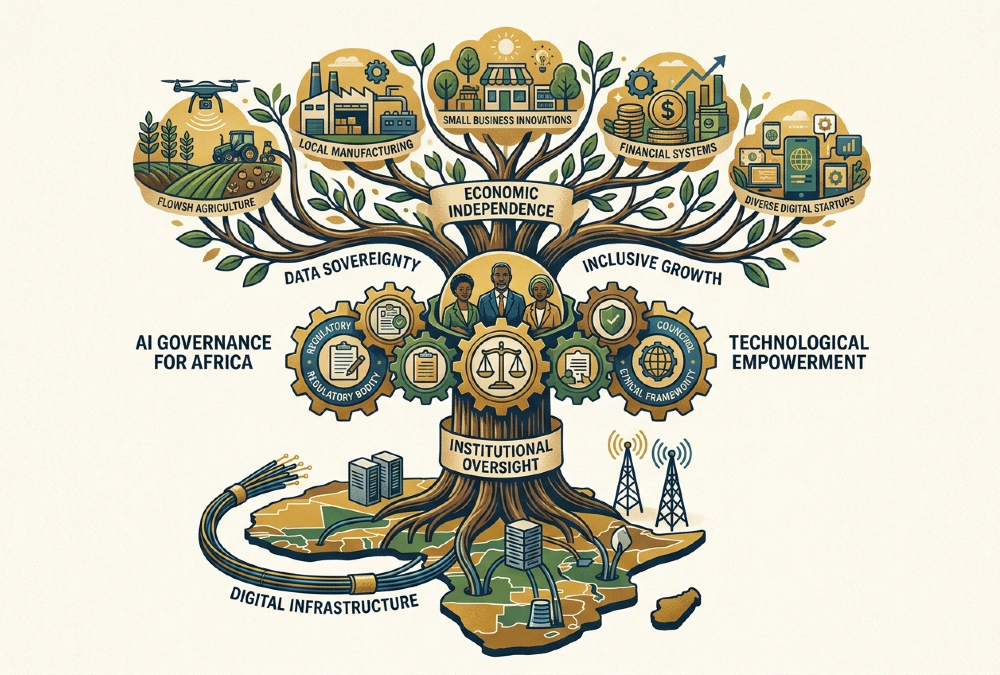
Africa’s digital transformation is often described as a three-part progression: infrastructure, then intelligence, then independence. The first two steps are well underway. Infrastructure is being built. Intelligence – in the form of AI models, data systems, and digital services – is beginning to run on top of it.
The third step, independence, is not automatic. It depends entirely on governance: the institutions, rules, and safeguards that determine who controls these systems, who benefits from them, and whether citizens have any reason to trust them at all.
This is easy to overlook, because governance doesn’t ribbon-cut well. No one holds a press conference to announce a new regulatory framework. But without it, even world-class digital identity systems, payment rails, and AI infrastructure remain fragile. They become exposed to cyberattacks, data abuse, political interference, and – perhaps most corrosively – quiet dependency on foreign powers who did build the institutional capacity to set the rules.
Treat Governance as Infrastructure, Not Bureaucracy
The mistake many policy conversations make is treating governance as a constraint on progress rather than a precondition for it. That framing has it backward.
Roads need traffic rules before they can move a country’s economy. Financial markets need regulators before they can attract serious capital. Energy grids need governance before they can be trusted to power a hospital or a factory. The intelligence economy is no different. It needs institutions that can regulate risk, protect citizens, preserve competition, and – critically – build sovereign capability, all without strangling the innovation the infrastructure was built to enable.
None of this requires the state to own every AI company or dictate every line of code. Government’s job is narrower and more foundational: set the rules, define the standards, and establish the safeguards that let the private sector build, universities research, and citizens trust the systems being built around them. Get that balance right, and infrastructure becomes the foundation for real industrialization and genuine sovereignty. Get it wrong, and sophisticated technology simply produces fragile, extractive outcomes dressed up as progress.
Three Questions Africa Cannot Outsource
If governance is the pillar that turns infrastructure into independence, then Africa faces three questions that no amount of capital or compute can answer on its own.
Who should govern national AI infrastructure? The state, independent regulators, public-private institutions, or some new hybrid model built for African conditions? Each option carries different risks – state control invites political capture; light-touch regulation invites foreign capture; hybrid models require institutional maturity that takes years to build.
How does Africa protect citizen data without regulating away investment? Over-regulate, and capital quietly relocates to friendlier jurisdictions. Under-regulate, and citizens’ data – and by extension their autonomy – becomes a resource extracted by whoever controls the infrastructure. Finding that balance is a design problem, not an ideological one.
What would a genuinely African model of AI governance look like? Not a copy of the European Union’s precautionary approach, not a replica of America’s market-led model, not an import of any Asian state-directed framework – but something built for African realities: fragmented markets, informal economies, mobile-first populations, and institutions still in the process of maturing.
The Real Test of the AI Age
These questions are not academic. They will determine where global capital flows on the continent, where technology companies choose to build, and who ultimately holds strategic power in Africa’s AI economy for the next generation.
The infrastructure race is already underway, and Africa is showing up for it. The harder, less visible race – the one that will actually determine the outcome – is institutional. It is the race to build governance capable of matching the ambition of the infrastructure it’s meant to oversee.
The AI age is coming to Africa whether or not the institutions are ready. The real question is not whether Africa can build data centers.
It’s whether Africa can govern what runs inside them.
Victory Azimih is a visionary entrepreneur and global investment consultant specializing in Africa’s economic growth and industrial transformation. As the CEO and founder of Azeemi Global, he leads a pioneering firm dedicated to accelerating the continent’s development through cutting-edge technology and infrastructure solutions. Under his leadership, Azeemi Global focuses on harnessing the potential of artificial intelligence, blockchain, and smart infrastructure to unlock sustainable investment opportunities across Africa. Based in Lagos, Nigeria, Azimih is at the forefront of driving Africa’s future as a hub of innovation and industrialization.
