
Opinion
Africa Will Not Code Its Future Through Dependency
Connectivity is not sovereignty. Unless Africa moves from digital adoption to digital ownership, the continent risks trading one form of dependency for a faster, shinier one.

By Daki Nkanyane
Africa is connecting at extraordinary speed. Broadband is spreading, mobile money is thriving, and a new generation of startups is putting the continent on the map of global technology. But speed of connection tells you nothing about who is in control. And that distinction – between being connected and being sovereign – may be the most consequential digital question Africa faces this decade.
Governments across the continent are not standing still. The African Union has adopted a Continental AI Strategy and an African Digital Compact. Its Data Policy Framework and Digital Transformation Strategy sketch a vision of integration, innovation and ownership. These are not token gestures; they show that African leaders understand what is at stake. But understanding the problem is not the same as solving it.
From Access To Dependency
For two decades, the defining challenge was access: more people online, wider broadband coverage, deeper mobile penetration, broader use of digital payments. That work is unfinished – the International Telecommunication Union’s 2025 Global Connectivity Report still points to significant infrastructure gaps across the continent – but a harder question has overtaken it. As Africa comes online, whose infrastructure does it run on? Whose cloud holds its data? Whose models does it query? Whose platforms mediate its trade, its speech, its learning and its commerce?
That is a question of sovereignty, and in the digital era sovereignty means more than flags and borders. It means compute capacity, cloud infrastructure, data governance, payment rails, technical standards and the linguistic and cultural depth to shape the systems a society now runs on. A country can be thoroughly wired and still be, in every practical sense, digitally subordinate – online every day, yet governed by architecture built somewhere else.
Producer, Not Just Consumer
The AU’s Digital Transformation Strategy calls on Africa to become “a producer and not only a consumer” in the global digital economy. That should be read less as an aspiration than as a warning. Consuming platforms, models and infrastructure designed elsewhere brings real convenience – but it also imports dependence, along with a set of rules the consumer had little hand in writing.
Digital adoption, in other words, is not the same as digital strength. A government can digitize its public services while still renting its cloud architecture from abroad. A startup scene can boom while building most of its value on platforms it will never own. A country can post impressive AI adoption numbers while lacking the local compute power, data governance capacity and language resources to shape that technology on its own terms. UNESCO’s 2025 work on AI in Africa made a similar point: adoption without localization leaves African contexts underrepresented and interpreted by outsiders.
A Dependency With Three Faces
This kind of dependency is never purely technical. It has three dimensions. Politically, reliance on foreign infrastructure narrows a government’s room to maneuver. Economically, the value generated by African data and African users accumulates somewhere else. And epistemically, systems engineered outside the continent risk failing to encode African languages, priorities and moral concerns at all. Put together, these three forms of dependency mean the digital age could just as easily entrench old patterns of subordination as break them.
The World Bank’s 2025 digital-development research frames the same problem in more technical terms, flagging the rising importance of data-center capacity, cloud readiness and compute access – and suggesting that governments may need to co-finance regional data centers and subsidize compute access for startups and researchers, given how steep the entry costs have become. The old digital divide, between the connected and the unconnected, is giving way to a new one: the divide between those who merely use digital systems and those who own enough infrastructure, capital and policy coherence to shape them. Africa cannot afford to land on the wrong side of that new divide.
The Seduction of the Rented Future
The trouble is that dependency is comfortable. Imported platforms, ready-made cloud services and off-the-shelf AI tools offer speed and efficiency that can look, for a while, indistinguishable from progress. For governments under budget pressure, companies chasing scale and consumers who just want things to work, that trade-off is tempting. But convenience has a way of masking structural exposure. The more a continent’s digital life runs on rented architecture, the less credible its claim to a genuinely independent digital future.
None of this is an argument for going it alone. Africa should keep partnering, learning and integrating into global technology systems – and the AU is already doing so, including through efforts to build sovereign AI capacity. But partnership should not curdle into passivity, and cooperation should not mean surrendering strategic direction. A continent that outsources too much of its cloud, compute, standards and intelligence stack may end up with a digital economy that looks vibrant on the surface but is thinly sovereign underneath. That would be a dangerous illusion to mistake for success.
Infrastructure is Destiny, Again
In the digital era, infrastructure once again determines destiny – not only roads and ports this time, but fiber-optic cable, data centers, cross-border payment systems, cloud architecture, cybersecurity, AI compute, semiconductor access and the language datasets and regulatory institutions needed to govern them all. The UN Conference on Trade and Development’s 2025 analysis underscores that investment in this kind of infrastructure is essential to closing the digital divide and building lasting competitiveness. The real question for Africa is no longer just “how fast can we adopt digital tools?” It is “how much ownership, capability and leverage are we building beneath that adoption?”
No continent becomes sovereign in a technological century through interface alone. It becomes sovereign through architecture – by controlling enough of the technology stack to protect its interests, shape its markets, govern its data and participate in the global digital order as more than a symbolic partner.
From Enthusiasm to Statecraft
Africa’s current policy direction suggests the continent is beginning to grasp this. The AU’s Data Policy Framework treats data as a core enabler of transformation. UNESCO’s AI readiness and ethics work is pushing African governments to think seriously about oversight and infrastructure. The World Bank and other institutions are now debating cloud readiness and the public sector’s role in digital infrastructure. These are encouraging signals – but policy recognition has to translate into material capacity, or it remains just rhetoric.
That means Africa must move from digital enthusiasm to digital statecraft: building regional cloud and data infrastructure where it makes sense, treating data governance as a strategic priority rather than a compliance checkbox, and approaching artificial intelligence not merely as a tool to consume but as an industry, a public capability, a language question and a sovereignty question in its own right. It means nurturing local innovation while recognizing that innovation without infrastructure stays fragile – and treating power supply, digital skills, cybersecurity, regulatory capacity and capital mobilization as parts of one coherent strategy, not separate line items.
Above all, it means resisting a shallow definition of digital success. A society that measures its digital progress only by app downloads, mobile penetration, fintech headlines or social-media buzz is missing the real contest. The real contest is about control: who owns the rails, who captures the value, who sets the rules, who stores the data, who trains the models, who governs the standards, who keeps the system running under pressure, and who can negotiate from strength rather than dependence. These are not technical footnotes. They are the central questions of the digital century.
A Continent at the Threshold
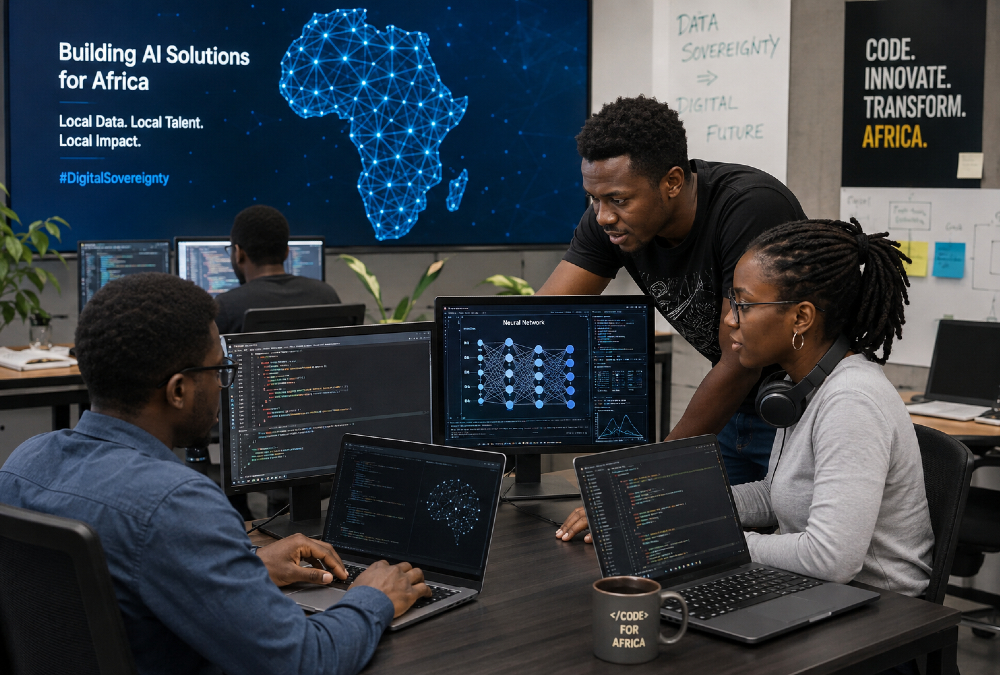
Africa will not code its future through dependency – not if it wants to be more than a marketplace for other people’s infrastructure, not if it wants AI systems that reflect African languages and realities, and not if it wants to convert digital adoption into digital power. To become, as the AU itself puts it, a producer rather than only a consumer, the continent must treat digital sovereignty as seriously as it treats digital growth.
Africa now stands at a threshold. It can digitize quickly and remain structurally exposed, governed by architectures built elsewhere. Or it can digitize strategically, building the capacity, infrastructure and institutional depth to set its own digital terms. That choice matters because the next global hierarchy will not rest only on land, labor and capital in the traditional sense – it will rest on compute, data, models, networks and the political capacity to govern them. A continent that enters that world mainly as a user will stay useful. A continent that enters it as a builder has a chance to become powerful.
Africa must decide which one it intends to be. A connected continent, after all, can still be a dependent one – and digital adoption without digital sovereignty is only dependency with better bandwidth.
Daki Nkanyane is a South African – born Pan-African thought leader, entrepreneur, keynote speaker, and strategist with over 25 years of experience driving innovation, identity, and development across Africa. He is the Founder & CEO of Interflex Capital, AfrisoftLive, QonnectedAfrica, and iThinkAfrica, where he focuses on youth empowerment, entrepreneurial ecosystems, and Africa’s economic and ideological renewal. His work spans technology, digital transformation, major international events, and strategic advisory for future-ready African institutions. As a contributing writer for The Habari Network, Daki covers African innovation, leadership, human capital, economics, entrepreneurship, and Africa–Caribbean relations through cultural, philosophical, and developmental perspectives. His mission is to help shape a new African consciousness rooted in pride, possibility, and self-determination for Africans on the continent and in the diaspora. He can also be reached on Facebook and X.
