
Opinion
Africa Does Not Need a Ferrari for Every AI Problem
The continent should stop chasing Silicon Valley’s infrastructure race and start building the right AI for its own roads.

By Sheena Raikundalia
The numbers explain the temptation. The four biggest American tech companies plan to spend more than Ksh90 trillion (US$700 billion) on AI infrastructure this year alone. Training a single frontier model now costs upward of half a billion dollars. America produces 62 percent of the world’s notable AI models.
That is their race, built on their economics. Should it be ours?
Africa does need compute, and it does need data centers. But the continent is asking the wrong question. The question is not how to build the biggest AI infrastructure. It is what the right architecture is for the problem we are actually trying to solve.
Context Beats Compute
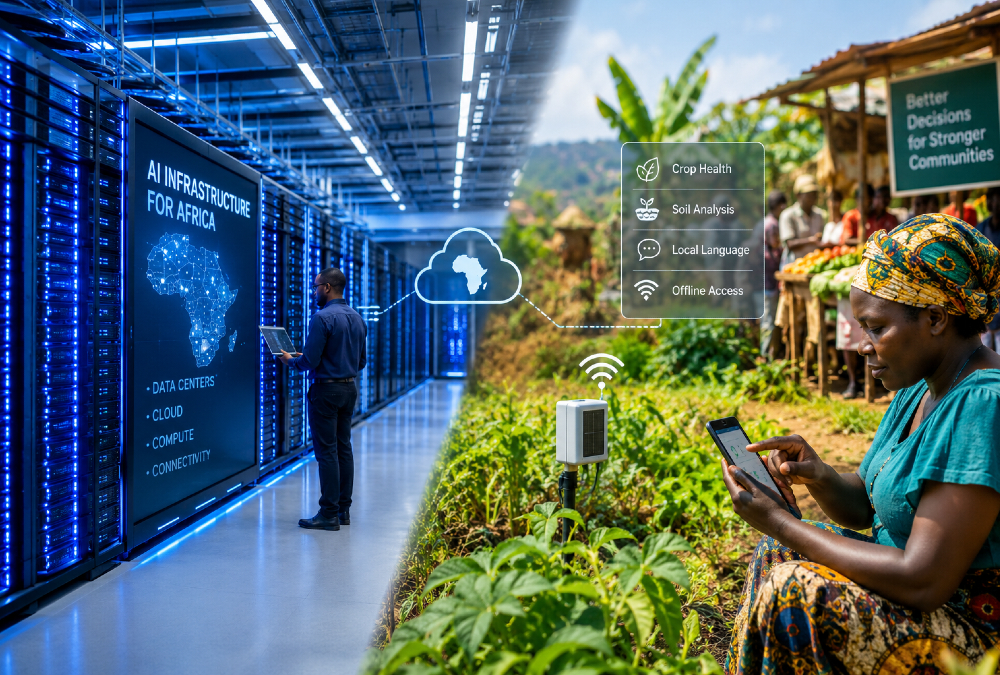
Consider a farmer in Kenya. Within a few kilometers, her soil can shift from acidic red volcanic earth to heavy black cotton clay. A giant model trained on global averages does not know her field. For her, context matters more than compute.
Efficiency points the same way. Small models built for a single task can cut energy use by up to 90 percent and still do the job. For a continent where power is expensive and often unreliable, that is a strategic advantage rather than a consolation prize.
When the Model Moves to the Phone
Consider, too, Adebayo Alonge, a Nigerian founder whose counterfeit-medicine scanner failed during a demo in Cape Town. The model lived on a server 14,000 kilometers (8,700 miles) away, and the connection could not keep up. His team shrank it to run on an Android phone within hours. It now works without broadband.
That is the boda boda principle in action: a lighter machine, matched to the terrain, that actually gets there.
Right-Sizing the Answer
None of this is an argument against ambition. Sometimes the answer is a large frontier model. Sometimes it is a far smaller model running at the edge, on a phone or a local device. And sometimes the most important part of the system is not the model at all, but the context, the people, the network or the market that turns an answer into action.
Africa’s advantage will not come from winning a spending contest it cannot afford. It will come from fitting the tool to the task, and from designing for its own roads rather than someone else’s racetrack.
The Ferrari isn’t a bad car. It may simply be the wrong one for the journey.
Sheena Raikundalia is an accomplished entrepreneur, former lawyer, government policy advisor, and angel investor with deep expertise across the legal, financial services, and impact investment sectors in Europe and Africa. She has played a pivotal role in advancing Africa’s technology and innovation ecosystems, leveraging a career that spans top-tier London law firms, leadership as Country Director of the UK-Kenya Tech Hub for the UK Foreign, Commonwealth & Development Office (FCDO), and her current position as Chief Growth Officer at agri-tech company Kuza One. Sheena is recognized for her strategic vision, commitment to fostering innovation, and strong advocacy for Africa’s growth potential in technology, entrepreneurship, and impact investment.
