
News
Liberia: Nobel prize no guarantee for re-election
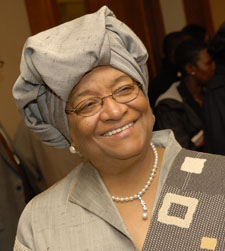
She may have won this year’s Nobel Peace Prize, but even that may not be enough to persuade voters in this nation with 80 percent unemployment to re-elect President Ellen Johnson Sirleaf (pictured), on Tuesday.
The 72 year-old Harvard-educated leader suffers from a rare paradox: She is lionized and her star has continued to rise, even as her popularity at home has waned over claims that she has done too little to alleviate the nation’s crushing poverty.
“One out of every three Liberians cannot feed themselves. They live in abject poverty. And they couldn’t care less about the Nobel prize,” said 60 year-old Charles Brumskine, one of 15 opposition candidates facing Sirleaf in Tuesday’s election.
“There’s a disconnect between how she is seen abroad and how she is seen here. Ellen will be lucky to get 10 percent of the vote in tomorrow’s election.”
Few dispute that the nation Sirleaf inherited five years ago was one of the most broken, its social fabric irreparably damaged by a 14-year civil war that left the countryside dotted with mass graves. Some towns were so hard-hit you could walk for blocks and not find one building that had been spared. Years later, judges still preside over courtrooms that have holes in the walls and nurses tend to patients in wards with blasted-out doors.
Sirleaf’s achievements include getting US$5 billion of the country’s international debt wiped clean, allowing Liberia to establish a sovereign credit rating, a precondition for issuing bonds. Her government has built clinics, schools and roads, though her critics say she has built too few. And despite the deep wounds inflicted by the civil war, she is credited with maintaining peace.
In Oslo on Friday, the Nobel Committee awarded her and two other female activists the 2011 Nobel Peace Prize, citing their nonviolent struggle for the safety of women.
Even those who support Sirleaf say the problem is that her accomplishments are mostly intangible and Liberia remains deeply impoverished, with only one in five people able to find work, according to a 2008 U.N. report.
Only some 8,000 customers receive piped water in Monrovia, the capital of 1.5 million. There isn’t even running water in the building that houses the state water utility.
“My feeling has been from early on that Liberians had unrealistic expectations of what anybody could do,” said West Africa expert Mike McGovern, an anthropologist at Yale University.
“The country has been pulverized by the war, the health system, the education system, the roads, everything was so destroyed that even an influx of money the likes which we saw in Iraq and Afghanistan would not have fixed everything. And frankly the amount of money that has gone to Liberia has been a few drops in the bucket by comparison,” he said.
Sirleaf was elected in 2005, becoming the first African woman to be democratically elected. She defeated soccer sensation George Weah, who came in second and who lost the race in part because of his lack of formal education.
