
Life
How schizophrenia became a Black man’s disease
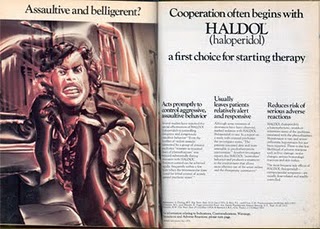
In a new book, The Protest Diagnosis, psychiatrist Jonathan Metzl describes how, in the late 1960s, “schizophrenia became a Black man’s disease.” The Haldol ad featured in the image is from 1974.
Beside a picture of a stereotypical angry Black activist we find the words, ‘Cooperation often begins with Haldol.’ The Black Power movement was calling for a revolution in economic policy but White America couldn’t listen.
Black people had already received the vote, access to public schools and the elimination of Jim Crow laws. “Surely that was enough. If Black dissidents were raging in the streets, the problem had to lie in their faulty emotional wiring.”
By 1974, the vagaries of Freudian analysis had been trashed in favor of biological diagnostic schemes. When I worked as a psychiatric social worker in the geriatric ward of Louisville’s Central State Hospital in the late 1970s, I could see the change in approach in the medical records of my clients. Many of them had been in and out of the mental hospital for decades. Early psychiatric evaluations linked early childhood trauma with a variety of Freudian syndromes. By the late 1960s all you got was a diagnosis and the prescription of the appropriate drug. In an article summarizing his book, Metzl demonstrates that paranoid schizophrenia went from being a relatively benign malady afflicting White women and men with an artistic temperament to being a “Black man’s disease.” Here’s an excerpt (I urge you to read the entire article):
“A series of transformations occurred during the American civil rights era of the 1960s and 1970s. During this vital period, new clinical ways of defining mental illness unintentionally combined with growing cultural anxieties about social change. Meanwhile, reports about new ‘psychochemical’ technologies of control merged with concerns about the ‘uncontrolled’ nature of urban unrest. As these historical contingencies evolved, the American public, and at times members of the scientific community, increasingly described schizophrenia as a violent social disease, even as psychiatry took its first steps toward defining schizophrenia as a disorder of biological brain function.
“As but one example, in 1968, psychiatry published the second edition of the ‘Diagnostic and Statistical Manual’ (DSM)—the ‘official’ source of psychiatric diagnoses. That text recast the paranoid subtype of schizophrenia as a disorder of masculinized belligerence. ‘The patient’s attitude is frequently hostile and aggressive,’ the DSM-II claimed, ‘and his behavior tends to be consistent with his delusions.’ My evidence shows that growing numbers of research articles used this language to cast schizophrenia as a disorder of racialized aggression. In the worst cases, psychiatric authors conflated the schizophrenic symptoms of African-American patients with the perceived schizophrenia of civil rights protests, particularly those organized by Black Power, Black Panthers, Nation of Islam, or other activist groups.” I also recommend this helpful evaluation of Metzl’s research, “Psychiatry, the DSM, and the Black Power movement.”
Metzl argues persuasively that the perceived link between Black protest and mental illness was driven by perceptions rooted deeply in cultural trends that influenced the American academy to a shocking extent. The folks who produced the 1968 edition of the “DSM” were not aware of the institutional racism at work in their midst. The bias was unintentional and therefore unacknowledged. This is precisely the kind of “color blind” racism we confront in the new Jim Crow that Michelle Alexander dissects in her ground breaking book.
By Alan Bean
Source: African-American News and Issues
