
News
Barbados PM Urges Global Rules-Based Order to Tackle Climate Crisis
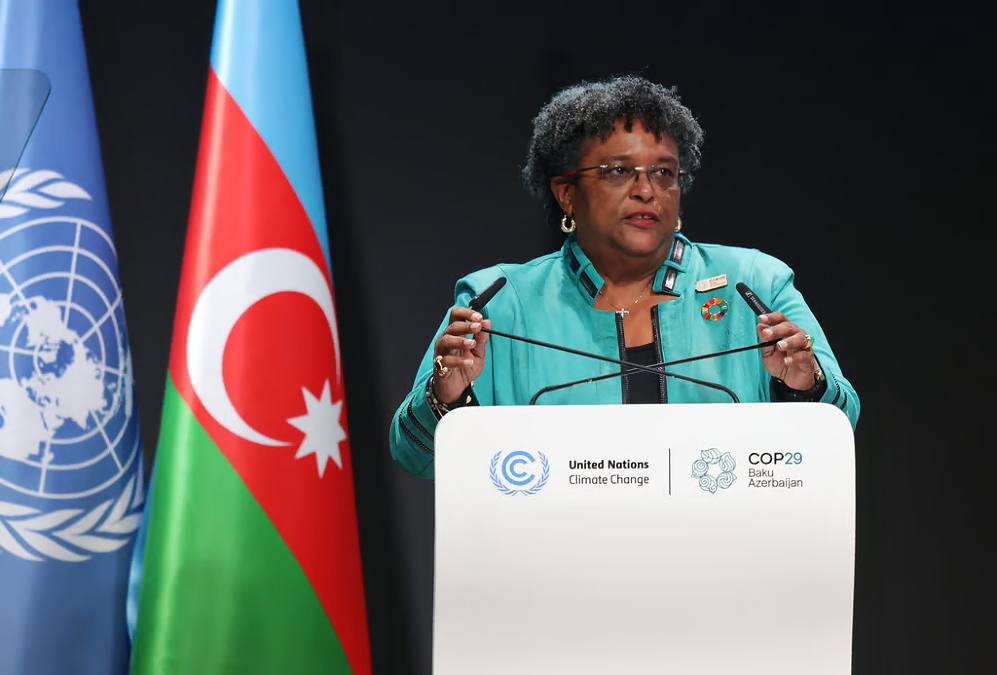
Barbados Prime Minister Mia Mottley has renewed her call for an international rules-based order to help small island developing states (SIDS) confront the growing impact of climate change.
Speaking at the Leaders’ Session on Climate and the Just Transition – convened by Brazilian President Luiz Inácio Lula da Silva and UN Secretary-General António Guterres – Mottley emphasized that such an order is essential for SIDS to overcome the consequences of the climate crisis.
“It would be impossible for us to mitigate the negative effects of climate change without it,” she said, acknowledging the increasing divergence in global perspectives. She cited Pope Francis’ reminder, in his encyclical, of the dangers of obstructionist attitudes, ranging from denial and indifference to blind faith in technical solutions.
As Chair of the Caribbean Community (CARICOM), Mottley stressed the urgency for collective action. “Our people are on the front lines,” she said, adding that the climate crisis also triggers secondary challenges.
She called for intensified efforts at national and regional levels, particularly in aligning climate goals with financial strategies – highlighting the Bridgetown Initiative as a key pathway forward.
The Bridgetown Initiative, originating in Barbados, advocates for reform of the outdated international financial architecture (IFA), arguing it no longer serves the needs of a world grappling with climate change, inequality, and systemic risks. While spearheaded by Barbados, the initiative is part of a broader coalition seeking global reform.
Mottley, the only Caribbean leader to speak at the conference – also attended by China’s Xi Jinping and France’s Emmanuel Macron – underscored the economic challenges SIDS face, such as unaffordable insurance premiums that deter investment.
She also noted the lack of meaningful behavioral change at the individual level, particularly in regions experiencing water scarcity or flooding. “We need greater resilience and adaptation efforts across all levels – individual, local, national, and regional,” she said.
Calling for enhanced international solidarity, Mottley proposed a global challenge: a 20- to 40-year target to eliminate methane emissions. “If we can agree on that,” she said, “we can align with fossil fuel stakeholders without needing ideological consensus.”
She concluded by stressing the shared responsibility to save the planet, calling for continued research and inclusive benefits from global climate action.
