
News
Haiti: Cholera victims threaten to sue United Nations
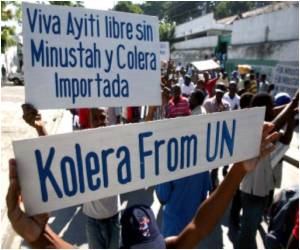
Concannon and Kurzban said they are operating on the legal principle that if the United Nations does not respond to appeals for justice, and leaves the plaintiffs with no legal recourse, the U.N. loses its immunity.
The United Nations-installed water system pumped sewage directed into the river, and “This was the system’s normal operation,” said Concannon.
Haiti had not had a problem with cholera since the 1800s until the 2010 outbreak, said Dr. Jean Ford Figaro, a Haitian doctor speaking for the lawsuit. He said the death toll has now surpassed 8,000, citing Haitian Health Ministry figures.
The UCLA’s School of Public Health sent a field mission to Haiti after the outbreak to study its origin. One of the school’s professors, Renaud Piarroux, later wrote that the study confirmed the epidemic was imported and started around the Nepalese peacekeepers’ camp, then “spread explosively due to massive contamination of the water.”
A study of the bacteria conducted in 2010 by scientists at Pacific Biosciences of California Inc. mapped its genome, the set of genes that makes any organism unique. The Haitian strain is almost identical to types found in South Asia and differs greatly from those circulating in nearby Latin America, according to the analysis published in the New England Journal of Medicine. That suggested humans carried the Asian strain into Haiti, though it did not pinpoint the country of origin.
Concannon said that if there is no settlement, the Institute for Justice and Democracy in Haiti will take the United Nations to court in 60 days. He told reporters that they will probably sue in New York State court initially, and anticipated that the United Nations will counter by saying the case should go to U.S. federal court.
He and Kurzban said they are also planning a lawsuit in a European venue.
