
Politics
“Fiscal Cliff”: What Obama and Boehner stand for
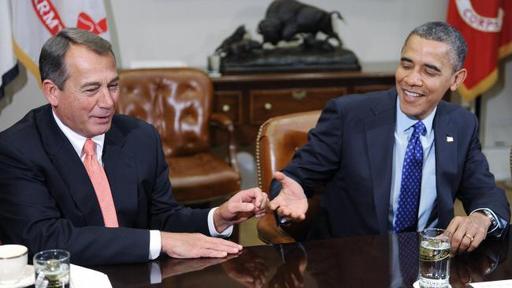
U.S. President Barack Obama (r) shakes hands with Speaker of the House John Boehner (l) during a meeting with bipartisan group of congressional leaders in the Roosevelt Room of the White House on November 16, 2012 in Washington, DC. PHOTO/Getty Images/Olivier Douliery
In their “fiscal cliff” standoff, President Barack Obama wants to raise taxes by about US$20 billion a year more than House Speaker John Boehner. The president wants the government to spend about that much more yearly than Boehner does, too.
That’s real money by most measures. Yet such numbers are barely noticeable compared to the US$2.6 trillion the government is projected to collect next year, and to the US$3.6 trillion it’s expected to spend.
As the “cliff” approaches, economy-shaking tax increases and spending cuts that start hitting in early January unless lawmakers act first, each side says the other isn’t being serious enough about trimming federal deficits. But their inability so far to strike a compromise underscores that their problem is more than arithmetic — it’s also about the difficult politics that Democrat Obama and Republican Boehner face when it comes to lining up votes.
Chastened by Obama’s re-election, Boehner has violated a quarter-century of Republican dogma by offering to raise taxes, including boosting income tax rates on earnings exceeding US$1 million annually. Eager for a budget deal that would let him move on to other issues, Obama in turn would cut the growth of Social Security benefits, usually off-limits to Democrats. He also would impose tax increases on a broader swath of people than millionaires — those with incomes over US$400,000. But that figure, too, is a retreat from what he campaigned on: the US$200,000 income ceiling on individuals and US$250,000 on couples.
That means both men have angered lawmakers and staunch supporters of their respective parties, just when the need to retain that support is crucial.
“When you walk into a room and represent a group and you have to give ground to get a deal, you have to stay in that room as long as you can and you have to walk out with blood on your brow,” said Joseph Minarik, research director for the Committee for Economic Development and a veteran of grueling budget talks as a former Clinton White House and House Democratic aide. “Otherwise, the people outside the room don’t believe you’ve fought hard for them.”
With no quick resolution in sight, Boehner worked Thursday to push a backup bill through the House that would raise taxes on people earning at least US$1 million but not on those earning less. A separate bill would replace across-the-board cuts in defense and domestic programs with cuts in Obama’s health care overhaul and other specified programs.
