
News
Ethiopia and Djibouti inaugurate new rail link – a mojor boost to both economies
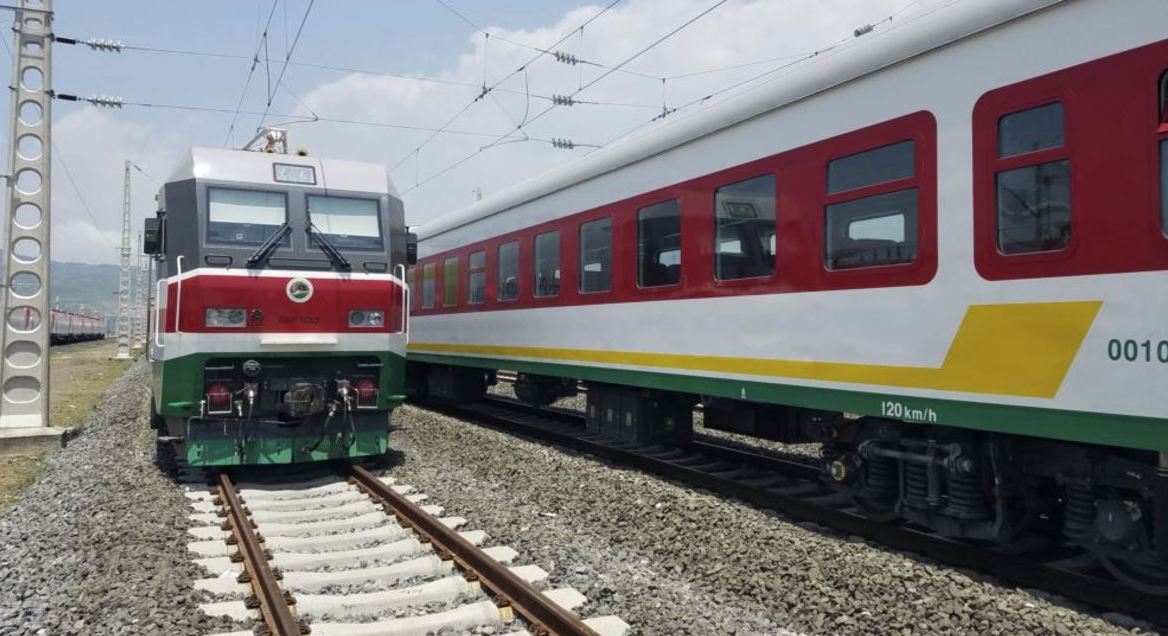
A fleet of shiny new trains on Wednesday began plying a new route from the Ethiopian capital to Djibouti, in a major boost to both economies.
The 750 kilometer (460 mile) railway, which links Addis Ababa to the Red Sea port city of Djibouti, was inaugurated at a newly built station by Ethiopian Prime Minister Hailemariam Desalegn and his counterpart from Djibouti Ismael Omar Guelleh, just outside the Ethiopian capital.
“This railway will speed up development of our country’s manufacturing industry and it will provide huge benefits to the industrial parks and modern farms that will be built in the future. It will give employment opportunities for our citizens,” Desalegn said at the ceremony.
While coffee production remains Ethiopia’s biggest earner and agriculture its main employer, the Horn of Africa nation is working on diversifying exports and boosting its manufacturing industry.
The new railway, the first electrified railroad in Africa, will take products between Ethiopia and Djibouti in about 10 hours, a far cry from the current excruciating multi-day trip along a congested, pot-holed road.
“We are so excited! It takes 2 -3 days for a truck to come from Djibouti,” said Ethiopian importer Tingrit Worku. “The rail link will make a huge difference.”
Some 1,500 trucks a day currently use the road which carries 90 percent of imports and exports from landlocked Ethiopia to the port – a key trade hub to Asia, Europe and the rest of Africa.
“This rail link is a game changer. Ethiopia is one of the fastest growing economies in Africa. The connection to the ports of Djibouti will give a bounce and our economy will grow faster,” said Mekonnen Getachew, project manager of the Ethiopian Railways Corporation.
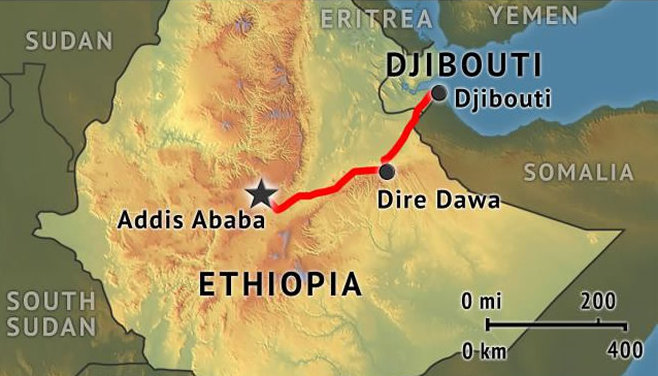
Map of the Ethiopia-Djibouti railway
Ethiopia was the world’s fastest growing economy last year at 10.2 percent, however the International Monetary Fund estimates that the worst drought in 30 years is likely to see this plummet to 4.5 percent in 2016.
Both countries benefit from economic integration, with Ethiopia gaining access to the sea and Djibouti gaining access to Ethiopia’s emerging market of 95 million people. The inauguration of the rail link will is to be followed by a 3 month test period, with no paying passengers and carrying only cargo. However, However when the line is fully functional, passengers will be able to access the infrastructure via the newly built stations all along the route.
Ethiopia has in the past decade invested heavily in infrastructure – the undertaking has contributed thousands of jobs to the local economy and enhanced the country’s rapid growth trajectory.
The railway is the first step in a vast 5,000 kilometer (3,100 mile)-long network of rail which Ethiopia hopes to build by 2020, connecting it to Kenya, Sudan and South Sudan.
Djibouti, the smallest state in the Horn of Africa, sees the project as the start of a trans-African railway crossing the continent from the Red Sea to the Atlantic Ocean.
Source: AFP
