
Politics
Boko Haram Takes Advantage of Nigeria’s Slow Military Decline
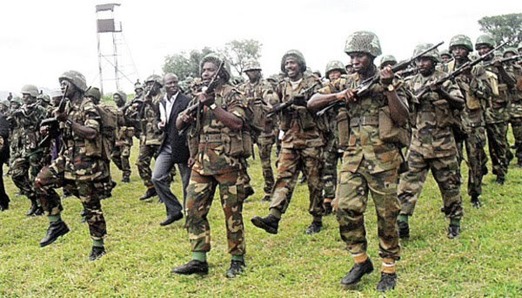
The militants know the military’s limitations. A police source said a fighter jet flew over the market town of Gamburu on Monday as a group of gunmen killed at least 125, but the killers didn’t flinch, knowing they could not be targeted while scattered in a densely populated area.
President Jonathan declared a state of emergency in the northeast a year ago, ordering extra troops, but security sources say the armed forces remain overstretched. Perhaps as few as 25,000 service-ready troops face an insurgency over a wide area in the northeast, communal violence across north and central Nigeria and rampant oil theft in the south, as well as commitments to peacekeeping missions, one security source says.
LOW MORALE
Morale is also a problem, says a ground soldier deployed in the northeast who did not wish to be named. He said the food was bad, sleeping conditions rough, very few people get the leave to which they are entitled, and they live in constant fear of Boko Haram attacks. “There is just a kind of hopelessness hanging over us,” he said.
That is not the case with their adversaries, whose fearless determination is fuelled by dreams of jihadist martyrdom. “In a typical unit, Boko Haram has between 300 and 500 fighters. It’s not a guerrilla force that you can fight half-heartedly,” said Jacob Zenn, a Boko Haram expert at U.S. counter-terrorism institution CTC Sentinel. “It’s snowballing. It’s getting more weapons, more recruits, their power is increasing every day.”
On Feb. 12 dozens of fighters loyal to Boko Haram attacked a remote military outpost in the Gwoza hills. A security source with knowledge of the assault said they came in Hilux tracks with mounted machine guns and showered the camp with gunfire. Boko Haram’s fighters had little cover and were easily picked off – 50 of them died against nine Nigerian troops; but they still managed to make off with the base’s entire armoury stockpile of 200 mortar bombs, 50 rocket-propelled grenades and hundreds of rounds of ammunition, the source said.
Their ability to dart over the border into Cameroon, whose own security forces have shown little appetite for taking them on, gives the militants an added advantage. Ethnic and religious divisions within the military have also bred some collusion with Boko Haram, sources say. An artillery soldier said units were sometimes suspiciously ambushed. He is convinced “someone in command leaks our plans to terrorists.”
“The military, just like the rest of Nigeria, is fractured, which means it probably does have Boko Haram sympathizers within it,” former U.S. Ambassador John Campbell said. The military isn’t that short of money on paper. In 2014 security will swallow nearly 938 billion naira ($5.8 billion), a quarter of the federal budget. Of that, the defence ministry will take more than a third, but only 10 percent is for capital spending.
