
News
Barbados: Mia Mottley administration announces new taxes to revitalize ailing economy
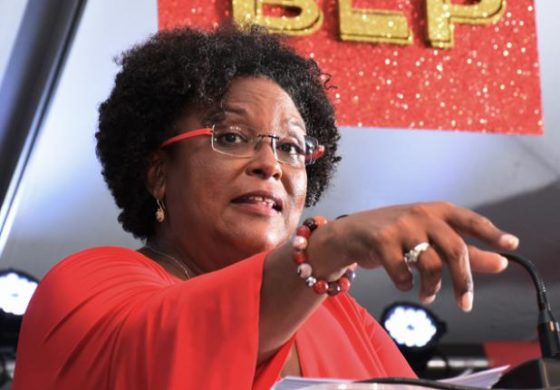
The new government in Barbados announced earlier this week, that it is prepared to implement “tough decisions” to revitalize an ailing economy as it announced a series of new tax measures as a part of new fiscal policies.
Prime Minister Mia Mottley, whose Barbados Labor Party (BLP) came to office following the May 24 general election, said that she is determined that the island-nation would not be regarded as a “failed state” under her administration.
Presenting her administration’s first financial statement and budgetary proposals for 2018, Mottley said that the new taxes underscored her Government’s desire to ensure “the burden must be shared by all of us”, as well as always protecting the most vulnerable in society.
In her lengthy statement, punctuated by criticism of the policies of the former Freundel Stuart administration, Mottley said the Barbados Economic Recovery and Transformation plan is carefully balanced and is in keeping with campaign promises to abolish the controversial National Social Responsibility Levy (NSRL) as well as the road tax.
She described the NSRL, which was applied to the production cost of locally produced goods, as “distortionary” saying while it “led to a revenue gain of BDS$145 million (US$72.5 million) when it was out, many prices across Barbados rose by double digits, depressing retail sales and economic activity generally”.
She said the government expects the removal of the NSRL “will lead within 2 months to a reduction in prices for the average Barbadian”, while defending also the removal of the road tax and replacing it with a more efficient fuel tax. “The fuel tax will be levied at a rate of BDS$0.40 (US$0.20) per liter of gasoline/ diesel and BDS$0.05 (US$0.025) per liter of kerosene,” Mottley said, telling legislators that the public must be told that the NSRL was levied to the tune of BDS$0.12 (US$0.06) on each liter of gasoline.
She said effective from July 1, the government will introduce a new upper income tax band of 40 percent.
Accordingly, the first BDS$25,000 (US$12,500) will remain tax free, with income reaching BDS$60,000 (US$30,000), attracting a rate of 16 per cent with assessable income of BDS$75,000 attracting a rate of 33 and a half percent.
Mottley, who announced a tax write-off for the period 1968 to 2000, said the new tax band of 40 percent will be on income in excess of BDS$75,001 (US$37,500.50).
“These new tax rates are expected to raise BDS$41 million (US$20.5 million) in a full tax year,” she said, adding that once the debt to gross domestic product (GDP) falls “to our target I would like to think that we can anticipate returning to the old rates, but we need to get out of this situation”. She also announced a tax waiver for persons who reach an agreement with the Barbados Revenue Authority (BRA) for outstanding taxes for the period 2001 to 2017.
Regarding corporation tax, Mottley said it would increase from 25 to 30 percent effective October 1, raising an estimated BDS$57 million (US$28.5 million) in a full financial year. The value added tax (VAT) will be imposed on Barbadians engaged in online transactions for goods and services.
“We currently do not pay VAT on these transactions. I am advised that the technology now exists for us to capture these transactions for the purpose of taxation,” she said, noting that effective October 1, “we intend to make all online transactions for the purchase of goods and services by Barbadian residents subject to the value added tax”, promising to provide further details later.
The Mottley administration has also announced plans to raise a 2.5 percent Health Service contribution with 1.5 percent of insurable earnings being paid by employers and 1 percent by workers.
Prime Minister Mottley said that there would also be increases in departure taxes to offset the collective marketing and product development of the tourism sector, estimated at an average BDS$96 million (US$48 million), annually.
She added: “My government has decided from October 1st, 2018 to introduce an Airline Travel and Tourism Development fee. This fee will be paid by passengers flying outside of Caribbean Community (CARICOM) and will be US$70, and for those within Caricom US$35. This fee will be in addition to the departure tax.”
Mottley said that this measure in a full fiscal year will realise BDS$95 million (US$47.5 million) and that BDS$75 million (US$37.5 million) of this amount will go toward the agencies involved in the marketing of the island and the remaining BDS$20 million (US$10 million) will go towards regulation of tourism, civil aviation and the island-nation’s shareholder responsibilities to the Leeward Island Air Transport (LIAT).
In addition, the new administration is also introducing new VAT fees for hotel accommodation, in keeping with the cost of maintaining the infrastructure.
“Currently, our hotels charge VAT for accommodation at a rate of 7.5 percent. It is our view that the fair sharing of the burden of adjustment requires a review of this rate to 15 percent. We, however, accept that to introduce this without a sufficient lead period will cause harm to our hotel sector,” she said, adding that any such rate adjustment should be applicable from January 1, 2020.
“This will provide more than adequate notice for them to plan and adjust their marketing efforts accordingly. In the interim…my government will introduce a Room Levy to be applied to our hotel rooms”, ranging from US$2.50 per room per night to US$10.
“In addition, we will apply a 2.5 percent product levy on all direct tourism services. This will be collected on the Government’s behalf by the providers of these services,” she said, adding that the shared accommodation sector, namely AirBnB, Home Away, and others, will also be asked to share the burden with the introduction of a 10 percent shared accommodation levy on all fees charged for the shared accommodation.
“It should be noted that this sector does not pay VAT on accommodation services and it is our belief that most providers fall below the threshold for VAT hence we believe this to be the fairest solution,” Mottley said, adding that these combined measures should allow for BDS$58.9 million (US$29.45 million).
Mottley told legislators that the new revenue measures will raise approximately BDS$303 million (US$151.5) in a full fiscal year. -(CMC)
