A Diaspora View of Africa
US-South Africa Dispute is a Longstanding Issue


By Gregory Simpkins
When US President Donald Trump ambushed South African President Cyril Ramaphosa in the Oval office in 2025 with allegations of genocide against white South Africans, he had a presentation prepared to make his case. Unfortunately, those facts were exaggerated to say the least.
Let me begin by saying that there is no genocide in South Africa, which I discussed in a May 26 2025 post.
According to Article II of the United Nations Convention of the Prevention and Punishment of the Crime of Genocide:
“In the present Convention, genocide means any of the following acts committed with intent to destroy, in whole or in part, a national, ethnical, racial or religious group, as such:
- Killing members of the group;
- Causing serious bodily or mental harm to members of the group;
- Deliberately inflicting on the group conditions of life calculated to bring about its physical destruction in whole or in part;
- Imposing measures intended to prevent births within the group;
- Forcibly transferring children of the group to another group.”
Crime in South Africa is horrific, and murders are numerous, but farm killings (of both whites and blacks) comprise a relatively miniscule number of the tens of thousands of murders in South Africa over the past several years according to statistics provided by the South African Police Service, which showed a high of only 59 white farm deaths in 2021. The totals don’t add up to a campaign of genocide.
There continue to be white South Africans holding high government position and leading major companies, despite the unfounded allegations.
Who Is Driving Washington’s Hostility Toward Pretoria?
It is widely believed that the Trump administration animus against South Africa’s government is led by white South African expatriates. The main alleged culprit is Elon Musk.
On X in 2023, Musk raised an alarm concerning the South African government openly pushing for a white genocide. Musk’s closeness to the administration has ebbed over the past year.
In fact, one of our South African contacts thinks he is now a minor influence, but his beliefs apparently set the stage for Trump’s anti-South African views.
Another South African expatriate, David Sacks, is chair of the President’s Council of Advisors on Science and Technology and does have weight in the administration. Still, he has made no known public statements about white genocide in South Africa.
US Problems with South Africa Predate Trump
In a April 7 article in the German news service DW, its Johannesburg correspondent Dianne Hawker reported that South Africa was in Trump’s crosshairs from the outset of his second administration.
“About two weeks after his inauguration, Trump announced that the US would cut all aid ties with South Africa, blaming this on its alleged human rights violations. The cuts have hit aid programs across South Africa, with potentially life threatening consequences for people living with HIV,” she added.
The Trump administration refused to participate fully in the G20 summit in South Africa last year and has used the accreditation process to pressure France to block South Africa from participating in the next G20 meeting. The trade relationship between the US and South Africa continues despite some longstanding issues, but how long will that remain if the diplomatic relations continue to deteriorate?
A Relationship Built on Mutual Suspicion
The Habari Network felt this issue required some further discussion and recorded a session of our podcast Real Talk Habari with international analysts Paul Nantulya and Lerato Tsebe to help make this situation more understandable.
Nantulya said the US executive branch over decades had traditionally supported the apartheid government in South Africa, which meant there has never been a collaborative relationship between the US government and the post-apartheid government in South Africa led by the African National Congress (ANC), and this divide has been fueled by mutual suspicions caused by South Africa’s longstanding ties to Russia, which had supported the anti-apartheid movement, and China, which has been a key figure in the non-aligned movement. But that is only one stumbling block between the two governments as Nantulya described.
“There are other systemic issues in this relationship. An example more recently is South Africa’s principled position on the issues in Gaza, and the establishment of a Palestinian state,” he said, citing the International Court of Justice petition against the State of Israel and South Africa’s support for the International Criminal Court action against Israeli Prime Minister Benjamin Netanyahu.
According to Nantulya, South Africa took the position that what the Israeli government has done in Gaza is akin to apartheid, which is seen as an affront to US national security interests involving its ally Israel.
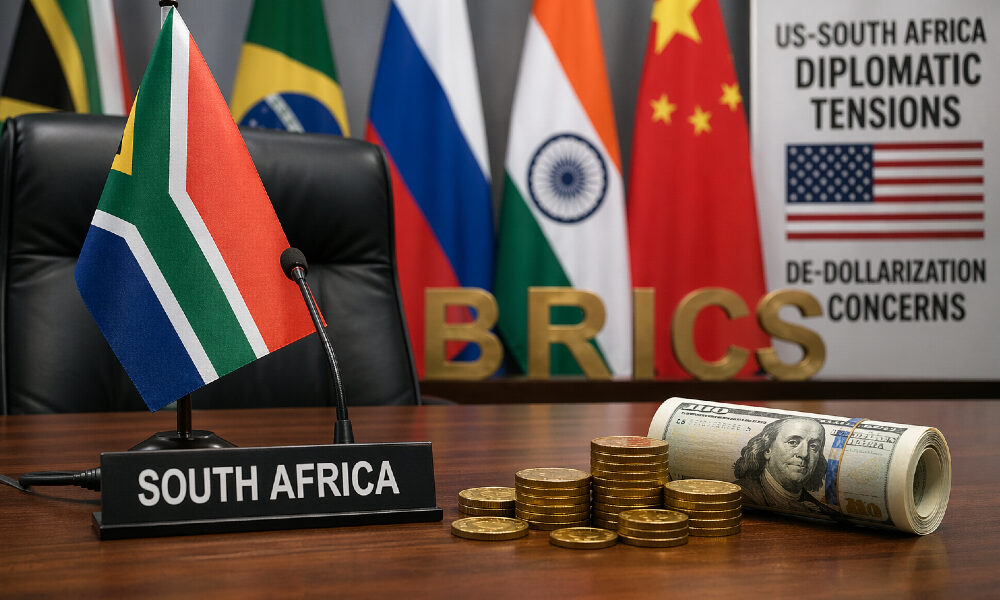
BRICS, De-Dollarization, and the Economics of Targeting a Smaller Power
Yet another sticking point is South Africa’s active membership in the BRICS (Brazil, Russia, India, China, South Africa) alliance.
“This is a grouping in which South Africa is very heavily invested in. South Africa is a country that is very into multilateralism. South Africa is a country that also talks about finding safety in numbers and building the global South-South solidarity,” he said.
In particular, the BRICS effort to de-dollarize the global economy is seen as a clear threat to the United States, and South Africa is an easy target in that context.
“(It’s) easier to pick on South Africa because, within the BRICS framework, it has the smallest economy among the original founders. So, it’s easier to target South Africa than it is to target China, Brazil, or Russia,” Nantulya explained.
Tsebe said the divide between the US and South Africa is quite broad due to differences in outlook.
“We’re also having two very different experiences about our places in the world, our experiences in the world, our perceptions of the world and how it functions,” she said.
In reaction to a question about whether South Africa could get the same or similar treatment from the United States as Venezuela, Tsebe said that would be very impractical.
“South Africa is the United States’ biggest investment in Africa. So you have to ask yourself, if you’re attacking your biggest interest commercially, financially and economically, well where are you going to go?” she asked.
“There was a lot of panic amongst elites about, among the South African business community about the fact that the US was going to pull out. The United States is going to suspend or expel South Africa from the African Growth and Opportunity Act. And my question has always been: Okay. they expel us, but where are they going to go?” she asked again.
A Deepening Rift With No Easy Resolution
The United States is South Africa’s second leading trading partner after China, and South Africa is the United States’ leading African trading partner.
The divide between the ANC in South Africa and the US government dates back to the 1980s and then-US President Ronald Reagan, who declined to sanction the apartheid government for its documented human rights violations. During the administration of Bill Clinton, there were hard feelings among Democrats and Republicans in Congress when then-South African President Nelson Mandela referred to US assistance as “peanuts”.
I have personally witnessed sometimes bitter trade discussions between the two countries involving government officials and businesspeople.
Unfortunately, this relationship seems to be on a course to worsen. The Trump administration has highlighted allowing the immigration of white South Africans at a time when immigration overall is being restricted.
Meanwhile, South Africa has been reluctant to criticize Iran for its human rights violations at a time of conflict with the United States. Iran joined BRICS on January 1 2024.
Small slights and open actions have metastasized into a relationship that wouldn’t be easy to dissolve, but which has become increasingly problematic to continue. Both Nantulya and Tsebe referred in their interview to American pro-majority rule in South Africa supporters such as the Congressional Black Caucus and civil society organizations.
But can support for a more positive US-South Africa relationship be separated from the current anti-Trump sentiment in the country in order for progress to be achieved? That will be a tall order in an important mid-term election year.
Gregory Simpkins, a longtime specialist in African policy development, is the Principal of 21st Century Solutions. He consults with organizations on African policy issues generally, especially in relating to the U.S. Government. He further acts as a consultant to the African Merchants Association, where he advises the Association in its efforts to stimulate an increase in trade between several hundred African Diaspora small and medium enterprises and their African partners.