A Diaspora View of Africa
The US-South African Troubled Relationship
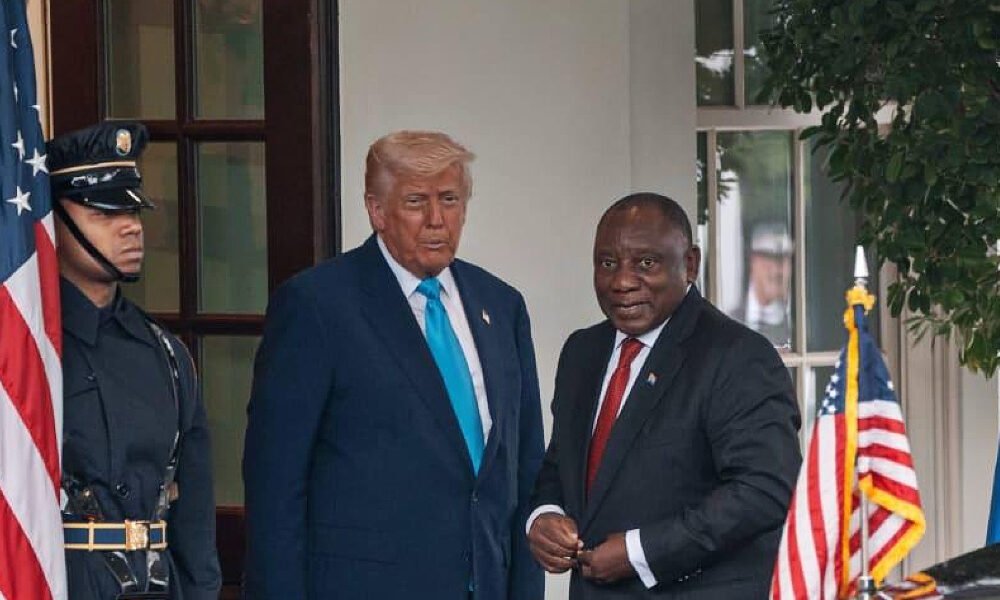


By Gregory Simpkins
Let me begin by saying that there is no genocide in South Africa. According to Article II of the United Nations Convention o the Prevention and Punishment of the Crime of Genocide:
“In the present Convention, genocide means any of the following acts committed with intent to destroy, in whole or in part, a national, ethnical, racial or religious group, as such:
- Killing members of the group;
- Causing serious bodily or mental harm to members of the group;
- Deliberately inflicting on the group conditions of life calculated to bring about its physical destruction in whole or in part;
- Imposing measures intended to prevent births within the group;
- Forcibly transferring children of the group to another group.”
Crime in South Africa is horrific, and murders are numerous, but farm killings (of both whites and blacks) comprise a relatively miniscule number of the tens of thousands of murders in South Africa over the past several years according to statistics provided by the South African Police Service:
2020: 49
2021: 59
2022: 50
2023: 43
2024: 55
2025 (to date):7
According to the Afrikaner farmer’s union (TLU-SA), there were 1,363 white farmers murdered between 1990 and now, but even so, they acknowledge that it averages out to about 40 killings a year. Therefore, it does seem to be getting worse lately.
Still, the scope of the killings of Afrikaner farmers obviously does not rise to the generally accepted level of genocide, especially since many white South Africans have significant non-land business holdings and hold high-ranking positions in government, and white South Africans may not be more in danger of criminal violence generally than any of their fellow countrymen. But these white farm deaths cannot be dismissed as insignificant.
One might criticize the government for not doing more to prevent such killings, but as I stated earlier, crime as a whole is rampant in South Africa.
A Washington Times op-ed by Kelley Sadler reported on May 22 that South African Agriculture Minister John Henry Steenhuisen acknowledged the seriousness of this matter at the White House meeting and called for more government action to address it.
“[The farmers] have a memorial for those who have died as a result of farm attacks. And as the minister of agriculture, it is something that I am particularly exercised with, my colleagues in police and my colleagues in the justice cluster, to start making farm attacks and stock theft a priority crime,” Steenhuisen was quoted as saying.
The photo of crosses denoting the Afrikaner (Boer) farmers who have been killed on farmlands were used in an effort to bring attention to farm murders and have since been removed.
Nearly 26 million hectares – about three quarters of privately-owned land – is still owned by white South Africans, who comprise 8 percent of the population. Only 4 percent of privately-held land is owned by Blacks who are nearly 80 percent of South Africa’s 60-million population.
Tense White House Meeting
Prior to the meeting between US President Donald Trump and South African President Cyril Ramaphosa, there were concerns about Ramaphosa being “Zelenskyy’d”, i.e. invited to a White House meeting and then ambushed with a more hostile atmosphere as happened to Ukrainian President Volodymyr Zelenskyy. Whether you think that’s what happened or not, Ramaphosa and his delegation handled themselves adroitly, unlike what some saw as them being defenseless while under assault.
In fact, the South Africans reportedly continue to believe a satisfactory trade agreement with the United States is possible.
During the often tense meeting, Trump played footage from political rallies in which participants sang “Kill the Boer” – a longtime, controversial anti-apartheid song that calls for violence against white farmers. South African courts have categorized the song as hate speech, but recent judgements have ruled that it can be legally sung at rallies as judges say it makes a political point and does not directly invoke violence.
BBC News reported on May 22 that Trump said that those leading the singing were “officials” and “people that were in office”. That was not accurate, but one might understand the misperception.
One of the men leading the rally was Julius Malema, a noted rabble rouser who previously led the ruling African National Congress’s (ANC’s) youth wing. In 2012, he left the party and has never held an official government position, the news service stated.
He now leads a party called the Economic Freedom Fighters (EFF) which won 9.5 percent in last year’s election, entering opposition against the new multi-party coalition. Responding to Trump’s accusations, Ramaphosa emphasized that the EFF is “a small minority party” and said that “our government policy is completely against what he was saying”.
However, another man in the video who can be heard singing the lyric “shoot the Boer” at a different rally is former President Jacob Zuma, who left office in 2018. The video is from 2012 when he was president.
The ANC promised to stop singing the song shortly afterwards. Zuma and other ANC leaders have sung that song for quite a few years.
While the number of farm murders isn’t as high as some imply, if you were a white farmer, would you feel safe with people – especially major figures – using words that spoke of your demise?
Certainly, many white South Africans haven’t felt safe for some time, as an estimated 612,000 left the country from 1985 to 2021.
The 59 recent white South African émigrés to the United States are only the latest in this long term exodus.
After hearing from white farm groups and civil rights organizations in his first term, Trump called on the State Department to investigate. Since that time, South Africa has become more tightly involved in the Brazil, Russia, India, China, South Africa coalition known as BRICS, which has in recent months called for removing the US dollar as the world’s reserve currency.
South Africa also pursued an international case against Israel, a major US ally, for its invasion of Gaza following the October 7 2023 Hamas attack. Further, South Africa, partly as a result of its membership in BRICS, has forged ties with Iran, which the United States considers a main supporter of terrorist groups such as Hamas, Hezbollah and the Houthis.
Diplomatic Row Missing a Vital Point
Still, this diplomatic row between the two nations does not address the need to some form of land reform. Europeans came to what is now South Africa hundreds of years ago, gradually appropriating land from indigenous people who didn’t have modern land titles, much like how indigenous people in the United States lost their land to those staking legal claims with the new government.
In both situations, indigenous people were shunted into reservations or homelands, unable to assert what they believed were their property rights.
As Reuters pointed out in a February 10 article on land reform in South Africa, nearly 26 million hectares – about three quarters of privately-owned land – is still owned by white South Africans, who comprise 8 percent of the population. Only 4 percent of privately-held land is owned by Blacks who are nearly 80 percent of South Africa’s 60-million population.
Somehow this inequity is not brought up by those advising Trump, who apparently are mainly white Afrikaner groups in South Africa and white South African expatriates who likely have bitter memories of their early lives in their home country. In the case of Elon Musk, his Starlink communications system is currently unable to be licensed there due to the legal requirement for 30 percent black ownership.
Many whites in the United States have latched onto the concept of “reverse discrimination” to oppose affirmative action. Somehow undoing the effects of past discrimination is just too divisive to move forward on efforts to reverse what has happened over the years.
Certainly, white families have lived their whole lives on land they considered their own, but at some point, it had been taken from indigenous people who were prevented, especially under the onerous apartheid system, from ever having an opportunity to contest for ownership of land their families had lived on for generations.
In truth, the Trump administration has several reasons to be at odds with the Government of South Africa, but the president has been ill-served by advisers who have personal axes to grind and staff who are too short-sighted to look at historic wrongs that cry out to be corrected. That attitude continues to be a problem in the United States for black people, despite unsuccessful efforts to correct injustice.
Unless American government officials can see beyond today’s headlines into a past that still impacts today’s reality, we will continue to experience situations in South Africa in which some grow impatient with uncertain government policies to correct injustice and decide to take matters into their own hands. After all, the land appropriation law has not been fully implemented, and at worst called for appropriation without compensation in a minimal number of cases.
Violence surely is not the way to amicably and definitively solve longstanding problems, but clearly, some will resort to violence if they feel there is no other way to achieve justice.
Gregory Simpkins, a longtime specialist in African policy development, is the Principal of 21st Century Solutions. He consults with organizations on African policy issues generally, especially in relating to the U.S. Government. He further acts as a consultant to the African Merchants Association, where he advises the Association in its efforts to stimulate an increase in trade between several hundred African Diaspora small and medium enterprises and their African partners.