A Diaspora View of Africa
The Connection Between the US, Greenland and Africa


By Gregory Simpkins
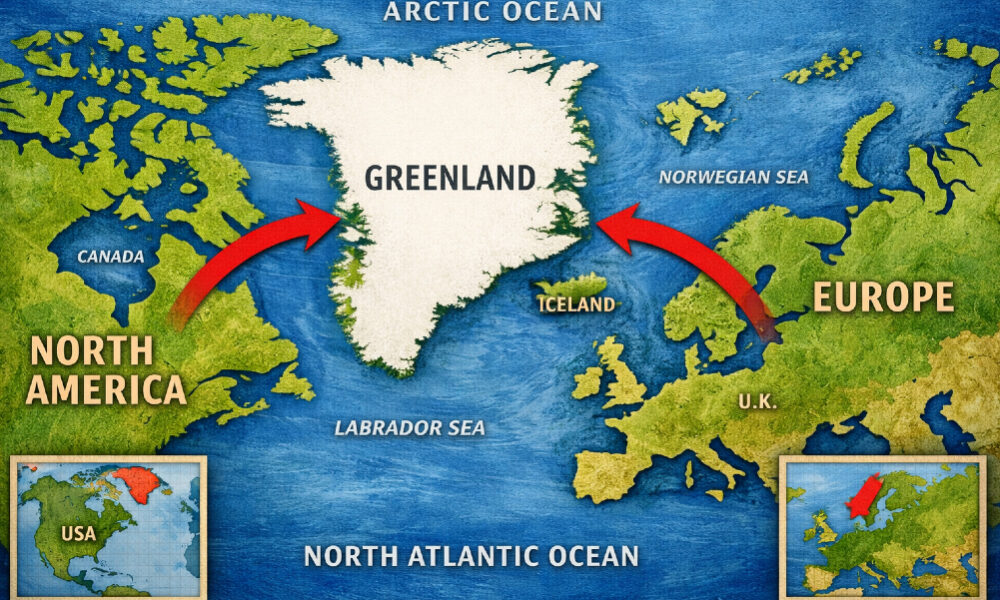
In recent weeks, the island of Greenland has become a hot international topic. It has been at the top of the agenda for US President Donald Trump and his administration, which has sent mixed signals about how far it was willing to go to safeguard what it said was US national interest in Greenland.
Critical minerals were part of the equation, but as it turns out, US control of Greenland is not a new concept for the American government.
According to a January 25 article in the Indian Defense Review, Trump merely reintroduced an acquisition discussed first more than a century ago.
In 1910, the article recalled, the U.S. ambassador to Denmark suggested a tripartite trade that involved Greenland, islands in the Philippines and the German region of Schleswig-Holstein. Under the plan, the United States would acquire Greenland and cede certain Philippine territories to Denmark.
Denmark would then pass those islands to Germany, which in turn would restore the northern German state of Schleswig-Holstein to Danish control.
US officials swiftly dismissed the proposal. Historical analysis published in Fortune confirms that the U.S. government found the diplomatic maneuver too ambitious. No public negotiations followed, and the idea was shelved.
It would take another 36 years before America formally offered to purchase Greenland.
That came in 1946, when the Truman administration extended an offer of US$100 million for the island. As detailed in this Arctic Institute analysis, Greenland’s strategic value had risen sharply with the onset of the Cold War.
The deal failed, but the United States retained military access to the island through the 1951 US-Denmark defense agreement.
Control of transport infrastructure (ports, rail, logistics) enables Chinese monopoly of the Africa supply chain from mine to factory
Modern Strategic Interests and Critical Minerals
“The renewed push by the United States to assert control over Greenland has placed the Arctic territory at the center of an intensifying geopolitical contest,” the article stated. “In early 2026, trade threats, mineral competition, and strategic calculations have replaced diplomacy as the primary levers of U.S. pressure.”
Today, Greenland’s value is viewed primarily through the lens of rare earth resources, Arctic military logistics and supply chain security. Greenland holds deposits of neodymium, dysprosium, terbium, and lithium – critical for both green energy technology and military-grade electronics.
A 2026 report in Fortune notes that 25 out of 30 raw materials listed as essential by the European Union are found in Greenland.
The Trump administration has linked control of these materials to US security goals. China currently dominates rare earth production and refining, controlling more than 60 percent of global extraction and around 90 percent of downstream processing.
Washington aims to reduce reliance on Chinese minerals by securing new sources, with Greenland positioned as a top target.
It is considered a national security issue for the United States because not only does the evolving technical infrastructure for sustainable energy require rare earths and other critical minerals, but military hardware is even more wedded to these minerals. Over the last couple of years, China has used its rare earths advantages to threaten to cut off or curtail their supply, especially for military purposes.
Greenland’s supply of such minerals is an important hedge against Chinese supply dominance – both in terms of securing these minerals for the United States and presumably other developed countries, but also to prevent China from gaining access and further control.
Moreover, since Trump has returned to the White House, he has emphasized the vital nature of Western Hemisphere national security, and Greenland is indeed located in the Western Hemisphere. It’s actually part of North America, situated between Canada and Iceland in the North Atlantic Ocean.
The island is positioned in both the Northern and Western hemispheres, making it a unique and strategic location.
So Greenland has what Trump considers of critical importance to the United States that previous administrations have not always recognized or considered so vital, and he and other administration officials have lamented that they do not think Denmark, which is nominally charged with protection of Greenland, is up to the task. This apparently is why Trump has been so anxious about securing critical minerals from Greenland.
So how does Africa figure into the Greenland situation?
The Africa Connection
China long ago realized the direction of the world economy would revolve around renewable energy and early on locked up the Africa supply chain of critical minerals such as rare earths. Too many American and other Western experts overlooked until relatively recently the potential of Africa’s contribution to the 21st century global economy.
China did not. Now Westerners are scrambling to overcome China’s established advantage.
In a January 20 article, Rare Earth Exchanges explains that China controls Africa’s critical minerals supply chain through early-stage financing, construction, logistics infrastructure, and downstream processing capacity, capturing value while African nations export raw materials. The Democratic Republic of the Congo (DR Congo), Zimbabwe, Guinea, and Zambia are China’s strategic anchors, securing cobalt, lithium, copper and bauxite through integrated investments from mine to port to refinery, the article states.
There are other leading African sources for rare earths and other critical minerals, including:
- Mali (lithium in a high-risk district)
- Tanzania (graphite and rare earths from Ngualla)
- Madagascar (graphite and clay-hosted rare earths)
- Namibia (lithium and a Chinese uranium project)
- Mozambique (graphite)
- Nigeria and Ghana (early-stage critical mineral projects)
Rare Earth Exchanges asserts that the West cannot compete on mines alone; winning requires matching China’s financing scale, building domestic processing capacity and delivering faster project execution with credible environmental, social and governance (ESG) standards.
Alexander Demissie, Founding Director of the ChinaAfricaAdvisory, states in a LinkedIn post that China brings in the finance and the builders. Chinese policy banks and state-owned enterprises finance projects that others shy away from.
This helps compress timelines and reduce dependence on Western capital markets. Control of transport infrastructure (ports, rail, logistics) enables Chinese monopoly of the supply chain from mine to factory.
Further, he says, China controls processing and pricing power. Other countries will need years, if not decades, to build similar processing capacity as China.
In a previous post, I discussed the Trump administration effort to trade military protection and intervention in security issues in return for access to critical minerals. The administration calculation apparently is that the US would offer security through peace negotiations backed by potential sanctions – something China is unlikely to do.
However, conflicts in the DR Congo and Sudan are complex and driven by leaders who are disinclined to let international concerns about the impact of conditions in their respective countries to affect their true acceptance of peace efforts or their response to threats of sanctions.
Consequently, this end-around to China’s mineral advantage in Africa has not worked thus far. That makes the Greenland stratagem even more desperate for the United States and quietly for other Western nations content to let America take the lead on the critical mineral front.
Gregory Simpkins, a longtime specialist in African policy development, is the Principal of 21st Century Solutions. He consults with organizations on African policy issues generally, especially in relating to the U.S. Government. He further acts as a consultant to the African Merchants Association, where he advises the Association in its efforts to stimulate an increase in trade between several hundred African Diaspora small and medium enterprises and their African partners.