Opinion
Grain and Grit: Burkina Faso’s Gamble on Rice Self-Sufficiency
As Ouagadougou halts rice imports to champion “economic patriotism,” the move tests whether West Africa’s food sovereignty ambitions can outpace the realities of supply and demand.


By Ashish Muley
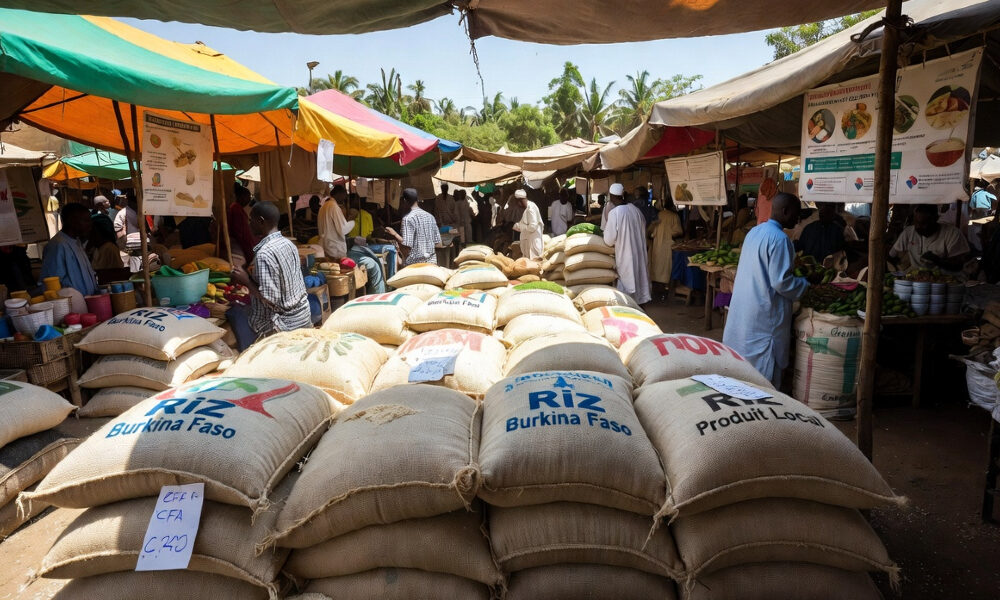
Burkina Faso has taken a bold gamble on food sovereignty. On April 29, the government suspended rice imports nationwide with immediate effect, freezing the issuance of Special Import Authorizations and giving licensed importers just two months to clear existing shipments. Officials framed the move as a call to “economic patriotism” – a rallying cry for consumers to buy homegrown grain and for the country to loosen its grip on foreign suppliers.
It is a striking gesture. But it also raises a harder question: can policy alone close the gap between what Burkina Faso grows and what it eats?
The Case for Self-Reliance
The logic behind the ban is not hard to follow. Burkina Faso has leaned heavily on imported rice to feed its cities, with the country recently ranking as one of Africa’s largest rice importers. USDA forecasts projected Burkina Faso’s rice imports at approximately 875,000 tonnes in 2025/26, compared with about 700,000 tonnes just a few years earlier. That trajectory, in the eyes of policymakers, was unsustainable.
Cutting imports promises several dividends: relief for foreign exchange reserves strained by rice purchases, a guaranteed market for domestic farmers, and a nudge toward greater investment across the local rice value chain, from paddy fields to mills. In theory, it’s a virtuous cycle – protect the market, and production will rise to meet it.
Burkina Faso is not acting alone. Senegal has rolled out subsidies for local rice and temporary import caps. Mali’s government has bought back tens of thousands of tonnes of unsold domestic rice to prop up farmers. Ghana has funneled tens of millions of dollars into its national food buffer stock. Across West Africa, a consensus is forming: dependence on Asian rice imports has gone on long enough.
The Trouble With Going Cold Turkey
Here is the catch. Burkina Faso is not yet self-sufficient in rice, and no amount of political will changes that overnight. Domestic production has improved, but it still falls well short of what a growing, increasingly urban population consumes. An abrupt halt to imports doesn’t create supply – it simply removes a cushion.
Closing that gap requires unglamorous, capital-intensive work: irrigation systems, better seed varieties, mechanization, and the post-harvest infrastructure that prevents grain from rotting before it reaches a plate. It requires stronger extension services to reach farmers directly, strategic reserves to smooth over shortfalls, and – if domestic supply falters – a mechanism to permit controlled imports rather than watching prices spiral for ordinary consumers.
Import substitution, in other words, is not a switch to be flipped. It is a transition to be managed. Countries that have pulled it off successfully – Indonesia’s decades-long effort to strengthen rice self-sufficiency is one example – did so over years of sustained investment, not a single ministerial communiqué.
Ripples Across the Region
The consequences of Burkina Faso’s decision won’t stop at its borders. As a landlocked country, Burkina Faso has long relied on regional ports and transport corridors to move rice inland – meaning logistics firms, freight forwarders, warehousers, and cross-border traders across West Africa now face a meaningful drop in business. Ecofin Agency reports that the timing is particularly awkward, arriving just as Benin tightened its own rice-import licensing rules, requiring importers to show years of established operations and clean customs records. Cargoes once destined for the port of Cotonou – many of them ultimately bound for Nigeria – have already begun rerouting through Lomé instead.
The upshot is a regional trade map in flux. Analysts expect volumes to redirect toward Ghana, Nigeria, or destinations beyond West Africa altogether, with growing stockpiles at some ports and downward pressure on prices at others.
The decision also raises broader questions for the African Continental Free Trade Area (AfCFTA). While national food security remains a legitimate priority, abrupt import restrictions can reshape regional trade flows and create uncertainty for businesses operating across African markets. The challenge will be balancing domestic production goals with the long-term vision of a more integrated continental market.
Exporters Feel the Squeeze
Global rice exporters are recalibrating too. India, historically Burkina Faso’s largest single supplier, shipped roughly 61,600 tonnes of rice there in 2025 – already down 25 percent year-on-year before the ban took hold. S&P Global’s Platts reports that the suspension is expected to weigh further on Indian export prices, particularly for parboiled rice typically routed through informal channels via neighboring countries.
Thai exporters, by contrast, say the damage will be limited; their shipments to Burkina Faso had already fallen nearly 24 percent in the first quarter of 2026, and demand from markets like Iraq now matters more to their bottom line. Exporters from Vietnam, Pakistan, and Myanmar are watching closely too, aware that a shrinking West African market means sharper competition wherever volumes get redirected – including into markets like Indonesia and the Philippines, both of which are managing their own domestic rice-price dynamics.
A Question of Sequencing
Supporting domestic agriculture is a defensible – even admirable – policy goal. Few would begrudge Burkina Faso the ambition to feed itself. But the sequencing matters enormously. Import substitution tends to work when domestic production can already shoulder the load, or when the transition is phased carefully enough to let supply catch up with demand.
Burkina Faso has chosen speed over sequencing. That may deliver a jolt of momentum to local farmers and millers in the short term. It may also leave urban consumers exposed to price spikes and supply gaps if the harvest doesn’t meet the moment – a risk with real political consequences in a country already navigating economic strain.
The more durable path, one Burkina Faso and its neighbors would do well to consider, pairs protection with patience: sustained investment in irrigation and infrastructure, support for farmers scaling up production, and enough flexibility to permit imports when the numbers don’t add up. Food sovereignty is a worthy destination. Getting there requires more than closing the border and hoping supply follows.
Ultimately, the coming harvests not the policy announcement itself will determine whether Burkina Faso’s strategy becomes a model for African food sovereignty or a cautionary tale about the risks of moving faster than agricultural capacity can sustainably expand.
Ashish Muley is an independent consultant with Stalwart Management Consulting, with 27+ years in agricultural commodity value chains, export markets, and international trade. He has led projects on business development and capacity building across African countries in partnership with international organizations. Formerly, he spent 15 years in financial services leadership, focusing on sales, marketing, and business development. Based in Pune, India, Ashish advises on agricultural trade, commodity markets, and Asia–Africa economic opportunities, and regularly writes on international trade and logistics.