Opinion
Africa’s Cashew Apples Are Rotting. Ethanol Could Change That
Ghana and its neighbors do not suffer from a shortage of cashew-apple recipes. They suffer from a shortage of industrial scale. The most promising route from waste to wealth may be a commodity nobody has to be taught to want.


By Curtis Akunfu
Anyone who has attended an African agribusiness conference in recent years has probably sampled the fruits of cashew apple valorization: juice, cashew-pineapple-ginger blends, jam, candy, breakfast cereal, even a meat substitute made from the pulp. Some are delicious. Visitors take a bite, widen their eyes and declare it amazing.
But a better question than “does it taste good?” is this: how many tons of cashew apple can the product absorb commercially? The answer exposes a gap between what Africa is celebrating and what the continent needs.
A Problem of Industrial Proportions
The cashew nut is the prize; the apple it hangs from is the afterthought. According to GIZ, a leading development cooperation agency, Ghana produced around 2 million metric tons of cashew apples in 2024, and 90-95 percent went unused. Ghana’s Tree Crops Development Authority now wants to see 40 percent of the harvest processed in the coming years. At 2024 volumes, that means finding sustainable commercial uses for roughly 800,000 tons of fruit that spoils within a day.
That is not a recipe-development challenge. It is an industrial one, and it is shared across Côte d’Ivoire (Ivory Coast), Nigeria, Benin, Guinea-Bissau, Tanzania, Mozambique and beyond. A recent conference in Accra drew 160 stakeholders from 13 countries for precisely that reason.
The Exhibition Trap
None of this is a case against experimentation. GIZ reports that more than 5,000 women and young people across the region have been trained in cashew apple processing, that 18 new products from Ghana, Ivory Coast and Nigeria were due to launch, and that 13 matching-grant projects worth about €3.1 million are under way in seven countries. That is meaningful work.
The danger is that the sector becomes expert at showing what can be made from cashew apples while never solving what to do with them at scale. Products that draw crowds at exhibitions are often hard to find in ordinary supermarkets afterward. Attention is not demand. Photographs at a stand are not distribution. A single taste is not a repeat purchase. And a successful prototype is not an industry.
If the goal is rural industrialization, higher farm incomes and less wasted fruit, the yardsticks must change. How many tons are bought from farmers? How much private capital arrived after the grant? How much is sold, again and again, without subsidy? How widely is it distributed?
Value Added: Not All Equal
Juices, sausages, cereals and candies may sustain good niche businesses, and the entrepreneurs behind them may prosper. But when the raw material runs to hundreds of thousands, perhaps millions, of tons, market absorption matters more than novelty. A food that consumers have never encountered must win over palates, brands, shelf space and distribution, and then keep winning repeat purchases. That is hard even when the fruit is free. Academic work on Ghana’s sector already lists limited market access, scarce processing facilities, perishability and investment costs among the constraints.
Alcohol is a different matter, because it enters an existing category. Ghana’s Export Promotion Authority lists cashew brandy among the exports of Mim Cashew, which sells in North America and Europe. Buyers need not understand cashew apples; they understand spirits. Yet even premium liquor is unlikely to swallow the volumes needed to transform the whole economy.
The Case for Ethanol
For that, think bigger. Cashew apples are rich in fermentable sugars, chiefly glucose and fructose, and can be fermented with ordinary yeast, without the costly hydrolysis that many other feedstocks require.
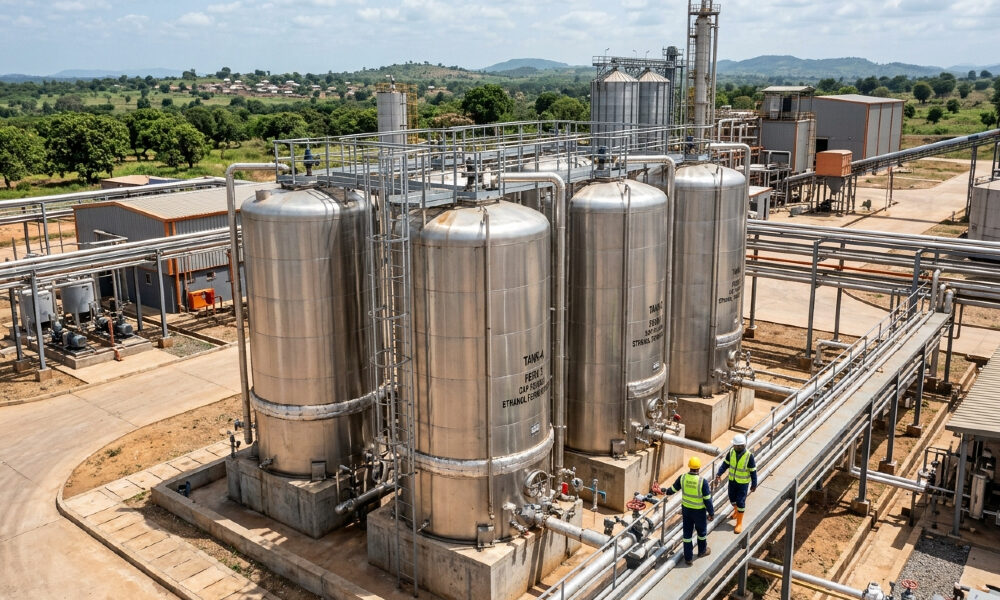
This is no longer just a laboratory notion. A 2024 techno-economic study modeled a plant processing 31,500 tons of cashew apples a year and simulated yields of roughly 66.5 to 88.9 liters of ethanol per ton, depending on the scenario. Profitability, it cautioned, is not automatic: feedstock cost, plant utilization and process efficiency all matter. But it judged the pathway technically credible and potentially viable under the right conditions.
Crucially, ethanol does not require inventing demand. Ghana imported about US$39.4 million of undenatured ethyl alcohol in 2025; a year earlier Brazil alone shipped it some 32.5 million liters. Meanwhile Ghana exported 14.3 million liters of the same broad category in 2025, mostly to Burkina Faso, Ivory Coast and Togo. Domestic beverage makers, pharmaceutical firms and industrial users already buy the stuff, and the government wants local drugmakers’ share of the market to double from roughly 30 percent to 60 percent by 2030.
Not every imported liter can be replaced overnight; different buyers demand different grades, certifications and prices. But the strategic point stands. The market already exists, which is a far better starting point than launching another novelty and hunting for someone to buy it.
Solving the Spoilage Problem
The strongest objection is that the fruit spoils in a day. It is a real constraint, but not an insurmountable one. The MA-CASH project in Ghana has demonstrated a low-cost clay cooling system that reportedly stretches shelf life from about 24 hours to six days.
Geography also helps. The Tree Crops Development Authority says the Bono, Bono East and Ahafo regions together produce more than 75 percent of Ghana’s cashew output. That suggests a hub-and-spoke model: satellite centers near dense growing areas collect, press and begin fermenting the fruit, and the intermediate product travels to a central facility for distillation and purification. Techiman, Nkoranza or Sunyani might one day host it, though only a proper siting study, weighing feedstock density, roads, power, water and environmental rules, can say so.
What $10 million Could Do
Given US$10 million for cashew apple valorization, a sensible funder would not commission another twenty recipes. Whether that sum could build a full network is a question for an engineering and financial feasibility study. But the starting points are clear:
- Map the feedstock. Know where the apples are, how much each cluster produces, the road distances, the harvest windows and the realistic cost of collection.
- Build decentralized hubs. Finance collection, pressing and fermentation centers in the densest growing areas so fruit enters processing quickly.
- Develop a bankable central plant. Design a distillation and purification facility around the grades buyers actually need, with energy, water, effluent treatment, quality assurance and storage.
- Sell before you build. Bring beverage makers, pharmaceutical and cosmetics firms, industrial users and regional traders in at the design stage, with binding or conditional offtake agreements.
That looks much more like industrialization than a trade-fair stand.
A Question for International Partners
Nobody is arguing that every cashew apple should become fuel. Let entrepreneurs make juice, distillers make brandy and researchers develop food ingredients. A healthy industry needs many outlets for the fruit.
But development finance, public money and technical-assistance budgets are all scarce. If the aim is to solve a mass-volume waste problem, a large share of support should go to solutions that can handle mass volume. The question should shift from “How many products can we make from cashew apples?” to “Which commercial pathways can absorb the most fruit, sustainably, after our project ends?”
Beyond Ghana
Ghana merely makes the opportunity easy to see. Ivory Coast imported about US$24.7 million of undenatured high-strength ethanol in 2025, Mozambique about US$9 million and Togo about US$8.4 million. Each country has its own feedstock geography, taxes, power costs and regulations, so the model cannot simply be copied. The principle, though, travels: find large volumes of underused fruit, turn them into a standardized industrial product, sell to markets that already consume it, and build logistics around the crop rather than forcing the crop into the wrong logistics.
Counting What Counts
The real risk is not a shortage of innovation. Africa is innovating plenty. The risk is that a decade from now the continent can point to dozens of handsome products, hundreds of workshops, thousands of trainees and many triumphant exhibitions, while most of the cashew apple still rots under the tree. That would be a failure not of science but of commercial imagination.
The fruit should be treated as an industrial feedstock, not a curiosity. Ethanol may not sound glamorous, but scale is. The measures that matter are tons bought from farmers, liters produced, imports displaced, regional exports created, factories financed and jobs that outlast the grant.
Curtis Akunfu is the Managing Director of Duapa Agri, a vertically integrated agribusiness operating across West and East Africa. With nearly 20 years of leadership in Africa’s agri-commodities sector, he also serves as a Global Council Member and Chair of the Agricultural Finance and Investment Working Group at the World Agriculture Forum.